
3200 Phaethon: an asteroid-like body and parent of the Geminid meteors
3200 Phaethon is an Apollo-class near‑Earth object with asteroid appearance and comet-like behavior; it is the source of the Geminid meteor stream and one of the Sun‑approaching 'rock comets'.
3200 Phaethon is a small near‑Earth object best known as the parent body of the Geminid meteor shower. Discovered in 1983 by observations from a spacecraft, Phaethon has characteristics of both asteroids and comets: it looks like a rocky asteroid at most times but sheds dust when it passes very close to the Sun, earning descriptions such as a "rock comet" or an asteroid with cometary activity. At roughly 5 kilometers across, it is one of the larger near‑Earth objects with a highly eccentric, Sun‑skimming orbit.
Image gallery
8 Images

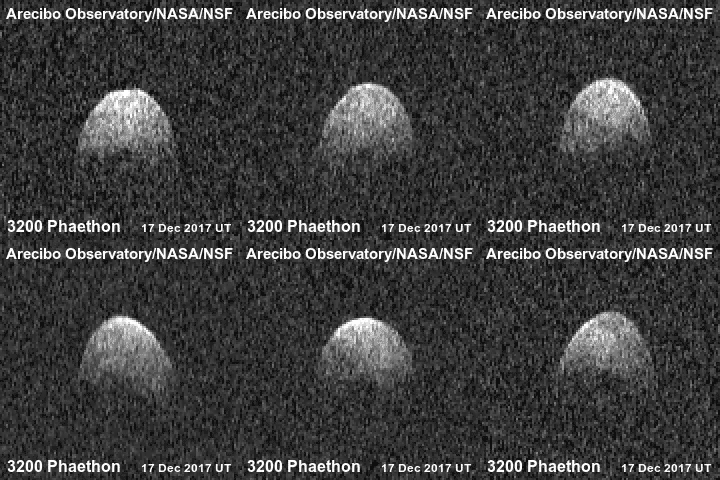



Physical characteristics
Phaethon appears relatively dark and unremarkable in visible light but shows occasional dust release near perihelion. Its diameter is commonly cited near 5 km, and photometric studies indicate a relatively rapid rotation. Thermal stresses and surface cracking from extreme heating during close solar passages are believed to produce the dust that replenishes the Geminid stream. Because it lacks a sustained coma or large volatile supply like typical comets, Phaethon is often classified as an extinct or dormant cometary nucleus, or alternatively as an active asteroid.
Orbit and activity
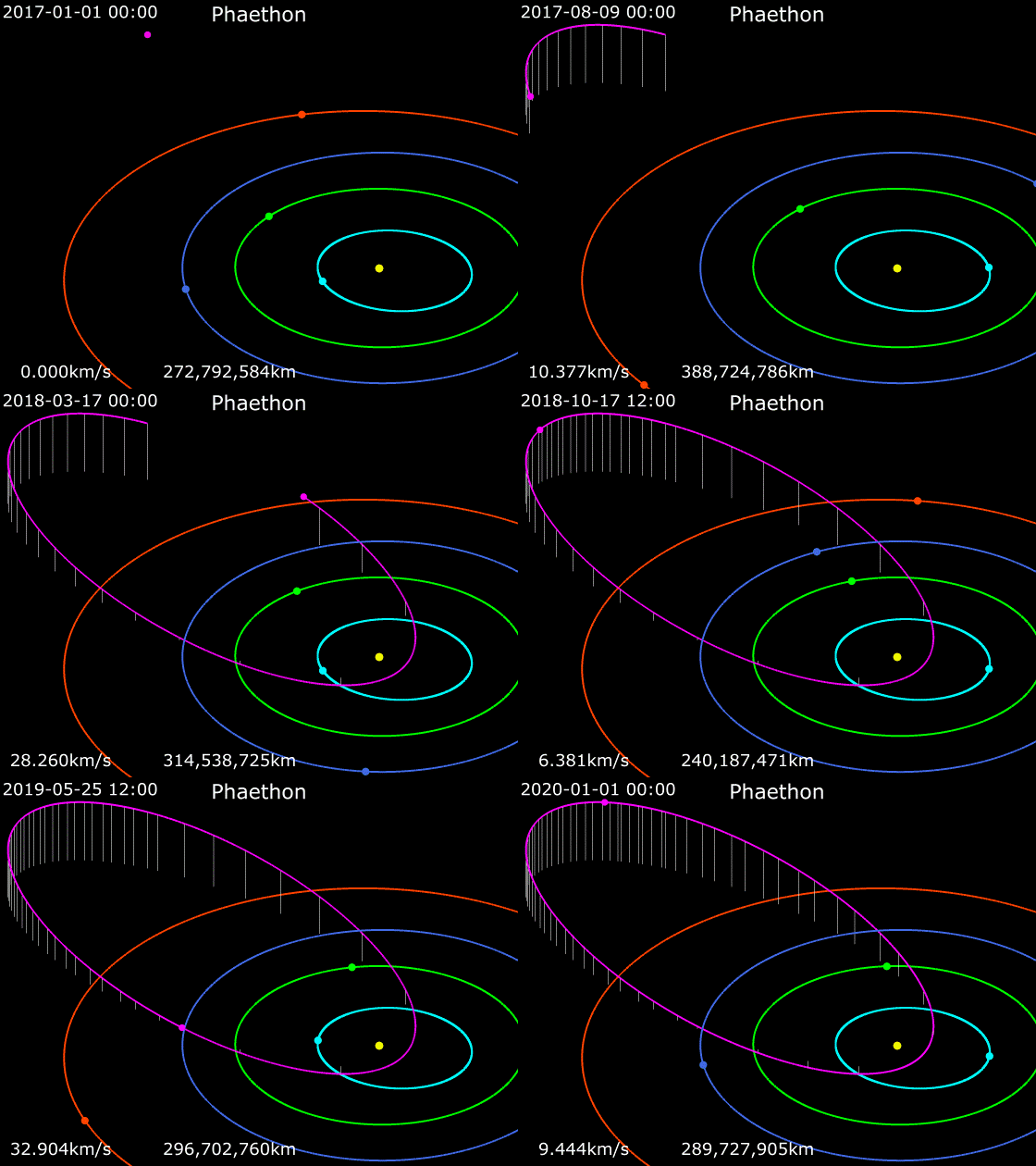
Phaethon is an Apollo‑class object: its orbit crosses those of Mercury, Venus, Earth and Mars. Its perihelion distance is extremely small—about 0.14 astronomical units—so it gets far closer to the Sun than Mercury does. At those near‑Sun distances the surface can reach temperatures high enough to drive fracturing and episodic dust release rather than the sublimation of ices that powers traditional comets. This behavior explains how Phaethon supplies the Geminid meteoroid stream even though it looks like an asteroid most of the time.
History, discovery and name
Phaethon was announced in October 1983 after detection by a spaceborne infrared telescope, making it notable as the first asteroid found by a spacecraft. Its name derives from the Greek myth of Phaëton, the son of the sun god who lost control of his father’s chariot, a fitting reference to the object’s extreme closeness to the Sun. Subsequent ground‑based observations refined its orbit and confirmed its connection with the Geminids through orbital analyses and meteoroid dynamics.
Exploration, significance and future encounters
Because Phaethon links an asteroid‑like object with an active meteor stream, it is of strong interest to planetary scientists studying the continuum between asteroids and comets, near‑Earth object hazards, and the processes that produce meteoroid streams. Space mission planners have proposed or developed flyby missions to study Phaethon up close to sample its surface properties and dust environment. Periodic close approaches to Earth make it accessible for observation, and long‑term orbit calculations identify several future encounters of interest to observers and mission designers.
Further reading and reference links
- General overview and classification
- Discovery announcement and early observations
- Size and physical measurements
- Perihelion and temperature effects
- Orbital elements and perihelion definition
- Distance measures and close approach data
- Comparison with Mercury's orbit
- Planet‑crossing classifications
- Mythology behind the name Phaethon
- Context on Helios and solar associations
Questions and answers
Q: What is 3200 Phaethon?
A: 3200 Phaethon is an Apollo asteroid and a dead comet.
Q: When was 3200 Phaethon announced?
A: It was announced on 14 October 1983 in IAUC 3878.
Q: What is the diameter of 3200 Phaethon?
A: The diameter of 3200 Phaethon is 5.10 km.
Q: Does 3200 Phaethon approach the Sun closer than any other numbered asteroid?
A: Yes, 3200 Phaethon approaches the Sun closer than any other numbered asteroid.
Q: What is the perihelion of 3200 Phaethon?
A: The perihelion of 3200 Phaethon (closest approach to the Sun) is only 0.140 AU – less than half Mercury's perihelion distance.
Q: Why was 3200 Phaethon named after the Greek myth of Phaëton?
A: 3200 Phaethon was named after the Greek myth of Phaëton, son of the sun god Helios because its surface temperature at perihelion could reach ~1025 K, or 1400 F.
Q: When will 3200 Phaethon pass closest to Earth?
A: 3200 Phaethon will pass closest to Earth on 14 December 2093, passing within 0.0198 AU (3.0 Gm).
Related articles
Author
AlegsaOnline.com 3200 Phaethon: an asteroid-like body and parent of the Geminid meteors Leandro Alegsa
URL: https://en.alegsaonline.com/art/112819
Sources
- ssd.jpl.nasa.gov : "JPL Small-Body Database Browser: 3200 Phaethon (1983 TB)"