
3 Juno (asteroid)
3 Juno is a large S-type main-belt asteroid discovered in 1804 by Karl Ludwig Harding. The third asteroid found, named for the Roman goddess Juno, it contains roughly 1% of the asteroid belt's mass.
3 Juno is a prominent object in the inner portion of the main belt of small bodies that orbit the Sun. It was the third such body identified in the Solar System, and today is classified as an asteroid of silicate composition. Observationally bright and large compared with most belt members, Juno has been studied by photometry, spectroscopy and stellar occultations to learn about its shape, rotation and surface.

Image gallery
8 Images

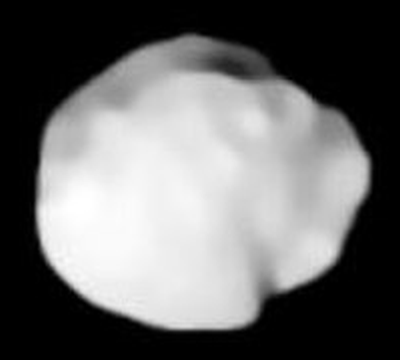




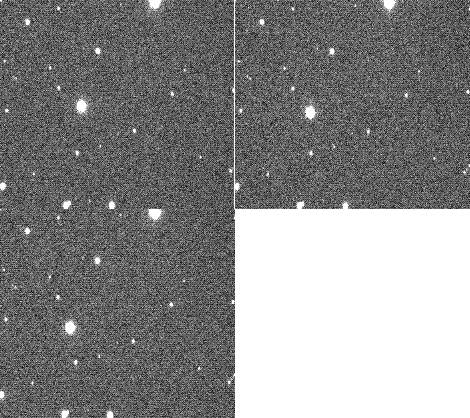
Physical characteristics
Juno is an S-type asteroid, meaning its surface is relatively stony and reflective compared with darker, carbon-rich types. Its overall bulk places it among the larger main-belt asteroids, and estimates suggest it contains about 1% of the total mass of the asteroid belt. Lightcurve studies show a non-spherical, irregular shape and a rotation period that has been measured from repeated observations. Spectral data reveal silicate minerals and metal-bearing materials typical of S-type bodies.
Discovery and name
3 Juno was discovered on September 1, 1804, by the German astronomer Karl Ludwig Harding. As the third object found after Ceres and Pallas, it helped establish the population of small Solar System bodies between Mars and Jupiter. The asteroid is named for the Roman goddess Juno, queen of the gods in Roman mythology; the name reflects the classical naming tradition and the link to Roman religion (Roman, queen).
Observations and scientific importance
Because Juno is relatively bright, it was studied early with telescopes and remains a target for modern surveys. Photometric monitoring provides rotation and shape constraints, while spectroscopy yields clues about surface composition and space weathering. Occultations—moments when Juno passes in front of a star—have allowed astronomers to refine its size and silhouette more accurately than imaging alone. These data contribute to broader models of asteroid family membership, collisional history, and the distribution of mass in the main belt.
Notable facts and distinctions
- Third asteroid discovered: its designation of "3" marks its early place in asteroid history.
- Representative of S-type bodies, making it useful for understanding stony asteroid mineralogy.
- Large enough to influence statistical estimates of the belt's total mass.
Juno remains an object of steady interest for both professional observers and advanced amateur programs. Continued monitoring refines knowledge of its spin state, shape and surface properties, contributing to the wider understanding of how small bodies in the main belt formed and evolved within the Solar System.
Questions and answers
Q: Who discovered 3 Juno?
A: Karl Ludwig Harding discovered 3 Juno on September 1, 1804.
Q: What is the symbol for 3 Juno?
A: There is no symbol listed for 3 Juno in the text.
Q: What is 3 Juno?
A: 3 Juno is a main belt asteroid.
Q: Which number asteroid is 3 Juno?
A: 3 Juno is the third asteroid discovered in the Solar System.
Q: Who is Juno named after?
A: Juno is named after the Roman goddess who is the queen of all gods.
Q: What type of asteroid is 3 Juno?
A: 3 Juno is an S-type asteroid.
Q: What percentage of the total mass of the asteroid belt is estimated to be contained in 3 Juno?
A: 3 Juno is estimated to contain 1% of the total mass of the asteroid belt.
Related articles
Author
AlegsaOnline.com 3 Juno (asteroid) Leandro Alegsa
URL: https://en.alegsaonline.com/art/112875
Sources
- ssd.jpl.nasa.gov : "JPL Small-Body Database Browser"
- books.google.com : Dictionary of minor planet names, Volume 1
- observatory.space.edu : "Multispectral analysis of Asteroid 3 Juno taken with the 100-inch telescope at Mount Wilson Observatory"
- iau-comm4.jpl.nasa.gov : "High-Precision Ephemerides of Planets—EPM and Determination of Some Astronomical Constants"
- doi.org : 10.1007/s11208-005-0033-2