
298 Baptistina: a Main‑belt Asteroid and the Baptistina Family
298 Baptistina is a main‑belt asteroid discovered in 1890. It is the namesake of the Baptistina family and was once proposed as linked to the K–Pg impactor; later studies revised that connection.
298 Baptistina is a main‑belt asteroid that orbits the Sun among the population between Mars and Jupiter. It was discovered by French astronomer Auguste Charlois on September 9, 1890 in Nice. The object serves as the namesake of the Baptistina family, a group of asteroids believed to have originated from a collisional breakup.
Image gallery
2 Images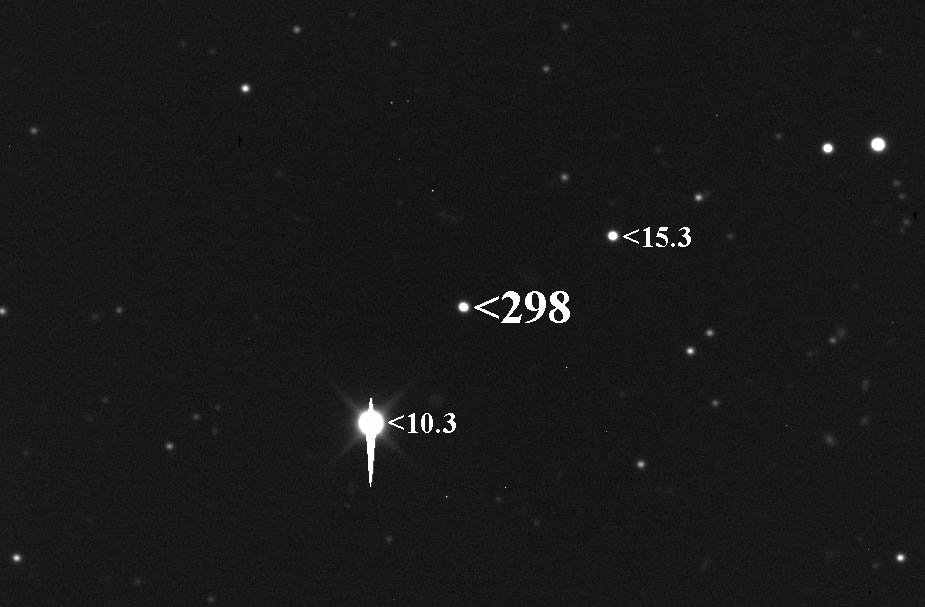
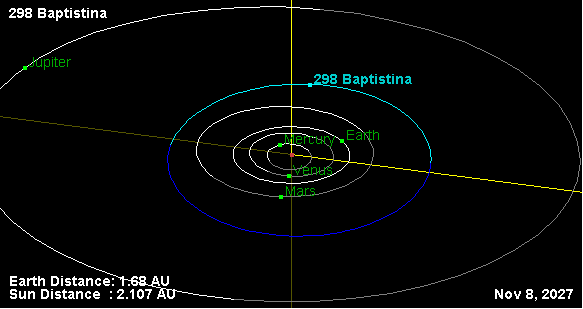
Orbit and classification
Baptistina lies in the inner portion of the main asteroid belt and follows an orbit that, in some respects, resembles members of the Flora region. Dynamical studies show, however, that it is not a true member of the Flora family; instead it belongs to its own collisional cluster, the Baptistina family. Its orbital characteristics place it among the common main‑belt population studied for clues about collisional evolution and fragment dispersal in the belt. For broader context see general descriptions of the main belt and asteroid grouping methods.
Physical properties and appearance
298 Baptistina is a moderate‑sized asteroid and the largest identified remnant associated with the family that bears its name. Like many family members, its surface composition and reflectance have been investigated with telescopic photometry and spectroscopy to classify its taxonomic type and compare it with other fragments of the same breakup. Fundamental properties such as exact diameter, mass and internal structure remain subjects of observation and modeling, and different surveys can give somewhat different estimates depending on observing wavelength and assumptions about surface reflectivity.
Family origin and the breakup hypothesis
In 2007 a collaborative US–Czech study proposed that 298 Baptistina is the largest surviving piece of a much larger parent body, roughly 170 km across, that was shattered by a collision hundreds of millions of years ago. That work suggested the collision produced many fragments (the Baptistina family) and raised the possibility that one of those fragments later evolved onto an Earth‑crossing orbit and produced the impactor responsible for the mass extinction at the end of the Cretaceous (often referenced as the K–Pg or K/T event). This scenario attracted attention because it linked an identifiable asteroid family to an event recorded in the geological record.
Subsequent studies and current view
Further observations, notably infrared surveys and dynamical analyses, have revised the timing and properties of the Baptistina breakup and have weakened the proposed link to the end‑Cretaceous impactor. In particular, thermal infrared data from wide‑field space telescopes and improved orbital simulations yielded age estimates and physical parameters that are inconsistent with the earlier scenario. As a result, the hypothesis that a Baptistina fragment struck Earth at the K–Pg boundary is now regarded as unlikely by much of the planetary science community. This example illustrates how evolving data can change interpretations of collisional histories in the asteroid belt.
Scientific importance and continuing study
298 Baptistina and its family remain of interest because asteroid families provide natural laboratories for studying collisional fragmentation, fragment dispersion, and how small bodies can be injected from the main belt into Earth‑crossing trajectories. Observations of Baptistina family members feed into models of asteroid dynamics, surface evolution, and impact hazard assessment. Ongoing spectroscopic surveys and sample‑return missions to other families continue to refine methods for linking fragments to parent bodies and to impact events.
For additional technical background and data on orbital elements or family membership, readers may consult dedicated resources and catalogs that track asteroid observations and dynamical families: main‑belt overviews and specialized asteroid databases provide regularly updated information.
Related articles
Author
AlegsaOnline.com 298 Baptistina: a Main‑belt Asteroid and the Baptistina Family Leandro Alegsa
URL: https://en.alegsaonline.com/art/112772
Sources
- ssd.jpl.nasa.gov : "298 Baptistina"
- lpi.usra.edu : Composition of 298 Baptistina: Implications for K–T Impactor Link
- lanl.arxiv.org : New Constraints on the Asteroid 298 Baptistina, the Alleged Family Member of the K/T Impactor
- news.bbc.co.uk : Space pile-up 'condemned dinos'