
Orbital resonance: dynamics, examples, and significance
Orbital resonance occurs when orbiting bodies exert regular gravitational influences because their orbital periods form ratios of small integers. It shapes planetary systems, rings, asteroids and exoplanet architectures.
Orbital resonance describes a dynamical relationship in which two or more orbiting bodies exert regular, periodic gravitational influences on one another because their orbital periods are commensurate — typically close to a ratio of small integers. This phenomenon, often termed resonance, arises among orbiting bodies such as planets, moons, asteroids or artificial satellites when their synodic geometry repeats. The simplest case is a mean-motion resonance, where the ratio of orbital periods (or equivalently mean motions) is p:q, so that one body completes p orbits while the other completes q in the same time interval, creating a repeating gravitational pattern that can alter orbital elements.
Image gallery
10 Images




Mechanisms and characteristic behavior
Resonances are produced by the changing gravitational forces that act as bodies pass particular alignments. Because most orbits are elliptical rather than perfectly circular, the strength and direction of these forces vary through each orbit, and repeated alignments can drive systematic changes. Resonant interactions can constrain orbital angles into oscillation (libration) about a fixed value rather than circulating freely, locking bodies into a predictable phasing. Related phenomena include elliptical orbital effects and rotational outcomes such as tidal locking, where a satellite keeps one face pointed toward its primary because that configuration is energetically favored over long timescales.
Not all resonances are stabilizing: some amplify eccentricities or inclinations and can destabilize orbits. Overlapping resonances produce chaotic zones in which small changes lead to large, unpredictable orbital evolution. Secular resonances act on slower timescales, exchanging eccentricity and inclination between orbits without requiring a simple period ratio. Together these mechanisms are core topics in celestial mechanics and are central to understanding the long-term stability of planetary systems including our own Solar System.
Solar System examples
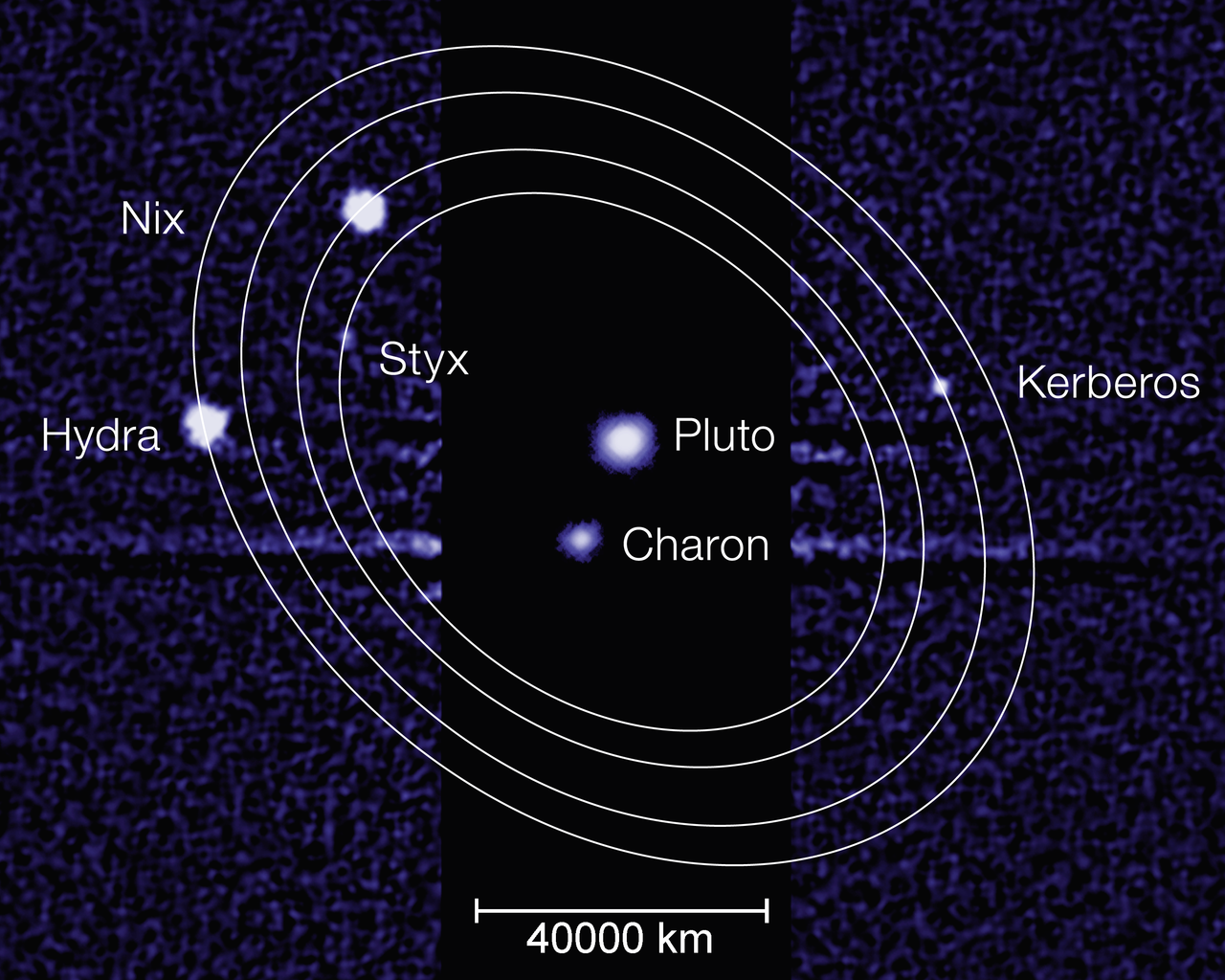
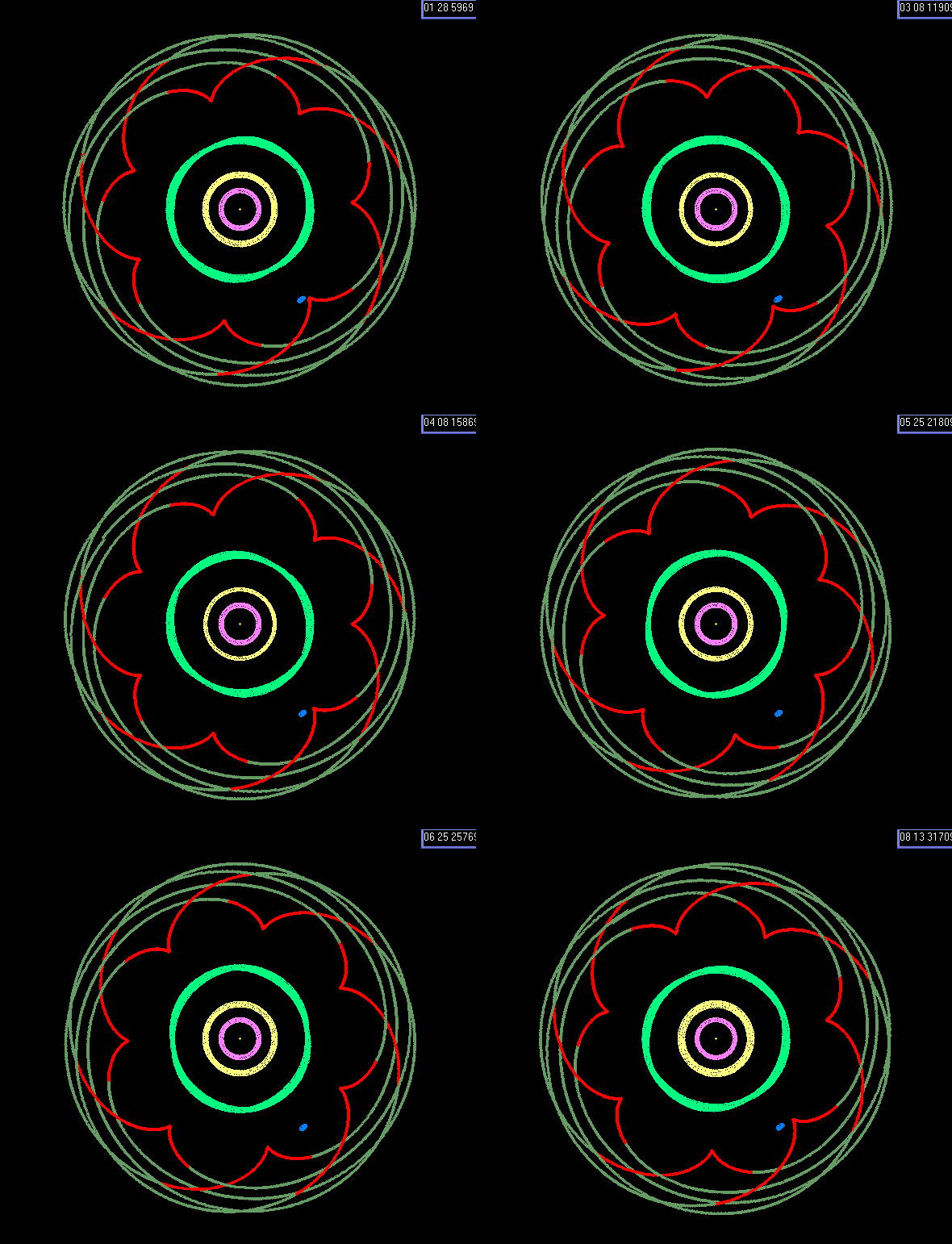
Several clear instances of orbital resonance exist within the Solar System and illustrate both stabilizing and clearing roles. The trio of Galilean moons Io, Europa and Ganymede are locked in a 1:2:4 Laplace resonance that synchronizes their orbital positions and drives tidal heating on Io. In the outer Solar System, Pluto and Neptune are in a 2:3 resonance: Pluto completes two orbits for every three of Neptune, a relationship that prevents close approaches. The asteroid belt shows gaps known as Kirkwood gaps, produced by mean-motion resonances with Jupiter that remove unstable asteroids; similarly, Saturn's rings display structures such as the Cassini Division linked to a 2:1 resonance with the moon Mimas.
Trojan asteroids in 1:1 co-orbital resonance share a planet's orbit near the stable Lagrange points, and many small-body populations bear signatures of past resonant interactions that shaped their present distribution. In the asteroid belt, secular resonances with the giant planets can slowly increase eccentricity until an object becomes planet-crossing, while resonant locations sweep and capture objects during episodes of planetary migration.
Formation, evolution, and broader importance
Resonances can form during the early, dissipative stages of a planetary system when interactions with a gas disk or planetesimal disk cause bodies to migrate. Convergent migration frequently produces capture into resonance, creating resonant chains observed among some exoplanet systems. Resonant locking can preserve relative orbital order and protect bodies from close encounters, but resonances can also pump eccentricity and lead to collisions or ejections. Models that include resonance capture and resonance sweeping help explain features such as irregular satellite placements, the distribution of trans-Neptunian objects, and the sculpting of ring systems.
- Mean-motion resonances: integer period ratios that repeat geometric configurations.
- Secular resonances: long-term exchanges affecting eccentricity and inclination.
- Spin-orbit resonances: alignments between rotational and orbital periods (e.g., tidal locking).
- Co-orbital (1:1) resonances: shared orbits, including Trojan companions.
Observationally, resonances serve as diagnostics of past migration and dissipation. Many exoplanetary systems show near-resonant chains (for example, compact multiplanet systems studied by transit surveys), and detailed dynamical work uses resonant angles and libration amplitudes to infer system histories. The mathematical foundations were developed as part of the study of planetary motion — from the work of Laplace and others to modern numerical simulations — and remain an active area of research because resonant interactions combine predictable periodicity with potential for chaotic evolution.
For further introduction to the terminology and specific phenomena mentioned here, consult basic references on orbital periods, planetary motion around primaries, the details of asteroid belt structure, Neptune's role among trans-Neptunian objects such as Neptune and Pluto, and historical treatments of resonant dynamics.
Questions and answers
Q: What is orbital resonance?
A: Orbital resonance is a phenomenon in which two orbiting bodies exert a regular, periodic gravitational effect on each other. Their orbital periods may be related by a ratio of two small integers.
Q: How does it occur?
A: It occurs when the changing gravitational forces of the bodies that are orbiting each other cause instability in their orbits. This can be caused by the orbits being elliptical rather than circular, or due to the planets and stars not being perfectly spherical and varying in their degree of oblateness.
Q: Who first studied the stability of the Solar System?
A: The stability of the Solar System was first investigated by Laplace.
Q: What is tidal locking?
A: Tidal locking is when satellites end up with one face towards their planet because that is the most stable position for them.
Q: What are Kirkwood gaps?
A: Kirkwood gaps are gaps in Saturn's rings which are caused by particles shifting into more stable positions due to Jupiter's influence.
Q: What is Neptune-Pluto resonance?
A: Neptune-Pluto resonance refers to a 2:3 ratio between Neptune and Pluto, meaning Pluto completes two orbits in the time it takes Neptune to complete three.
Q: What area of mechanics studies these phenomena?
A: The area of mechanics used for studying these phenomena is called celestial mechanics.
Related articles
Author
AlegsaOnline.com Orbital resonance: dynamics, examples, and significance Leandro Alegsa
URL: https://en.alegsaonline.com/art/72981
Sources
- lpl.arizona.edu : preprint
- arxiv.org : preprint