
433 Eros: A large Near‑Earth asteroid and NEAR Shoemaker target
433 Eros is a large, elongated Near‑Earth asteroid of S spectral type. It was the first recognized NEA and was extensively studied by the NEAR Shoemaker mission, which orbited and landed on it in 2001.
Overview
433 Eros is a prominent example of a Near‑Earth asteroid (NEA) that has been studied intensively from both Earth and space. Its name comes from the Greek god of love; the asteroid is commonly referred to simply as Eros, written in ancient Greek as Ἔρως. Early observers recognized Eros as the first identified asteroid whose orbit brings it relatively close to Earth's path, making it a key object for understanding the population of bodies that approach our planet.
Image gallery
10 Images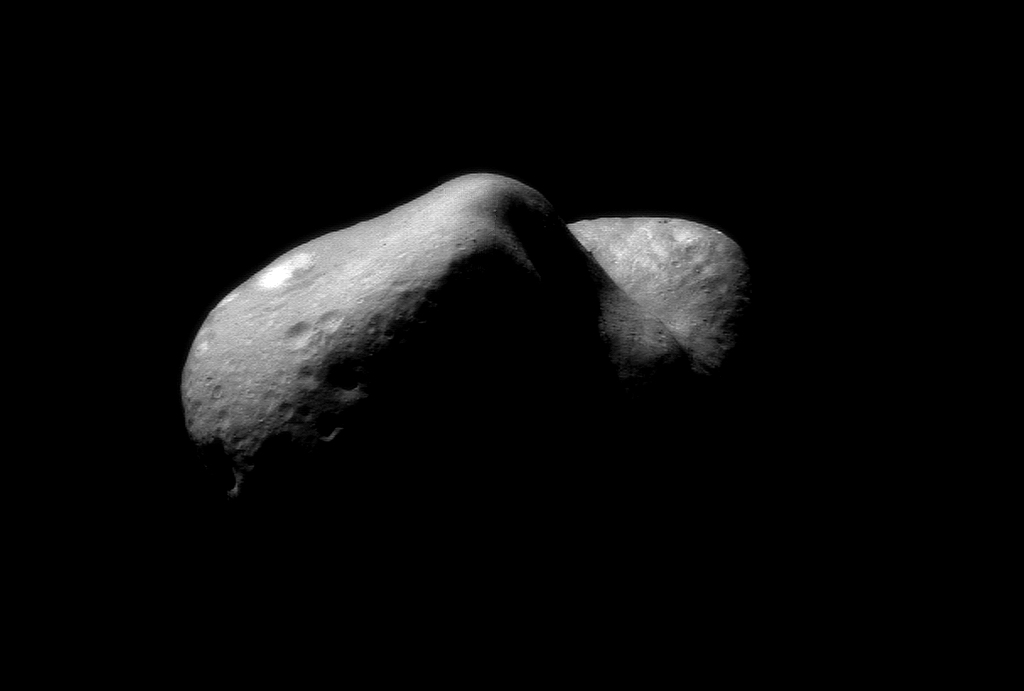






Physical characteristics
Eros is an elongated, irregular object classified as an S‑type asteroid, composed largely of silicate rocks and metals. Its overall dimensions are approximately 13 × 13 × 33 km, giving it an unmistakable peanut or potato shape rather than a spherical form. As one of the few NEAs larger than about 10 km across, Eros ranks among the biggest near‑Earth bodies, second in size to 1036 Ganymed within the NEA group.
Orbit and dynamical behavior
Eros belongs to the Amor group, asteroids whose orbits approach but do not currently cross Earth's orbit. It was the first asteroid observed to cross the orbit of Mars and it has an orbit that keeps it mainly exterior to Earth's, although gravitational interactions can alter such orbits over long timescales. Disturbances from planets and resonances mean objects like Eros are dynamically evolving; numerical studies suggest that the orbit can change enough over millions of years to produce different crossing relationships, potentially becoming an Earth‑crossing object in some scenarios.
Exploration and scientific importance
Eros was the primary target of the NEAR Shoemaker spacecraft, which provided detailed mapping, compositional measurements and close imagery. The spacecraft orbited Eros, producing high‑resolution views of its rugged terrain and cratered surface, and on February 12, 2001 it performed a controlled descent and came to rest on the asteroid, delivering the first soft landing on an asteroid. Data from NEAR have improved our knowledge of asteroid geology, internal structure and surface processes, and helped calibrate remote observations of other small bodies.
Significance, brightness and comparisons
At favorable geometries Eros can become relatively bright as seen from Earth. During certain rare alignments known as oppositions it can reach magnitudes that make it easier to observe than many main belt objects, and observers have recorded particularly bright apparitions roughly every eight decades. Distinguishing Eros from typical main belt asteroids highlights how NEAs can provide accessible targets for telescopes and missions. Comparisons are often drawn with other large bodies: Eros is larger than the estimated impactor that formed the Chicxulub crater in the Yucatán, and its size places it among the handful of near‑Earth objects that merit study for both science and planetary defense.
Quick facts and notable points
- Type: S‑type asteroid (stony).
- Group: Amor group.
- Exploration: NEAR Shoemaker orbiter and landing mission.
- Unit of distance often used in descriptions: astronomical unit.
- Bright oppositions: occasionally brighter than many asteroids in the belt, rivaling objects such as 4 Vesta and, at times, larger bodies like 2 Pallas or 7 Iris in apparent brightness.
As an object of historical and scientific importance, 433 Eros remains a benchmark for comparative studies of small bodies. Its unusual shape, accessible orbit and the wealth of data returned by NEAR make it a frequent reference in discussions of asteroid composition, impact hazards and the early exploration of solar system small bodies. The adjectival form derived from its name, though rarely used, is "Erotian."
Questions and answers
Q: What is the name of the first Near-Earth asteroid (NEA) that was found?
A: The first Near-Earth asteroid (NEA) that was found is 433 Eros.
Q: What is the size of 433 Eros?
A: 433 Eros is an S-type asteroid about 13 × 13 × 33 km in size.
Q: What type of asteroid does 433 Eros belong to?
A: 433 Eros belongs to the Amors.
Q: How close did 433 Eros pass to Earth on January 31, 2012?
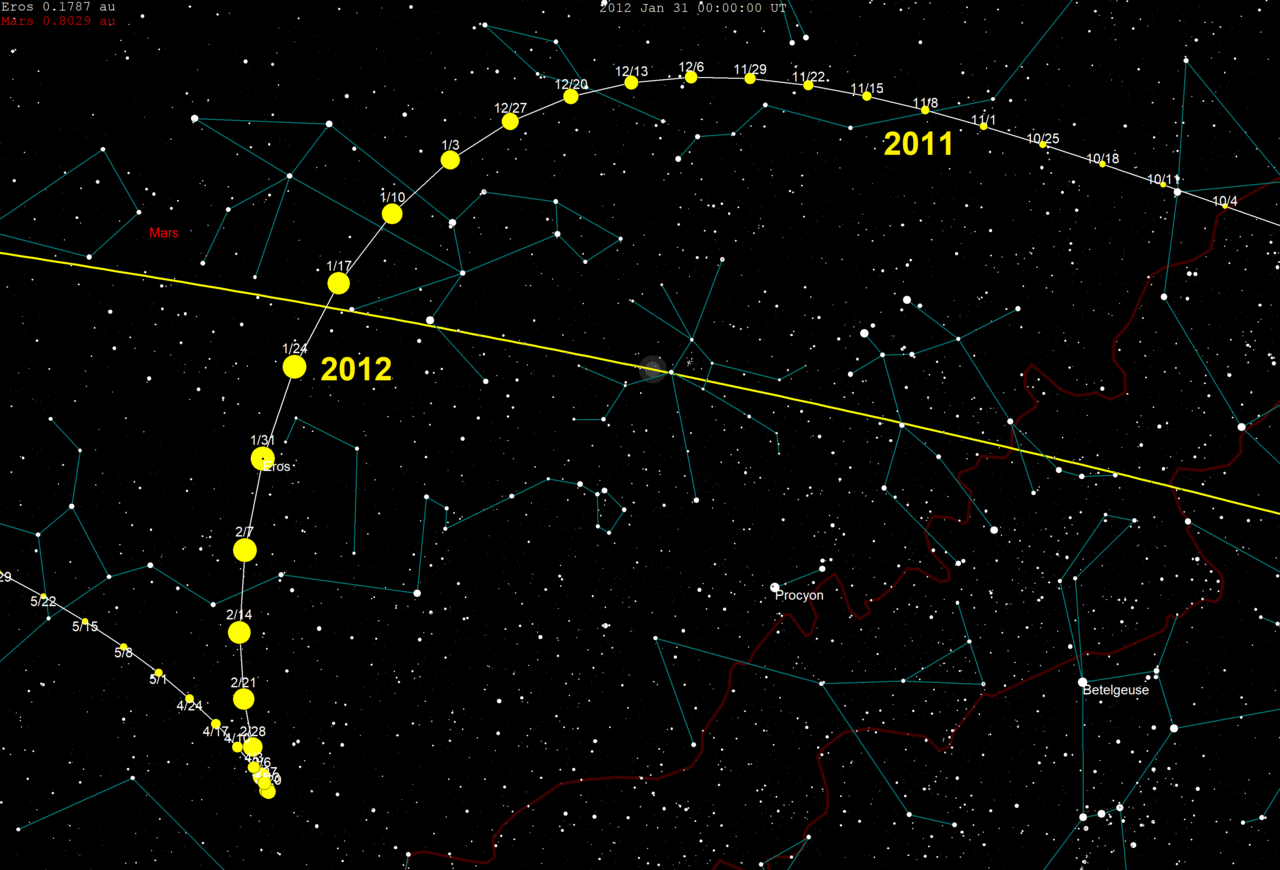
A: On January 31, 2012, 433 Eros passed close to Earth at 0.1787 astronomical units (16.6 million miles). This is about 700 times farther from the Earth than the moon is.
Q: How bright can 433 Eros become during rare oppositions?
A: During rare oppositions, every 81 years such as in 1975 and 2056, 433 Eros can reach a magnitude of +7.1 which is brighter than Neptune and brighter than any main belt asteroid except 4 Vesta (and sometimes 2 Pallas and 7 Iris).
Q: What spacecraft visited433Eros?
A: The NEAR Shoemaker probe visited433Eros.
Q: How long will objects in an orbit likeErosexist before their orbits are changed by gravity?
A: Objects in an orbit likeEroscan exist for only a few hundred million years before their orbits are changed by gravity.
Related articles
Author
AlegsaOnline.com 433 Eros: A large Near‑Earth asteroid and NEAR Shoemaker target Leandro Alegsa
URL: https://en.alegsaonline.com/art/112902
Sources
- trs-new.jpl.nasa.gov : trs-new.jpl.nasa.gov
- iac.es : iac.es/en/system/404