
Betelgeuse — the red supergiant in Orion
An overview of Betelgeuse: its nature as a red supergiant, observable properties, evolutionary status, notable features such as variability and bow shock, and why it matters to astronomy.
Overview
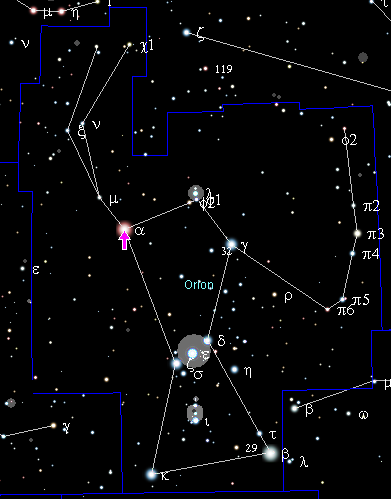
Betelgeuse is a prominent red supergiant star located in the northeastern shoulder of the Orion constellation. It is one of the brightest objects in the night sky and is easily visible to the naked eye. Long known by its Arabic-derived name, Betelgeuse stands out because of its large apparent size, red color and irregular brightness variations.
Image gallery
10 Images



Physical characteristics
Betelgeuse is extremely large and luminous compared with the Sun. Interferometry and other techniques have shown it to have a radius of the order of hundreds of solar radii — so large that, if placed at the center of the Solar System, its photosphere would extend past the orbit of the inner planets. Its luminosity and surface temperature place it firmly among the cool, bright red supergiants. The star's visual brightness changes over time: it is classified as a semiregular variable star, with apparent magnitude that can shift by about a magnitude during complex cycles.
Evolution and age
Betelgeuse is a massive star that has exhausted hydrogen in its core and moved into later burning stages. Because of its high mass it evolves much faster than the Sun and is already in a later stage of stellar evolution. Observations place the star at a distance on the order of several hundred light-years; published estimates commonly cite roughly 600–700 light-years as an average value for the distance from Earth. Its remaining lifetime is short on astronomical timescales: models predict it will end as a core-collapse (type II) supernova sometime within the next several hundred thousand to a million years, though the exact timing cannot be predicted precisely.
Observable behavior and environment
Betelgeuse is known for a wide range of observable phenomena. It has one of the largest amplitude brightness ranges among first-magnitude stars and underwent a well-publicized deep dimming event in 2019–2020 that prompted intensive study. Stellar winds from Betelgeuse interact with the surrounding interstellar medium, producing a large bow-shaped feature. The motion of the star through space generates a shock wave and a wake of material; far-infrared observations by the Herschel Space Observatory revealed complex structures where the wind collides with the ambient gas.
Notable facts and historical notes
- Betelgeuse was among the first stars (after the Sun) whose angular diameter could be measured by early interferometric work in the 20th century.
- The star's name derives from an Arabic phrase meaning the armpit of Orion, reflecting its position in the constellation pattern.
- It produces one of the more prominent examples of a stellar bow shock; other red supergiants with similar features include Mu Cephei and IRC‑10414.
Importance and continuing study
Astronomers study Betelgeuse because it provides a nearby laboratory for late-stage stellar physics: convection in extended atmospheres, mass loss from massive stars, dust formation, and the precursors of supernova explosions. High-resolution imaging, spectroscopy, and time-domain monitoring continue to refine estimates of its size, brightness variations and motion. Amateur observers also follow Betelgeuse's seasonal visibility and variability; historically it has served as a useful reference point in the winter sky when locating other objects in Orion.
For further reading on its classification, variability, and environment see specialized resources: brightness ranking, detailed spectral studies at solar comparison levels, and dedicated catalogs of massive stars at stellar databases and observatory archives at mission summaries and research portals such as constellation guides and instrument pages at distance and parallax studies.
Despite being one of the most observed stars, Betelgeuse still yields surprises; ongoing observations across the electromagnetic spectrum aim to clarify its current state and sharpen predictions for its ultimate fate.
Questions and answers
Q: What is the name of the star discussed in the text?
A: The star discussed in the text is Betelgeuse.
Q: What does Betelgeuse mean in Arabic?
A: In Arabic, Betelgeuse means "the armpit of Orion".
Q: How wide is Betelgeuse compared to the Sun?
A: Betelgeuse is 950 to 1,000 times wider than the Sun.
Q: How far away from Earth is Betelgeuse?
A: Betelgeuse is about 640 light-years away from Earth.
Q: What type of star is Betelgeuse?
A: Betelgeuse is a red supergiant star.
Q: How old is Betelgeuse?
A: Betelgeuse is less than 10 million years old.
Q: What was observed by Herschel Space Observatory in 2013 regarding this star's winds?
A: An observation by Herschel Space Observatory in 2013 showed that the star's winds are crashing against the surrounding interstellar medium.
Related articles
Author
AlegsaOnline.com Betelgeuse — the red supergiant in Orion Leandro Alegsa
URL: https://en.alegsaonline.com/art/11001
Sources
- aavso.org : aavso.org/vsots_alphaori
- iopscience.iop.org : iopscience.iop.org/article/10.1088/0004-6256/135/4/1430
- arxiv.org : arxiv.org/abs/0911.4720
- esa.int : "Betelgeuse braces for a collision"