
Stellar evolution: the life cycles of stars
Stellar evolution describes how stars form, change, and end their lives. It explains physical processes, stages from nebula to remnant, timescales that depend on mass, and why stars shape chemical evolution of the cosmos.
Overview. Stellar evolution is the study of how a star forms, changes, and ultimately finishes its life. A star’s appearance, internal structure and energy output change as it consumes nuclear fuel and responds to gravity and pressure. The energy emitted as light and heat can persist for millions or billions of years, so astronomers and scientists reconstruct life cycles by observing many objects at different stages.
Image gallery
10 Images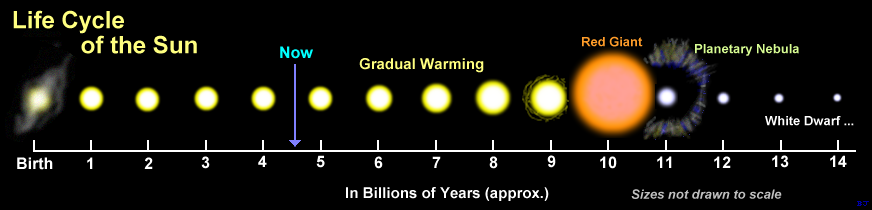




Key physical processes
Two principles govern most stellar changes: hydrostatic equilibrium (the balance of gravity and pressure) and nuclear fusion in the core. On the main sequence a star fuses hydrogen to helium; when core hydrogen is exhausted the core contracts and outer layers expand. In more massive stars successive fusion stages produce heavier elements up to iron; beyond that point fusion stops being an energy source and collapse can follow.
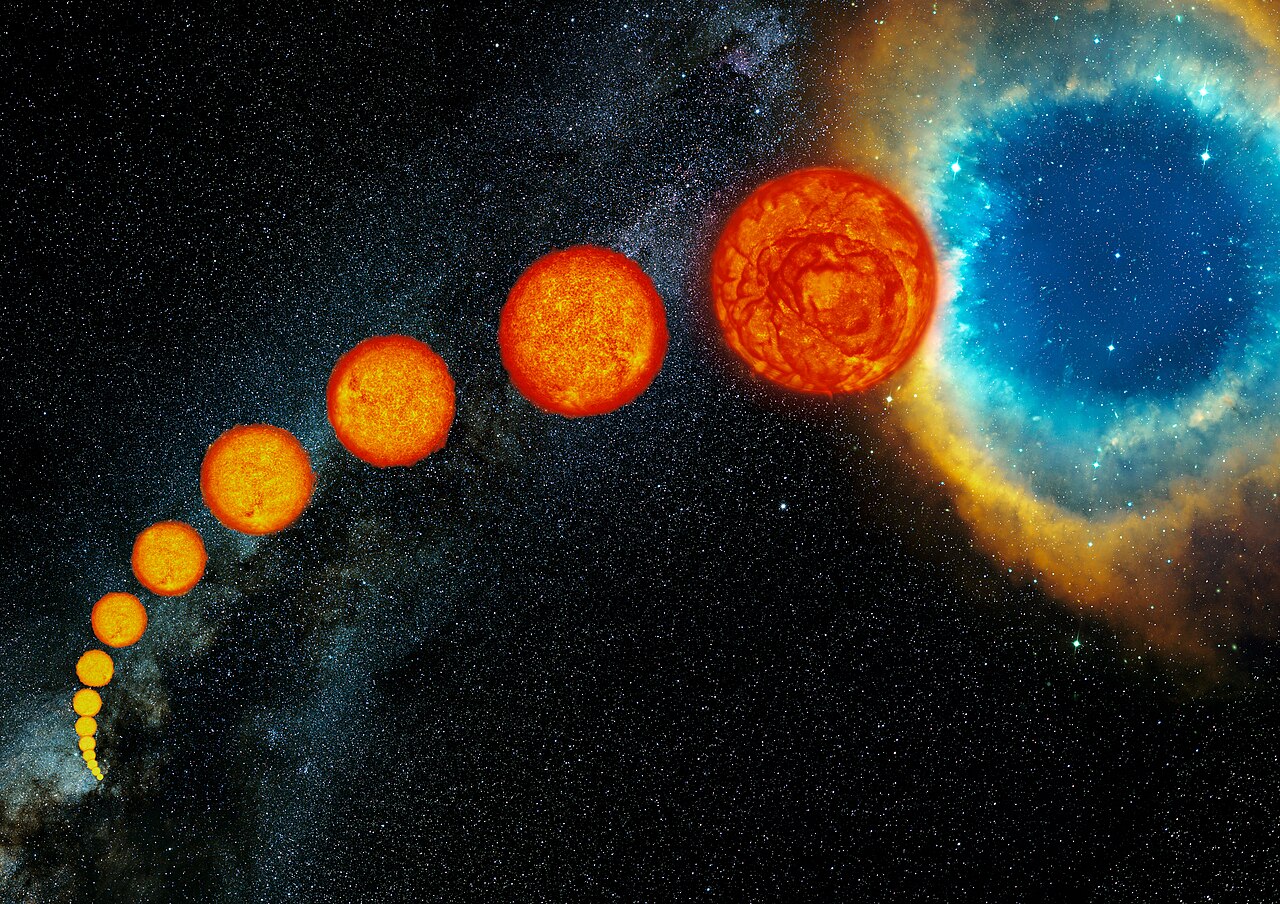
Typical evolutionary stages
- Nebula — a cloud of gas and dust that can collapse to form protostars.
- Main-sequence star — long-lived phase powered by hydrogen fusion.
- Red giant or supergiant — expanded, luminous phase after core hydrogen exhaustion.
- Final remnants — low- and intermediate-mass stars become white dwarfs (eventual black dwarfs are theoretical), while high-mass stars may leave a neutron star or collapse to a black hole.
Whether a star becomes a white dwarf, neutron star or black hole depends mainly on its mass and the details of mass loss and binary interactions. Low-mass stars evolve slowly and never fuse elements heavier than helium or carbon; the most massive stars live fast, synthesize heavy elements, and may end in energetic supernovae that disperse enriched material.
Observational methods and historical context
Astronomers use photometry, spectroscopy and theoretical models to place stars on the Hertzsprung–Russell diagram and infer ages and compositions. Historically, the concept of stellar evolution grew from 19th– and 20th‑century studies of star clusters and nuclear physics. Today, computer simulations and observations across wavelengths refine the timing of stages and the role of rotation, magnetic fields and binary companions.
Importance and notable facts
Stellar evolution explains the origin of the chemical elements, regulates galactic ecology, and sets environments for planet formation and life. Some outcomes (for example, black dwarfs) are theoretical because the universe is not old enough for them to exist yet. Understanding stellar lifecycles remains central to astrophysics and cosmology.
Questions and answers
Q: What is stellar evolution?
A: Stellar evolution is the study of how a star changes over time.
Q: Can stars change very much over time?
A: Yes, stars can change very much between when they are first created and when they run out of energy.
Q: How do scientists study the process of stellar evolution?
A: Scientists study stellar evolution by studying many different stars in different stages of their life.
Q: What are the different stages in a star's life?
A: The stages in a star's life are nebula, main-sequence star, red giant and either white dwarf followed by black dwarf, neutron star or black hole.
Q: How long can stars produce light and heat for?
A: Stars can produce light and heat for millions or billions of years.
Q: Are all stars the same at every stage of their life?
A: No, stars are not the same at every stage of their life, they change over time.
Q: Why is studying stellar evolution important?
A: Studying stellar evolution is important because it helps us understand the processes that occur in stars and how they evolve over time, which in turn helps us to better understand the universe.
Related articles
Author
AlegsaOnline.com Stellar evolution: the life cycles of stars Leandro Alegsa
URL: https://en.alegsaonline.com/art/93707