
Mu Cephei (Garnet Star): red hypergiant in Cepheus
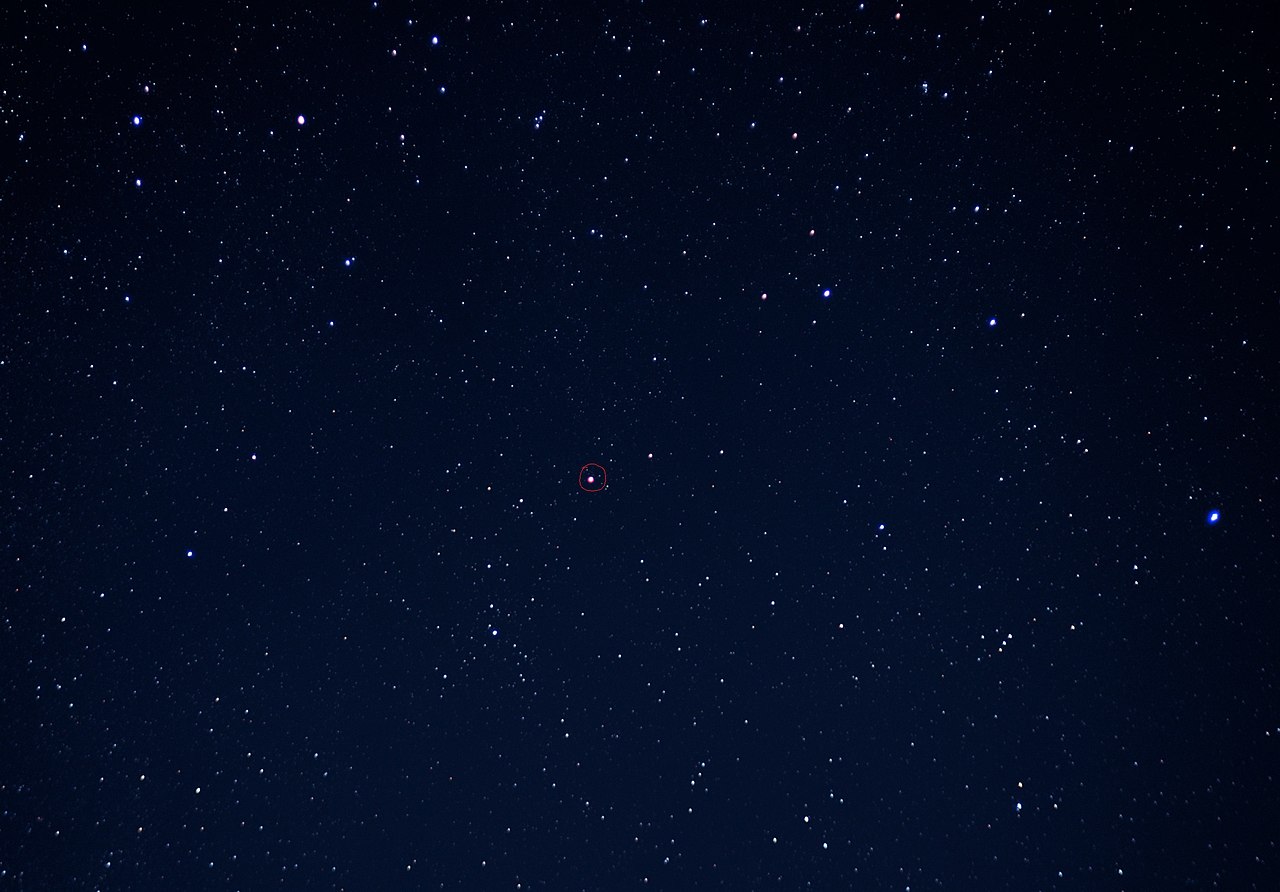
Mu Cephei, nicknamed the Garnet Star, is a red hypergiant in the constellation Cepheus. It is one of the largest known stars, a semiregular variable and an important object in stellar evolution studies.
Overview
Mu Cephei, widely known as the "Garnet Star," is a striking red hypergiant in the northern constellation of Cepheus. Its deep red hue has made it an attention-grabbing object for observers since early telescopic astronomy, and the star is often referred to in historical accounts by the Herschel family—hence the informal name Herschel's Garnet Star. Mu Cephei stands among the largest and most luminous stars visible to amateur and professional observers.

Image gallery
8 Images





Physical characteristics
Mu Cephei is classified as a red hypergiant (often written as a very luminous red supergiant), with a radius many hundreds to over a thousand times that of the Sun. It emits the majority of its energy at long (red and infrared) wavelengths, giving it a pronounced garnet-like color often mentioned in descriptions of the star. Its extended atmosphere and strong mass loss place it in the upper extremes of stellar size and instability.
Variability and observational properties
The star is a semiregular variable, meaning its brightness changes with time in a pattern that is not strictly periodic. Because of this variability and its large apparent size in infrared measurements, Mu Cephei has been used as a prototype for studying semiregular variable behavior in very luminous cool stars. At brighter phases it can be seen with the naked eye from dark locations; at fainter phases it becomes more difficult to detect without optical aid.

History and scientific importance
Historical observers noted Mu Cephei's unusual color long before modern spectroscopy. In the 19th and 20th centuries, astronomers established its status as an extremely luminous cool star and studied its spectra and changing light output. Today it serves as a laboratory for investigating late stages of massive star evolution: how very large stars lose mass, form extended molecular and dust shells, and approach the final stages of their lives.
Notable facts and future fate
- Mu Cephei is among the largest stars known by radius and is notable for its intense red coloration described as "garnet-like"; see discussion of its color at garnet-like color.
- As a highly evolved, massive star, it is expected to end its life in a catastrophic event such as a core-collapse supernova, though the precise timing and remnant type are uncertain.
- Its status as a prototype semiregular variable and its extreme physical parameters make it a frequent subject in studies of stellar atmospheres, mass loss, and dust formation around evolved stars; for general context see red hypergiant literature.

Mu Cephei remains a familiar target for both visual observers and modern telescopes. By combining long-term brightness records, spectral monitoring, and infrared imaging, astronomers continue to refine understanding of very large, cool stars and the processes that shape their final evolution.
Related articles
Author
AlegsaOnline.com Mu Cephei (Garnet Star): red hypergiant in Cepheus Leandro Alegsa
URL: https://en.alegsaonline.com/art/67313
Sources
- doi.org : doi.org/10.1086/430901