
Weather balloon (sounding balloon)
A weather balloon is a free-flying high-altitude platform that carries instruments to measure atmospheric pressure, temperature, humidity and winds for forecasting and research.
Overview
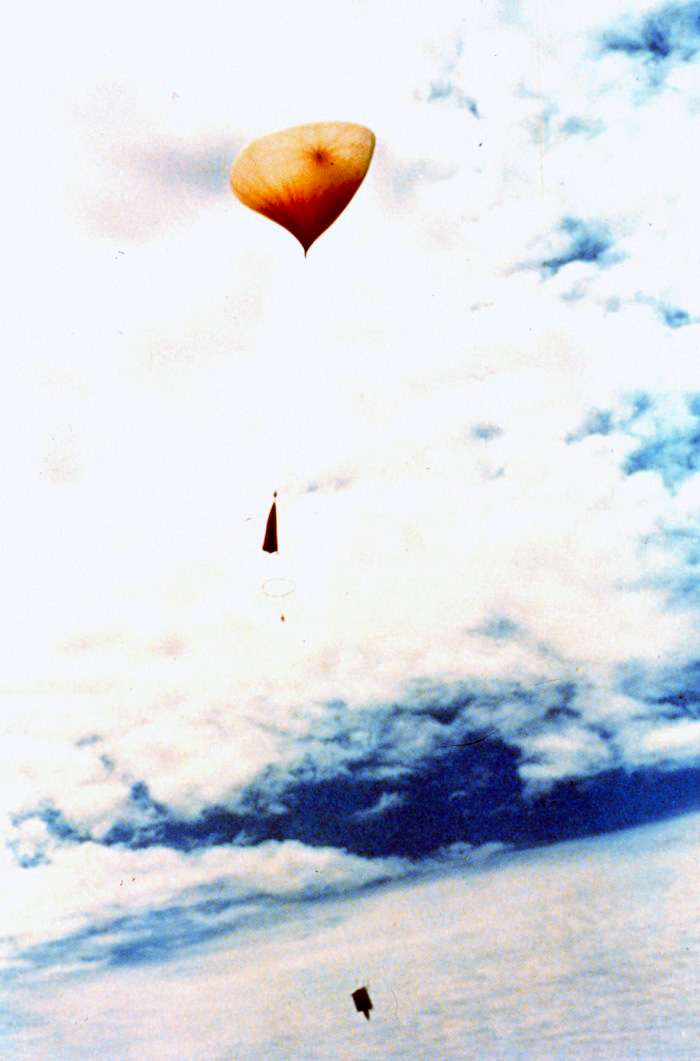
A weather balloon, often called a sounding balloon, is a type of high-altitude balloon used to carry meteorological instruments upward through the atmosphere. The primary payload is a radiosonde, a compact instrument package that measures and transmits profiles of atmospheric pressure, temperature and humidity. By rising through many kilometers of air and relaying data in real time, weather balloons provide vertical snapshots that are essential to numerical weather prediction, aviation safety and atmospheric research.
Image gallery
7 Images



Design and main parts
Typical weather balloon systems are deliberately simple and reliable. The main elements include:
- an elastic envelope made from latex or polyethylene that expands as external pressure falls;
- a lifting gas, commonly helium or sometimes hydrogen, chosen for buoyancy and availability;
- a payload containing the radiosonde with sensors for pressure, temperature and humidity, a radio transmitter and sometimes a Global Navigation Satellite System receiver;
- a lightweight parachute or descent device to return the radiosonde once the balloon bursts at high altitude.
The radiosonde converts sensor readings into digital telemetry that ground stations receive directly or via relays. Some launches also include additional instruments for specialized studies, such as ozone sensors, aerosol samplers or small cameras.
How they operate and how winds are measured
After inflation at the launch site the balloon ascends at a roughly constant rate until it expands and bursts, typically in the stratosphere. Wind information is derived by tracking the drifting radiosonde. Common tracking techniques include following the radio signal direction, using radar tracking, or relying on satellite navigation. For example, position fixes from the Global Positioning System are widely used today; older systems made use of radar and radio direction finding. Wind speed and direction profiles extracted from these tracks are fundamental to understanding atmospheric motion and convection.
History and development
Remote atmospheric sounding began in the late 18th century when early balloon flights were used to sample winds aloft. In 1783, an observation balloon was launched to assess wind conditions immediately before the first manned ascent by Jean-François de Rozier and the Marquis d'Arlandes. Systematic scientific use accelerated in the late 19th and early 20th centuries when meteorologists such as Léon Teisserenc de Bort used balloons to map temperature structure and to define the lower atmospheric layer now known as the troposphere. By the 1930s, radio-equipped sondes enabled routine, repeated launches that turned sounding balloons into dependable floating weather stations.
Uses and importance
Weather balloons remain indispensable for several reasons. They supply high-vertical-resolution measurements that complement satellite soundings and surface observations, improving forecasts of storms, aviation turbulence, and severe weather. Atmospheric researchers use them to study inversion layers, humidity transport, and the distribution of chemical species. High-altitude balloons are also platforms for astronomy and cosmology experiments: astronomers and cosmologists have lifted instruments above much of the lower atmosphere to observe wavelengths and particles that are strongly scattered or absorbed near the surface.
Practical details, limitations and alternatives
Many national meteorological services launch sounding balloons on a routine schedule (for example twice daily from fixed sites) to feed numerical weather models. Despite their value, balloons have limits: they provide profiles only along the balloon's ascent path, they are subject to daylight and seasonal operational constraints, and they eventually burst and lose their payloads unless recovered. Safety rules and airspace coordination are necessary where launches occur. Alternatives and complements to balloon soundings include aircraft-based observations, dropsondes released from aircraft, ground-based remote sensors, and satellite remote sensing; each method trades off cost, spatial coverage and vertical resolution.
Tracking methods and instruments (summary)
- Direct telemetry from the radiosonde, including pressure, temperature and humidity sensors and signal links to ground stations.
- Navigation-based tracking using satellite systems such as the Global Positioning System and other GNSS constellations.
- Remote tracking via radar or radio direction finding to infer drift and winds.
- Specialized payloads and sensors for ozone, aerosols, radiation and other targeted measurements to support research and operational needs related to airflow and climate.
Weather balloons represent a straightforward, cost-effective technology that continues to provide unique, high-quality in situ data from the lower and middle atmosphere. Their long history—from early observation flights to modern, instrumented sondes—illustrates how simple airborne platforms can yield outsized benefits for weather forecasting, atmospheric science and certain observational astronomy applications.
instruments used in sondes vary by mission, and technologies continue to evolve as sensors and telemetry become smaller and more capable. For historical context and operational details consult national meteorological services or specialized literature on upper-air observation techniques; many services provide launch schedules, data and descriptions online via portals and technical reports.
Common tracking and measurement vocabulary includes terms such as wind profiling, radiosonde telemetry, and ascent rate monitoring. For hands-on procedures and safety guidance, professional manuals and national agencies offer standard operating practices that cover gas handling, launch clearance and payload recovery.
Further technical references and open datasets may be available through meteorological agencies and scientific institutions; see service portals and publications for installation-specific information and data access (example links and portals are represented here by placeholders).
temperature, humidity and pressure profiles obtained from sounding balloons continue to be core inputs for weather models and research, making the technique a lasting and vital component of atmospheric science.
For additional specialized or archival material see agency pages and publications linked via institutional resources and research databases (link placeholders in this article: balloon types, lifting gases and operational notes).
Related articles
Author
AlegsaOnline.com Weather balloon (sounding balloon) Leandro Alegsa
URL: https://en.alegsaonline.com/art/107035