
Troposphere: Earth's Lowest Atmospheric Layer — Structure, Composition, and Role
The troposphere is the lowest layer of Earth's atmosphere where weather occurs. This article explains its structure, composition, temperature profile, role in climate and aviation, and how it differs from higher layers.
Overview
The troposphere is the lowest layer of Earth's atmosphere and contains the bulk of the air mass that surrounds the planet. Extending from the surface up to an altitude that varies with latitude and season, it is the domain of weather, clouds, and most airborne life. The name derives from Greek roots meaning a region of mixing or change, reflecting the turbulent, convective character of this layer.
Image gallery
8 Images





Extent and vertical structure
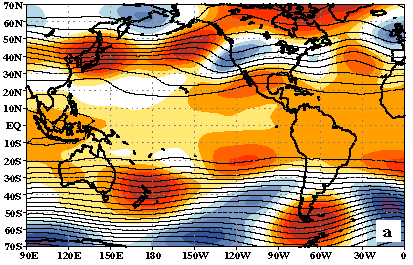
The top of the troposphere, called the tropopause, is not at a fixed altitude. It is typically lowest near the poles and higher over the tropics: roughly a few kilometers above the surface at high latitudes, around 10–12 kilometers at mid-latitudes, and up to nearly 18 kilometers in tropical regions. Within the troposphere, temperature generally decreases with height. The average rate of decline, known as the environmental lapse rate, is about 6.5°C per kilometer, although local conditions can alter this value significantly.
Composition and physical properties
Air in the troposphere is composed mainly of nitrogen and oxygen, with smaller amounts of argon and trace gases such as carbon dioxide, methane, and ozone. Nearly all of the water vapor and aerosols in the atmosphere are found here; water vapor concentrations fall rapidly with altitude. The troposphere contains roughly three quarters of the atmosphere's mass, which means most of the pressure and particle content experienced at the surface lie in this layer.
Weather, circulation, and climate role
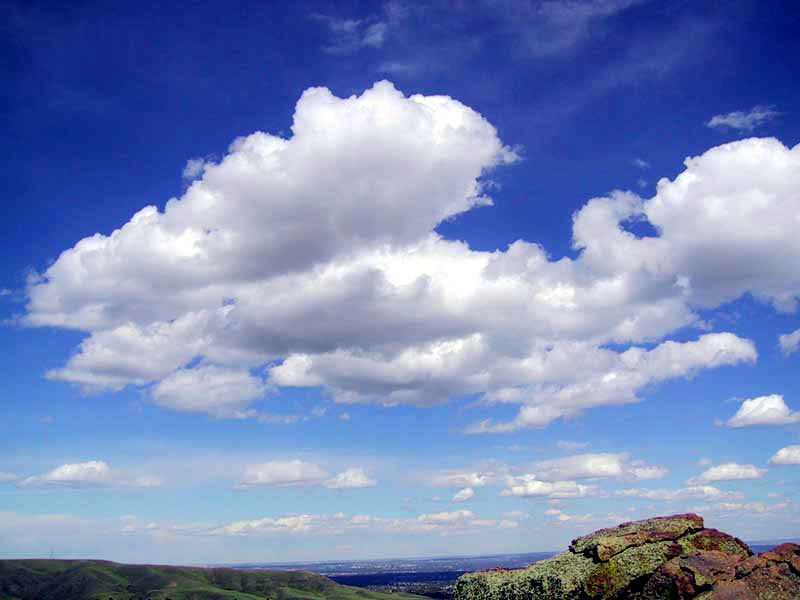
The troposphere is the seat of weather. Heating of Earth’s surface drives convection, producing rising air, clouds and precipitation. Large-scale circulation patterns — from local sea breezes to planetary jet streams — are established within or just above the troposphere. Because it contains the bulk of atmospheric water vapor and clouds, the troposphere plays a central role in the planet’s energy balance and short-term climate variability.
Human relevance and observations
Human activities and technologies interact with the troposphere in many ways. Commercial aircraft commonly cruise in the upper troposphere or near the tropopause to take advantage of stronger winds and more stable conditions. Pollution, aerosol distributions, and greenhouse gases in the troposphere directly affect air quality and climate. Scientists study this layer with weather balloons (radiosondes), aircraft, ground stations, and increasingly with satellites to monitor temperature, humidity, and composition.
Key characteristics and distinctions
- Contains most of the atmosphere's mass and nearly all water vapor and aerosols.
- Temperature generally decreases with altitude, producing turbulence and convection.
- Bounded above by the tropopause, which separates it from the more stratified stratosphere where temperature increases with height.
- Location of virtually all weather systems and the majority of living organisms that rely on atmospheric oxygen.
Historical and scientific context
Recognition of distinct atmospheric layers evolved as instrumental measurements became available in the 19th and 20th centuries. The layered model—troposphere, stratosphere, mesosphere, and thermosphere—helps organize understanding of atmospheric processes. Ongoing research continues to refine knowledge about tropospheric dynamics, its coupling to the stratosphere, and the impacts of human-caused changes in composition.
Related articles
Author
AlegsaOnline.com Troposphere: Earth's Lowest Atmospheric Layer — Structure, Composition, and Role Leandro Alegsa
URL: https://en.alegsaonline.com/art/101738