
Vibrating string: physics, musical use, and behavior
An overview of vibrating strings: how they produce waves and sound, the physical laws and modes that govern them, their role in musical instruments, historical study, and practical distinctions.
Overview
A vibration in a string is a mechanical wave that travels along, and often stands on, the string. When a string vibrates it transfers energy into surrounding air and into any structure it touches, creating waves and ultimately sound. The audible pitch depends primarily on the frequency of the vibration, which listeners perceive as pitch.
Image gallery
2 Images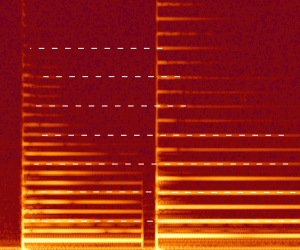

Basic physics
Idealized vibrating strings exhibit transverse standing waves with nodes (points of no motion) and antinodes (points of maximum motion). The lowest-frequency standing wave is the fundamental; higher-frequency standing waves are harmonics or overtones. For a uniform string under tension, the wave speed v relates to the tension T and linear mass density μ by v = sqrt(T/μ). The fundamental frequency f for a string of length L is given by f = (1/2L)·v, so changing length, tension, or mass alters pitch.
Modes, timbre and damping
Practical strings are not perfectly flexible or lossless. Stiffness, inharmonicity, damping, and excitation method (plucked, bowed, struck) shape the harmonic content and decay. Bowed strings can sustain a nearly steady tone through stick-slip action, while plucked or struck strings produce a decaying sound rich in transients. These properties determine the instrument's timbre and dynamic behavior.
Musical instruments and examples
Vibrating strings form the sound source in many instruments: the string instrument family includes the guitar, the cello, and the piano. In guitars and violins the strings couple to a resonant body (soundboard) that amplifies and colors the sound. A piano's strings are struck by hammers; their stiffness and inharmonicity are compensated by tuning stretched pitches and multiple strings per note.
History and scientific development
Study of string vibration goes back to antiquity with musical ratio observations and to early scientific work in the 17th century (often associated with scholars such as Mersenne) that clarified the relations among length, tension and mass. Over time, the theory of waves and modern measurements refined the understanding used in instrument design and acoustic engineering.
Practical distinctions and notable facts
- Different excitation methods (pluck, bow, strike) create distinct transient and steady-state behaviors.
- Real strings show inharmonicity; piano design compensates for it to make chords sound in tune.
- String materials (gut, steel, nylon) change density, stiffness and tone.
- Electronic pickups measure string motion to convert vibrations to electrical signals for amplification.
For further reading on fundamental concepts, experimental measurements, or instrument-specific design, follow introductory resources linked here: vibration overview, string mechanics, wave phenomena, sound production, frequency basics, pitch and perception, string instruments, guitar, cello, and piano.
Related articles
Author
AlegsaOnline.com Vibrating string: physics, musical use, and behavior Leandro Alegsa
URL: https://en.alegsaonline.com/art/104865