
Vienna Philharmonic
The Vienna Philharmonic is a world-renowned orchestra based in Vienna, Austria, famed for its distinctive Viennese sound, residency at the Musikverein, and its annual New Year's Concert tradition.
Overview
The Vienna Philharmonic (die Wiener Philharmoniker) is a professional orchestra based in Vienna, Austria. Widely regarded as one of the leading orchestras in the world, it is known for its refined ensemble playing, long associations with major conductors, extensive recording history, and a repertoire that emphasizes the Viennese classical and Romantic traditions.
Image gallery
4 Images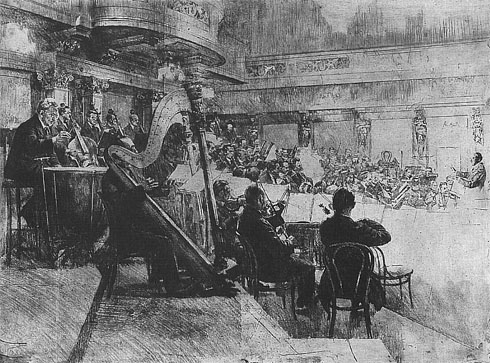


Characteristics and sound
The orchestra’s sound is often described as warm, agile and distinctly 'Viennese.' This identity arises from several factors: the use of traditional Viennese instruments and instrument-making practices, particular choices in vibrato and phrasing, and a stylistic approach handed down through generations of players. These features give the ensemble a recognizable timbre, especially in works by Mozart, Beethoven, Brahms and the Strauss family.
History and home venue
The Vienna Philharmonic traces its origins to the orchestral forces of the mid-19th century and was formally established in the 1840s by musicians associated with the city's opera and concert life. Its principal concert hall is the Musikverein, whose Great Hall (the "Golden Hall") remains the orchestra’s principal home and a celebrated venue for chamber and symphonic music.
Membership, governance and practice
Membership in the orchestra is selective. Traditionally, players must first serve with the Vienna State Opera orchestra—commonly for a probationary period—before they may be proposed for Philharmonic membership. The ensemble is self-governing: members vote on artistic and administrative matters, elect their management, and determine many aspects of programming and tradition.
Repertoire, performances and recordings
The Vienna Philharmonic maintains an active schedule of subscription concerts, opera collaborations, international tours and studio recordings. It is particularly identified with composers of the Viennese tradition but performs a broad range of repertoire. A signature event is the annual New Year's Concert, broadcast worldwide and featuring light classics and waltzes associated with the Strauss family and their contemporaries.
Notable facts and contemporary issues
- The orchestra has a long recording and touring legacy that helped define 20th-century performance practice.
- It has been praised for artistic excellence while also facing public discussion about diversity and representation; in recent decades the ensemble has adjusted policies in response to evolving expectations.
- Because the players control appointments and traditions, the Philharmonic preserves a strong institutional continuity that shapes its musical identity.
The Vienna Philharmonic continues to play a prominent role in the global classical music scene, balancing deep local traditions with an international presence through concerts, recordings and broadcasts.
Questions and answers
Q: What is the Vienna Philharmonic?
A: The Vienna Philharmonic is an orchestra based in Vienna, Austria.
Q: Is the Vienna Philharmonic considered one of the greatest orchestras in the world?
A: Yes, it is thought of as one of the greatest orchestras in the world.
Q: Where does the Vienna Philharmonic perform?
A: The Vienna Philharmonic performs in a concert hall called the Musikverein.
Q: What is the requirement for musicians to become a member of the Vienna Philharmonic?
A: Before becoming a member of the Vienna Philharmonic, musicians have to work for at least three years in the opera house (the Vienna State Opera), and then they are allowed to try to become a member of the orchestra.
Q: In what language is the name of the Vienna Philharmonic written in?
A: The name of the Vienna Philharmonic is written in German, as "die Wiener Philharmoniker".
Q: How long must musicians work in the Vienna State Opera before trying to join the Vienna Philharmonic?
A: Musicians must work for at least three years in the Vienna State Opera before trying to join the Vienna Philharmonic.
Q: Where is the Vienna Philharmonic based?
A: The Vienna Philharmonic is based in Vienna, Austria.
Related articles
Author
AlegsaOnline.com Vienna Philharmonic Leandro Alegsa
URL: https://en.alegsaonline.com/art/105067