
Vibration: principles, types, measurements and practical importance
Vibration is oscillatory motion about an equilibrium point. This article covers basic properties, types, measurement, mathematical models, engineering concerns, resonance, damping and practical applications.
Overview
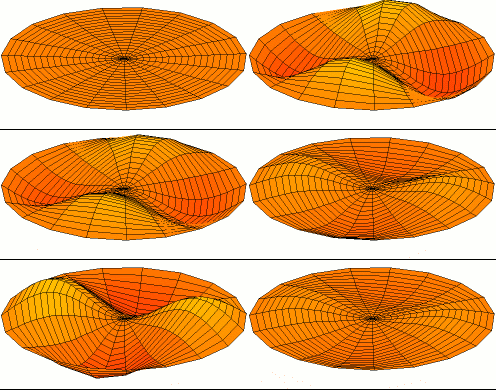
Vibration is the repeated motion of a body or system about a point of equilibrium. It ranges from simple, periodic oscillation to complex, stochastic movement. Vibrations often appear as shaking or trembling and, when transmitted to a surrounding medium, can produce sound by setting the air or another medium into motion; these disturbances move as waves and are detected by the ear and interpreted by the brain. Some vibrating systems are deliberately designed, as in musical instruments, while others are unwanted and require mitigation.
Image gallery
10 Images




Key characteristics
Three primary quantities describe most vibrations. The maximum displacement from equilibrium is the amplitude. The time for one full cycle is the period, and the number of cycles per second is the frequency, measured in Hertz (Hz). Simple harmonic motion is an idealized form where restoring forces are proportional to displacement; many practical systems approximate this behavior over limited ranges.
Types and behavior
- Free vs forced: Free vibration follows an initial disturbance with no ongoing input; forced vibration arises from a continuous external excitation.
- Damped vs undamped: Damping mechanisms—friction, material hysteresis, fluid resistance—remove energy and reduce amplitude over time.
- Periodic vs random: Periodic vibrations repeat at one or more definite frequencies; random vibration lacks a simple repeating pattern and is treated statistically.
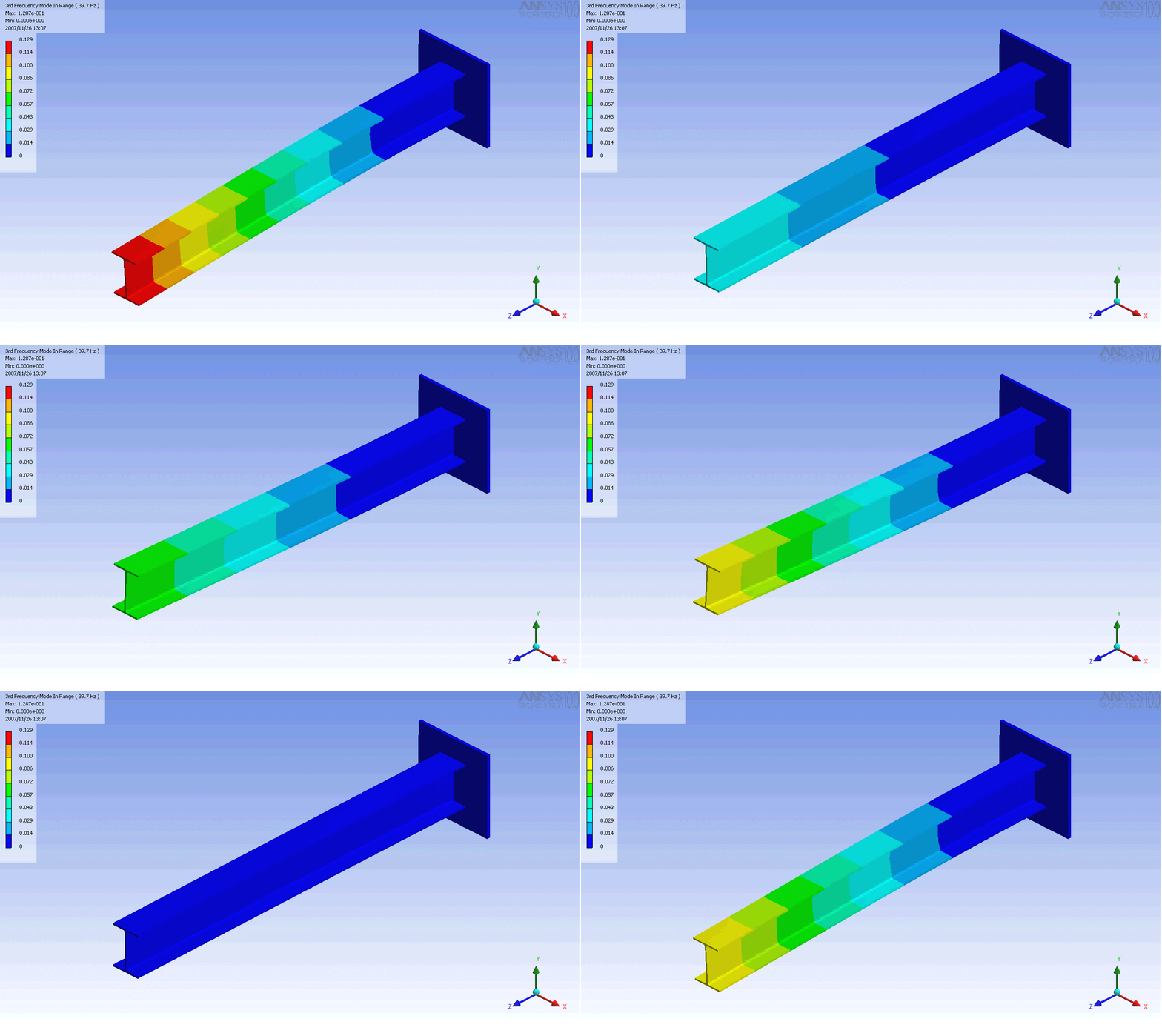
- Resonance: If an excitation frequency matches a system's natural frequency, amplitudes can become large and cause damage unless controlled.
Mathematical models and analysis
Basic models use mass, stiffness and damping to represent a vibrating system. The simplest example is the mass–spring–damper model, which yields a natural frequency and a damping ratio that determine response. In many applications, analysis proceeds in the frequency domain using Fourier techniques to identify dominant spectral components. For random excitation, statistical descriptors such as power spectral density are used to characterize response.
Damping, energy and resonance
Damping dissipates vibrational energy and limits motion near resonance. The practical effect of resonance depends on input energy, damping level and duration; not all resonant responses cause failure, but uncontrolled resonance has been responsible for structural damage and equipment breakdowns. Designers often shift natural frequencies, add damping, or isolate systems to reduce harmful effects.
Measurement and instrumentation
Vibration is measured with instruments such as accelerometers, geophones, velocity pickups and displacement transducers. Time-domain records are converted to the frequency domain to reveal modal frequencies and amplitudes. Proper mounting, calibration and signal processing are important for reliable results in both laboratory and field settings.
Applications and engineering concerns
Vibration is central to many technologies and safety disciplines. In industry it affects machine life, comfort, and accuracy; in civil and structural engineering and earthquake engineering it influences design against fatigue and collapse. Non-destructive testing uses vibrational responses to detect flaws. In microtechnology, resonant elements underpin sensors and timing devices. When uncontrolled, vibration can make components fail or lead to unacceptable noise and wear.
Human perception and health
Human sensitivity to vibration depends on frequency, amplitude and direction. Low-frequency motion tends to be felt as swaying, higher frequencies as buzzing. Prolonged exposure to vibration can affect comfort, performance and, in occupational settings, health; guidelines and standards exist to limit harmful exposure.
Practical mitigation strategies
- Increase damping by material choice or added dampers to reduce resonance peaks.
- Alter stiffness or mass to shift natural frequencies away from expected excitations.
- Use isolation mounts, tuned mass dampers, or active control systems to limit transmitted motion.
History and further reading
The study of vibration grew with classical mechanics and the mathematical description of oscillatory systems. Over time, experimental methods and computational tools expanded applications across science and engineering. For introductory material, topics connected to equilibrium, musical acoustics, the behavior of air in sound production, the nature of waves and human hearing via the ear and brain provide useful context. Practical engineering resources address how to prevent systems from failing under vibratory loads and how to specify units like Hertz and measures such as amplitude.
Readers interested in specialized topics can follow up on measurement techniques, modal analysis, statistical methods for random vibration, or mitigation strategies used in civil, mechanical and acoustic engineering.
Questions and answers
Q: What is vibration and what does it mean?
A: Vibration means quickly moving back and forth (or up and down) about a point of equilibrium.
Q: Is vibration always periodic?
A: No, vibration may be periodic (having a pattern) or random.
Q: Can something that is vibrating shake at the same time?
A: Yes, something that is vibrating may shake at the same time.
Q: Can a regular vibration produce a musical note?
A: Yes, if vibration occurs in a regular way, it may produce a musical note because it can make air vibrate.
Q: How does a vibrating object produce sound?
A: A vibrating object produces sound by sending sound waves to the ear and the brain.
Q: What kind of vibrations may be bad in structural engineering including earthquake engineering?
A: Vibrations that may cause the structure to fail are bad in structural engineering including earthquake engineering.
Q: What is the period and frequency of a vibrating object?
A: The time it takes a vibrating object to go back and forth completely is the period, while the number of back-and-forth movements in one second is its frequency, measured in Hertz (Hz).
Related articles
Author
AlegsaOnline.com Vibration: principles, types, measurements and practical importance Leandro Alegsa
URL: https://en.alegsaonline.com/art/104868
Sources
- commons.wikimedia.org : Vibrations