
Bell P-39 Airacobra
Mid-engined American fighter of World War II, notable for its nose cannon, tricycle undercarriage and widespread use by the Soviet Air Force in low-altitude combat.
The Bell P-39 Airacobra was an American single-engine fighter developed by Bell Aircraft. Its prototype made a first flight in 1939 and the type entered service around 1941. The Airacobra is easily recognised by its unusual layout: the engine was mounted behind the cockpit and drove the propeller through a long shaft, freeing up the aircraft nose for heavy armament. That arrangement, combined with a tricycle landing gear and car-style doors, made the P-39 distinctive among fighters of the era.
Image gallery
10 Images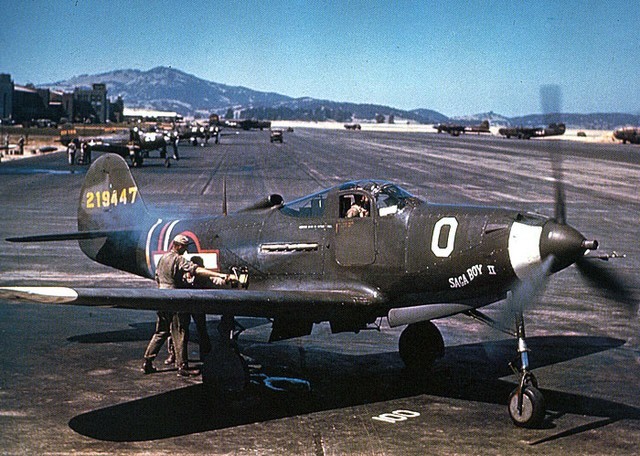


Design and main characteristics
Unlike most contemporary fighters that placed the powerplant up front, the P-39's mid-fuselage engine left room in the nose for a powerful cannon. The typical armament mix on later production models included a central, nose-mounted 37 mm cannon supplemented by several .50-inch (12.7 mm) machine guns — often listed as 12.7 mm machine guns in reports. The configuration gave the Airacobra exceptional forward firepower, useful against both aircraft and ground targets.
Performance at low and medium altitudes was acceptable: the improved 'Q' version could reach roughly 375 miles per hour (about 600 km/h). However, the P-39 lacked an effective turbocharger, and therefore suffered a loss of performance above approximately 5,000 meters; this limitation is often attributed to the absence of a dedicated turbocharger system. Pilots also reported handling quirks and demanding stall and spin characteristics in some flight regimes, making the type less forgiving than many contemporaries.
Operational history and use
The P-39 saw service with the United States Army Air Forces early in World War II, but its strengths and weaknesses made it better suited to other roles and users. One of the most significant operators was the Soviet Union, which received large numbers through Lend-Lease and employed the type extensively on the Eastern Front during World War II. Because much combat on the Eastern Front occurred at low altitude, Soviet pilots were able to exploit the Airacobra's manoeuvrability near the ground and its heavy nose armament. Several Soviet pilots became leading aces flying the type.
In Soviet service, ground-attack and interceptor roles were common. Crews sometimes modified the aircraft — for example, removing wing guns to improve roll rate and manoeuvrability — and used the 37 mm cannon effectively against enemy aircraft, armored vehicles and ground targets. In contrast, Western Allied use tended to be more limited, with the aircraft often reassigned to training, local defence and ground-attack tasks as higher-altitude interceptors became available.
Variants, legacy and notable facts
Bell produced a series of variants that adjusted armament, installation details and equipment; the P-39Q is among the best-known production models. The Airacobra's most enduring legacies are its unusual mid-engined layout and its role in demonstrating how aircraft design trade-offs influence operational use. The central 37 mm cannon made a powerful impression in combat, and its forward placement set the P-39 apart from many fighters that relied primarily on wing-mounted guns.
- Distinctive features: mid-fuselage engine, nose-mounted cannon, tricycle gear and car-style crew access.
- Strengths: heavy forward firepower, effective at low altitude, appreciated by Soviet pilots.
- Limitations: poor high-altitude performance due to lack of effective turbocharger, handling challenges in some regimes.
- Armament highlights: central 37 mm cannon with additional 12.7 mm machine guns or similar weapons depending on variant.
Readers seeking more technical details or squadron histories can consult specialised sources and archival material via manufacturer and military reference links such as Bell and wartime documentation (first flight records, service entry notes). Broader context on piston-engine fighter development and turbocharging choices is available through dedicated studies of engine and airframe trade-offs (turbocharger topics). For the aircraft's combat record and user experiences, primary accounts and unit histories from the Soviet Union and Allied operators provide firsthand perspectives from World War II.
For visual and technical illustrations and museum references see manufacturer pages or restored-aircraft exhibits and archives. Further reading and source collections are available through aviation archives and museum catalogues linked from technical and historical portals (Bell, prototype records, service lists, engineering discussions, Soviet service, World War II history, undercarriage studies, armament summaries, cannon specifications).
Related articles
Author
AlegsaOnline.com Bell P-39 Airacobra Leandro Alegsa
URL: https://en.alegsaonline.com/art/10271
Sources
- acepilots.com : "Army Air Forces Statistical Digest – World War II."