
Ulster: province of Ireland, its counties and identity
Ulster is one of Ireland's four historic provinces, made up of nine counties split between the Republic of Ireland and Northern Ireland; it has distinct geography, history and cultural identities.
Overview
Ulster is one of the four traditional Irish provinces and a long-standing cultural region on the island of Ireland. In historic terms it is classed as a province alongside Leinster, Munster and Connacht. The province is often discussed in geographic, historical and political contexts because its nine counties now lie in two different sovereign jurisdictions.
Image gallery
8 Images


Geography and counties
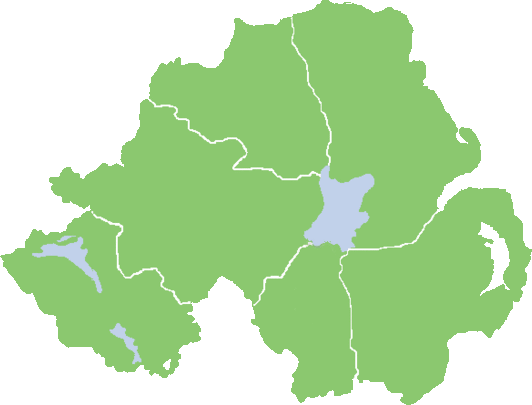
Ulster comprises nine counties in the north of the island. The province includes rural and urban landscapes: lowlands, upland areas and many lakes and rivers that shape local life and economy. Administrative county boundaries are used for many purposes, although provinces no longer serve as formal governmental units in either state.
The nine counties of Ulster are commonly listed as follows (see also the general term counties):
- Three counties are part of the Republic of Ireland:
- Six counties form Northern Ireland, which is part of the United Kingdom:
Historical background and identity
Ulster's identity derives from a long history that includes early Gaelic kingdoms, medieval shifts in power, and later colonial and administrative changes. Over centuries its population, language use and landholding patterns were affected by internal migration, external settlement and economic change. In the 20th century the political partition of Ireland placed six of Ulster's counties in Northern Ireland and three in the independent Republic, a division that still influences social and political life across the province.
Political and cultural significance
Because the majority of Ulster's counties are in Northern Ireland, the name "Ulster" is sometimes used informally to refer to Northern Ireland as a whole. This use substitutes the whole for a part and is an example of totum pro parte, a rhetorical concept often mentioned when discussing names and regions (totum pro parte). At the same time, many people mean the historic nine-county province when they say "Ulster," so context matters.
Uses, traditions and modern notes
Ulster remains important in cultural and sporting life. Several sporting bodies and cultural organizations still use the provincial boundaries for competitions, festivals and heritage work. Languages, traditions and community practices vary across the province: Irish and Ulster-Scots dialects, local music, folklore and built heritage all contribute to a diverse regional character. Symbols and flags associated with Ulster can have different meanings to different communities, and these meanings are shaped by history and contemporary politics.
For readers seeking more structured information about the province, its administrative history and the modern political arrangements that affect the nine counties, consult introductory and specialised sources on Irish geography and history. The separate jurisdictions that now contain Ulster's counties continue to work with provincial, county and local identities in ways that reflect both shared pasts and distinct present-day circumstances.
Related articles
Author
AlegsaOnline.com Ulster: province of Ireland, its counties and identity Leandro Alegsa
URL: https://en.alegsaonline.com/art/102686