
Amalthea — Jupiter’s irregular inner moon
Amalthea is a small, irregular inner moon of Jupiter discovered in 1892. Reddish and non‑spherical, it is a source of dust for Jupiter’s gossamer rings and was imaged by Voyager and Galileo spacecraft.
Overview
Amalthea is one of Jupiter’s inner moons and is commonly cataloged as Jupiter V. It was discovered by the American astronomer Edward Emerson Barnard on September 9 of 1892. The satellite was named after a nurturing nymph of classical legend; the name links to the figure Amalthea within Greek mythology. Amalthea orbits relatively close to Jupiter and belongs to the population of inner, irregularly shaped moons rather than the larger, spherical satellites.
Image gallery
10 Images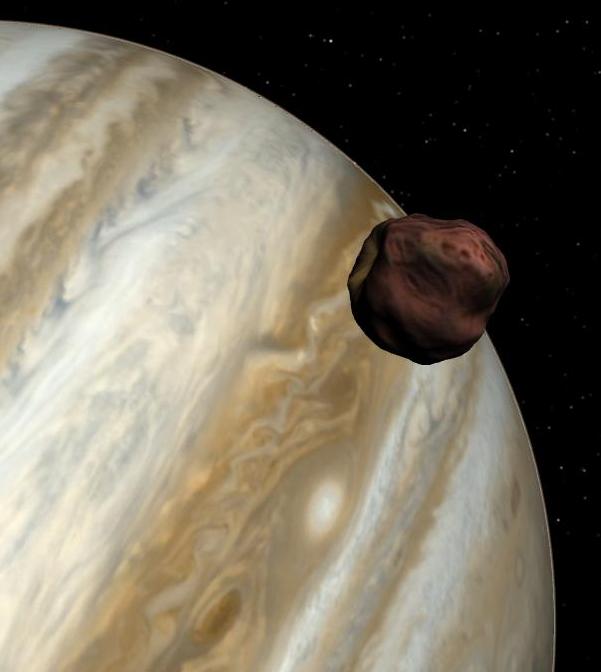
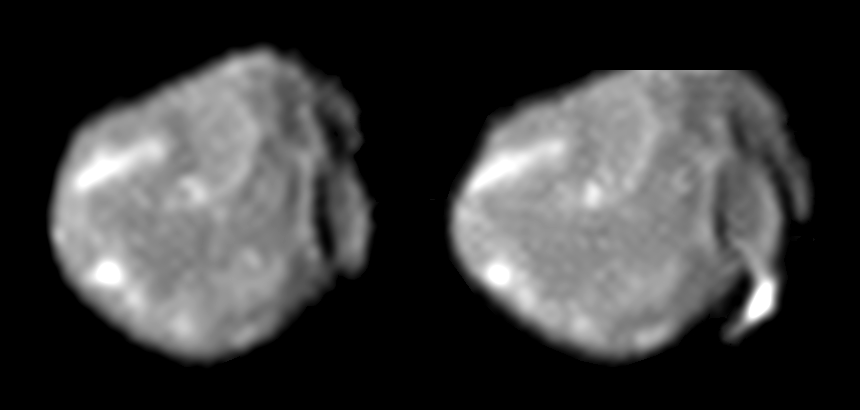

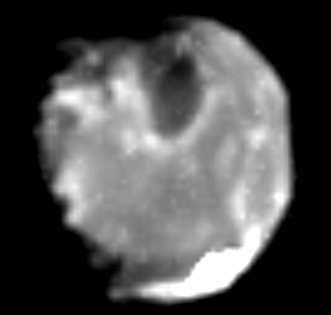



Physical characteristics
Amalthea is noticeably non-spherical and has an irregular, elongated shape that reflects its small size and low gravity. Observations describe the surface color as reddish; this hue may result from the accumulation of complex, dark materials and possibly sulfur compounds transported through Jupiter’s magnetospheric environment and interactions with other Jovian moons. Its bulk composition is thought to include a mixture of water ice with darker rock and dust, but the precise internal makeup is not well constrained from remote data.
Surface features and environment
The surface of Amalthea is heavily scarred by impacts and shows large basins, steep slopes and prominent topography. Because it lies deep within Jupiter’s magnetosphere, charged particles and micrometeoroid bombardment modify its regolith and may drive the ejection of dust from the surface. Those liberated grains are a significant contributor to the diffuse material known as Jupiter’s gossamer rings, linking Amalthea directly to the ring system.
Exploration and imaging
The first close images of Amalthea were taken by the twin Voyager spacecraft: Voyager 1 in 1979 and Voyager 2 in 1980, which revealed its irregular shape and reddish color. Later, the Galileo orbiter in the 1990s obtained more detailed views and measurements that improved knowledge of the moon’s dimensions, rotation, and surface texture. Ground‑based telescopes and space observatories have supplemented these data, but direct spacecraft imaging remains the primary source of detailed information.
Why Amalthea matters
- Proximity to Jupiter: as one of the closest moons, Amalthea experiences strong tidal and radiation influences from the planet.
- Ring contribution: dust from its surface helps maintain Jupiter’s faint gossamer rings.
- Laboratory of processes: its altered, reddened surface offers clues about space weathering under intense magnetospheric conditions.
Notable facts and observations
From the surface of Amalthea, Jupiter would dominate the sky, appearing hugely larger than the Moon appears from Earth; estimates often describe Jupiter’s disk there as many tens of times the apparent diameter of our full Moon, producing a spectacular skyward presence (see comparative appearance). The moon is classified as non‑spherical and retains its catalog designation Jupiter V in some contexts. Historic and modern missions—especially the early Voyager encounters and the more detailed Galileo observations—remain the main sources for our understanding of this small, intriguing Jovian satellite.
For further reading, mission archives and planetary science summaries provide deeper technical data and imagery collected across multiple encounters. Researchers continue to use those datasets to refine models of Amalthea’s structure, surface processes and role within the Jovian system.
Questions and answers
Q: What is Amalthea?
A: Amalthea is the third closest moon to Jupiter.
Q: Who discovered Amalthea and when?
A: Edward Emerson Barnard discovered Amalthea on September 9, 1892.
Q: What is Amalthea also known as?
A: Amalthea is also known as Jupiter V.
Q: How big does Jupiter look in the sky on Amalthea?
A: Jupiter would look 92 times bigger than the Full Moon in Amalthea's sky.
Q: What is the surface of Amalthea like?
A: The surface of Amalthea has big craters and high mountains.
Q: When were pictures of Amalthea taken and by which spacecrafts?
A: Pictures of Amalthea were taken in 1979 and 1980 by the Voyager 1 and 2 spacecraft, and later, in more detail, by the Galileo orbiter in the 1990s.
Q: What do we know about the composition of Amalthea?
A: Amalthea is non-spherical and reddish in colour, and it is thought to have water ice with unknown amounts of other materials.
Tags
Related articles
Author
AlegsaOnline.com Amalthea — Jupiter’s irregular inner moon Leandro Alegsa
URL: https://en.alegsaonline.com/art/3202
Sources
- adsabs.harvard.edu : "Cassini ISS astrometric observations of the inner jovian satellites, Amalthea and Thebe"
- doi.org : 10.1016/j.icarus.2005.11.007
- adsabs.harvard.edu : "The Small Inner Satellites of Jupiter"
- doi.org : 10.1006/icar.1998.5976 · webcitation.org
- adsabs.harvard.edu : "Amalthea's Density Is Less Than That of Water"
- doi.org : 10.1126/science.1110422 · webcitation.org
- adsabs.harvard.edu : "Leading/Trailing Albedo Asymmetries of Thebe, Amalthea, and Metis"
- doi.org : 10.1006/icar.2000.6474 · webcitation.org
- adsabs.harvard.edu : "Amalthea: Implications of the temperature observed by Voyager"
- doi.org : 10.1016/0019-1035(83)90244-0
- oarval.org : "Classic Satellites of the Solar System" · webcitation.org