
Autonoe (Jupiter XXVIII)
Autonoe (Jupiter XXVIII) is a small retrograde irregular moon of Jupiter discovered in 2001. It orbits at about 24.26 million km, is roughly 4 km across, and belongs to the Pasiphaë group.
Overview
Autonoe, formally designated Jupiter XXVIII and initially recorded as S/2001 J 1, is one of Jupiter's many small irregular satellites. It was discovered in 2001 by a survey team from the University of Hawaii led by astronomer Scott S. Sheppard. The object is faint and distant; follow-up observations established its orbit and allowed the International Astronomical Union to assign the name Autonoe in 2003.
Image gallery
2 Images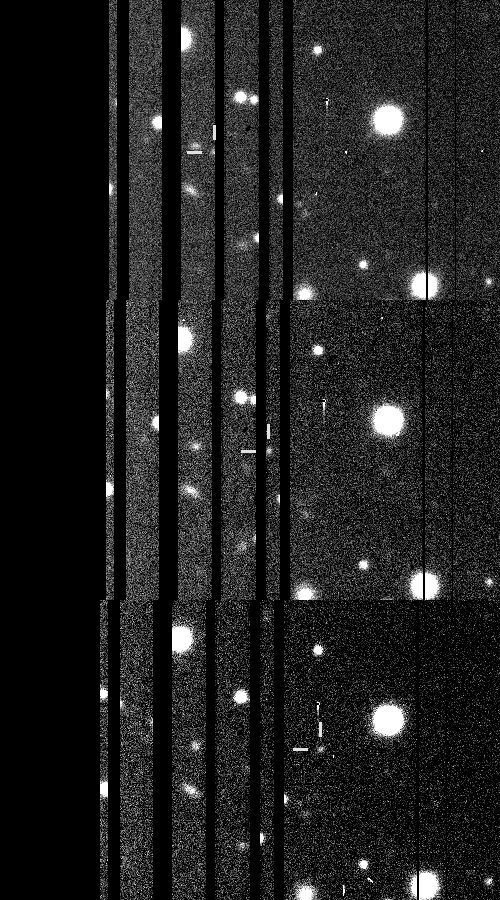

Orbital characteristics
Autonoe follows a retrograde orbit around Jupiter with an orbital period of roughly 772.168 days. Its mean distance from Jupiter (semi-major axis) is about 24,264,000 kilometres. The orbit is inclined close to 151° relative to the ecliptic (approximately 150° relative to Jupiter's equator), and it is notably eccentric, with an orbital eccentricity near 0.369. Those parameters indicate a highly elongated and tilted path that carries the satellite well outside the realm of the regular, near-equatorial moons.
Physical properties
Based on its observed brightness and assumed reflectivity typical of irregular Jovian satellites, Autonoe's diameter is estimated at about 4 kilometres, corresponding to a mean radius near 2 kilometres. At this size the body is expected to be irregular in shape rather than spherical, and surface details are not resolved by current ground-based observations. Photometric data suggest a dark, likely primitive surface composition broadly similar to other outer irregular satellites, although detailed spectral measurements remain limited.
Group membership and origin
Autonoe is classified as a member of the Pasiphaë group, a dynamically related collection of mostly retrograde irregular moons that orbit Jupiter at distances roughly between 22.8 and 24.3 million kilometres and share comparable inclinations. The group is named after its largest member, Pasiphaë, and is thought to represent fragments of a captured progenitor that was later disrupted by collisions or tidal effects. Dynamical studies use the shared orbital elements of group members to infer likely capture epochs and subsequent collisional evolution.
Discovery, naming and mythological association
Following its discovery and orbital determination, the moon received the name Autonoe in August 2003. The name follows the modern nomenclature convention for Jovian retrograde satellites by ending in -e. The name derives from figures in Greek mythology; classical sources vary in details, but Autonoe is associated in some traditions with Zeus and cited by some authors as a mother of the Charites (the Graces). Ancient genealogies are inconsistent, so modern references treat the precise mythological role cautiously.
Observations and scientific significance
Autonoe and similar small irregular satellites are important tracers of the capture and collisional history of the Jovian system. Because these moons are faint, the primary data come from astrometry to refine orbital elements and occasional photometry to estimate size and surface properties. Continued observations can improve knowledge of their long-term orbital stability and any non-gravitational effects. Studies of the Pasiphaë group also help constrain models of how Jupiter captured and subsequently fragmented outer bodies early in the Solar System's history.
Practical notes and catalogue data
Autonoe is not resolved by ground-based imaging beyond a point source; no spacecraft has visited it. Its small size and distance make detailed compositional or geological study difficult with current facilities, so most published information remains limited to orbital parameters and brightness measurements. Researchers interested in irregular satellites typically consult dedicated surveys and the Minor Planet Center for the most up-to-date astrometric listings.
- Designation: S/2001 J 1; permanent name: Autonoe (Jupiter XXVIII)
- Discovery: 2001, team from the University of Hawaii under Scott S. Sheppard
- Estimated diameter: ~4 km (mean radius ~2 km)
- Semi-major axis: ~24,264,000 km
- Orbital period: ~772.168 days (retrograde)
- Inclination: ~151° to the ecliptic
- Eccentricity: ~0.369 (orbital eccentricity)
- Group: Pasiphaë group (Pasiphaë group), irregular, likely non-spherical
- Mythological name origin: references in Greek mythology linked to Zeus and the Charites in some traditions
Further study of Autonoe depends on deeper photometric and spectroscopic observations from large ground-based telescopes and future surveys that may recover fainter members of Jupiter's irregular population. Such work continues to refine our understanding of the outer architecture and history of the Jovian satellite system.
Tags
Related articles
Author
AlegsaOnline.com Autonoe (Jupiter XXVIII) Leandro Alegsa
URL: https://en.alegsaonline.com/art/7624
Sources
- cfa-www.harvard.edu : IAUC 7900: Satellites of Jupiter
- cfa-www.harvard.edu : MPEC 2002-J54: Eleven New Satellites of Jupiter · webcitation.org
- cfa-www.harvard.edu : MPEC 2002-V03: S/2001 J 1
- iau.org : IAU Website: Satellites of Jupiter, Saturn and Uranus
- planetarynames.wr.usgs.gov : USGS Astrogeology: Gazetteer of Planetary Nomenclature - Planetary Body Names and Discoverers · webcitation.org