
Temple of All Religions (Kazan)
Unfinished multi-faith cultural complex in Kazan, Russia, begun by artist Ildar Khanov in 1992. A symbolic assemblage of architectural elements from many religions and a local landmark for visitors and interfaith dialogue.
Overview
The Temple of All Religions is a distinctive cultural and architectural ensemble on the outskirts of Kazan, in Russia. Often called the Universal Temple or by its Russian name, the complex is intended as a symbolic meeting place that brings together elements from many faith traditions. It is best understood as a hybrid cultural centre and work of public art rather than a single functioning house of worship: the site assembles forms and motifs that recall churches, mosques, synagogues and other sacred architectures to express an ideal of coexistence.
Image gallery
8 Images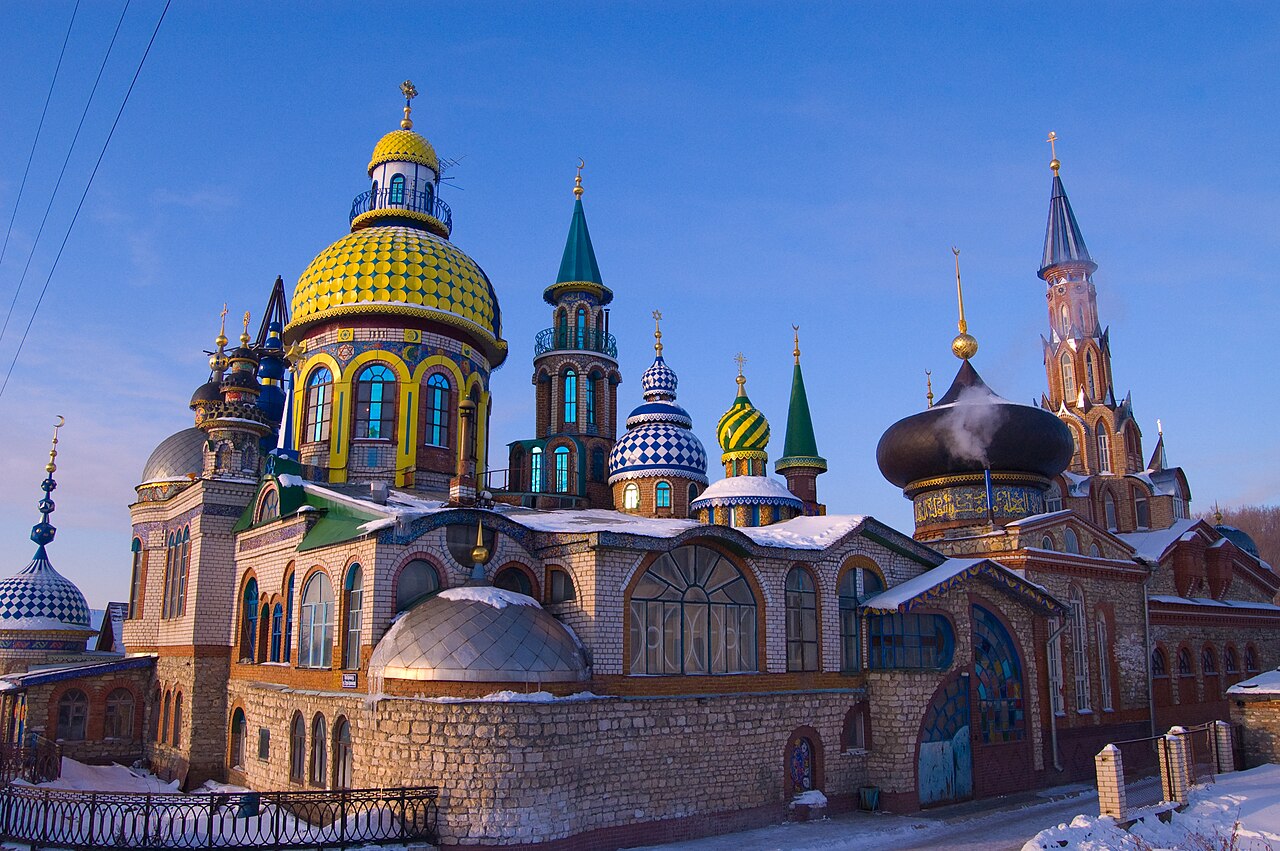


Design and components
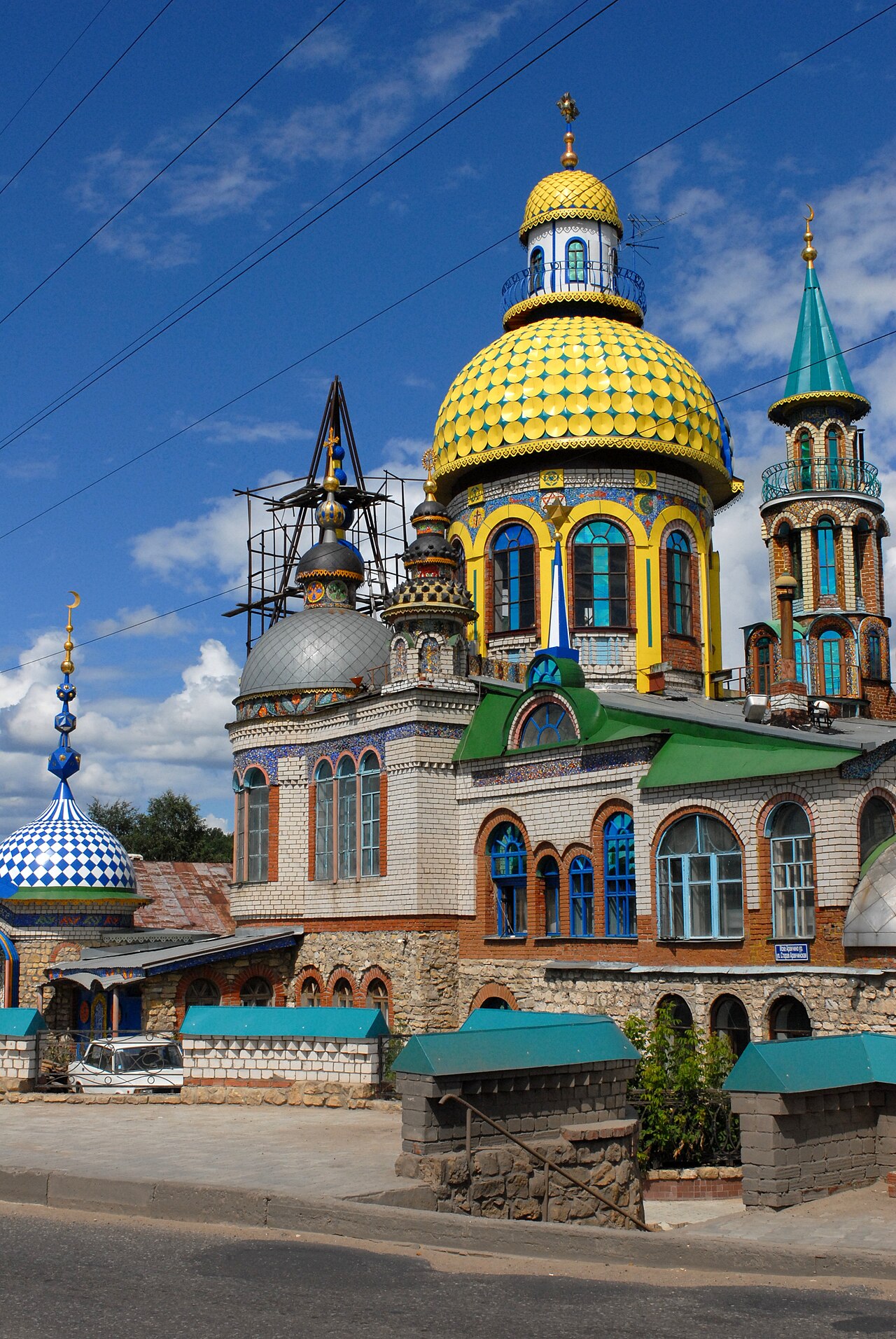
The composition incorporates motifs drawn from a variety of religious building types. Visitors recognise features such as cupolas, arches, towers and decorative façades that evoke an Orthodox church, a mosque, a synagogue and other ritual structures. Rather than functioning as distinct liturgical spaces for each faith, many of the elements are symbolic or serve as exhibition rooms, workshops and communal areas. Descriptions in travel and architectural writing refer to the ensemble as an eclectic structure and emphasise its role as an experimental architectural project that blends styles and iconographies.
History and origins
Construction began in 1992 under the initiative of local artist and philanthropist Ildar Khanov. Khanov conceived the project as a visible symbol of cultural and religious harmony in a region where Tatar Islamic heritage and Russian Orthodox traditions have long coexisted. Work has proceeded in phases and the complex is commonly described as still under construction; additions and decorative details have been added incrementally over the years. The individual-driven nature of the undertaking, rather than sponsorship by a single religious institution, is one reason the site is often framed as a civic and artistic endeavour.
Symbolism and significance
The Temple is intended to be inclusive in spirit. Popular accounts describe plans for multiple cupolas or domes, each intended to represent different faiths; some reports mention a scheme of many domes associated with the world's traditions. Khanov and supporters have presented the project as a celebration of coexistence and as a response to the multicultural character of Tatarstan, where Islamic Tatar culture, Orthodox Russian traditions and other communities intersect. In this way the complex functions as a local emblem of intercommunal dialogue and plural identity rather than as a site for formal interfaith governance.
Uses, visitors and public role
The complex attracts tourists, students of architecture, and people interested in interfaith themes. It hosts exhibitions, small cultural events and displays of local crafts or art, and is often described in guidebooks as a notable photo location and a point of civic pride. Many visitors come to view the eclectic façades, to learn about the project's philosophy, or to seek informal help from Khanov's circle of volunteers and associates. The site is therefore both an artistic installation and a place with modest social outreach functions.
Conservation, status and future
Because construction and embellishment have continued over many years, the appearance of the site changes as new pieces are added; this gradual development is part of its character. The long-running, incremental nature of the work reflects limited funding and the personal commitment of its founder. Public commentary about the Temple typically stresses its unfinished quality while also recognising its value as a cultural landmark and a demonstration of local civic imagination.
Visiting information and practical notes
- The complex is commonly presented in travel literature as a must-see local curiosity; it is not generally used as a regular place of worship but as a cultural centre and exhibition space (religious buildings).
- Because the site remains under development, opening hours, access and on-site activities can vary; visitors are advised to consult current local listings or guides for practical details and event schedules.
- Photography of the exterior and many interior spaces is frequently permitted; respectful behaviour is expected because the project invokes sacred architectural forms and cultural meanings.
- The complex is often discussed in the context of world religions and comparative culture; scholars and commentators use it as an example of contemporary, syncretic civic architecture.
The Temple of All Religions remains notable for its ambition to represent many traditions in one ensemble and for its role as a visible symbol of Kazan's multicultural civic identity. For further contextual information about the site and its founder see materials that address the complex's local history and its continuing, artist-led development (temple, Ildar Khanov).
Related articles
Author
AlegsaOnline.com Temple of All Religions (Kazan) Leandro Alegsa
URL: https://en.alegsaonline.com/art/96914
Sources
- amusingplanet.com : "The Temple of All Religions in Russia"
- commons.wikimedia.org : Temple of All Religions