
Shinto: Japan’s Indigenous Way of the Kami
Shinto is Japan’s indigenous religion focused on kami—divine or spirit presences linked to nature, ancestors and places. It emphasizes rituals, shrines, festivals and the harmony between people and the natural world.
Overview
Shinto (Japanese: 神道) is the native religious tradition of Japan that centers on reverence for kami, spirits or divine forces present in natural phenomena, objects and ancestors. Often described as a form of animism, Shinto lacks a single founder or canonical scripture and is expressed largely through ritual, local practice and community observance rather than doctrinal teaching. Scholars sometimes frame it as a set of practices and sensibilities rather than a belief system in the Western sense (traditions and patterns).
Image gallery
10 Images
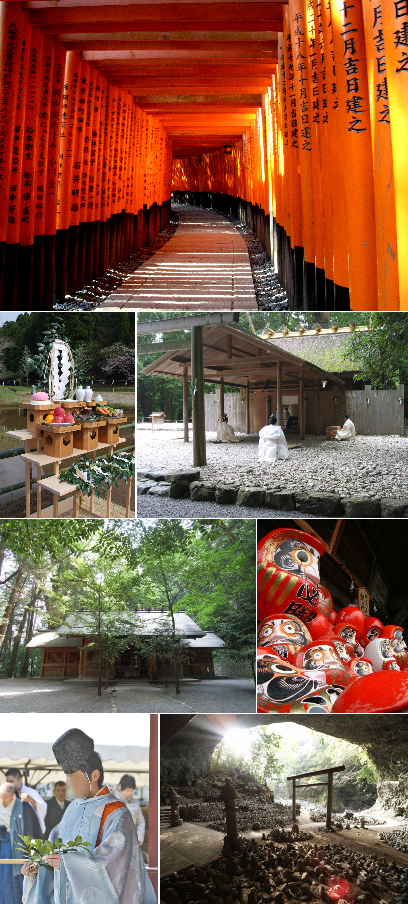


Beliefs and terminology
The term kami has no exact English equivalent. It is frequently rendered as kami (the native word), or translated as gods or nature spirits depending on context. Kami can be powerful mythic figures, such as the sun deity Amaterasu, or local guardian spirits associated with a particular tree, river, mountain, shrine or lineage. Relationships with kami are maintained by acts of care: offerings, purification, and festival observance.
Shrines, rituals and customs
Shinto practice is oriented around shrines and communal rites. A typical shrine features a torii gate marking the boundary between ordinary space and sacred ground, and structures for offerings and purification. Common ritual forms include purification rites (harae), offerings, prayers, and seasonal festivals. Many everyday observances are practical and ceremonial at once, and some Shinto practices are integrated into private life as customary acts (rituals, customs).
- Purification and cleansing
- Offerings and prayers at shrines
- Matsuri (community festivals) marking harvests, seasons and local histories
- Life-cycle rites such as blessings for newborns and weddings
History and State Shinto
Shinto developed over centuries alongside Buddhism and other influences. In the modern era the Meiji state restructured Shinto institutions; from about 1868 to 1945 a form often called State Shinto was promoted by the government. During that period Shinto institutions were used to bolster national identity and imperial authority, and the system was employed for official purposes such as education and public ritual (state propaganda). Military endeavors were sometimes framed in sacred terms (war as duty) and the emperor was publicly represented as divine until the wartime era ended and institutions changed (Emperor). These developments also intersected with Japanese Buddhist institutions (Buddhism) and have been critically examined in modern histories (scholarly studies).
Modern expressions and distinctions
After World War II, official separation of religion and state reduced government control over Shinto shrines, and the tradition continues today in a diversity of forms: local shrine worship, national ceremonies, personal observance and cultural festivals. Shinto often coexists syncretically with Buddhism in Japan, with many people participating in both traditions for different life events. Contemporary Shinto is marked by its practical orientation, attention to seasonal rhythms, and emphasis on maintaining good relations between people, communities and the natural world.
Further reading
For introductions to specific rites, shrine architecture, and regional practices, see linked resources and guidebooks that treat Shinto as a living, locally rooted set of practices rather than a single, uniform creed. Helpful starting points include general overviews, shrine directories and academic summaries for historical context.
More on the term | Animism and context | Traditions | Kami explained | Translations | Nature spirits | Amaterasu | State Shinto | Government use | War and ritual | Emperor | Buddhism | Scholarly works | Ritual practices | Customs and festivals
Related articles
Author
AlegsaOnline.com Shinto: Japan’s Indigenous Way of the Kami Leandro Alegsa
URL: https://en.alegsaonline.com/art/89843