
Animal Scales: Structure, Function and Diversity
An overview of scales in animals: definition, types, development, functions and noteworthy differences among fish, reptiles and insects.
Overview
In zoology, a scale is a small, typically hard plate or modified surface element that forms on an animal's body to serve protection, display or other roles. Scales appear in very different groups: the external plates on fish and reptiles, and the flattened surface elements found on the wings of many insects such as butterflies and moths. They are diverse in form and origin but commonly help an animal interact with its environment.
Image gallery
10 Images


Types and structure
Scales can be composed and arranged in distinct ways. Reptilian scales are primarily keratinized epidermal folds that arise from the skin surface, providing a tough outer layer for animals like reptiles. Fish scales usually have a dermal origin and vary among groups: placoid scales on cartilaginous fishes, ganoid or bony scales in some ancient lineages, and the smoother cycloid or ctenoid scales of many modern bony fish. In insects, scales are modified hairs or setae that cover the wing membranes of many lepidopterans and act more like tiny plates than the mineralized scales of vertebrates.
Development and evolution
Developmental pathways differ: reptile scales form from the epidermis; fish scales commonly develop within the dermis as ossified or odontogenic elements; insect wing scales are epidermal outgrowths. These origins mean similar-looking structures evolved independently (convergent features) in multiple lineages. For example, feathers and hair are also epidermal derivatives related in developmental terms to reptile scales, and feathers are widely considered to have evolved from ancestral reptilian integument.
Functions and examples
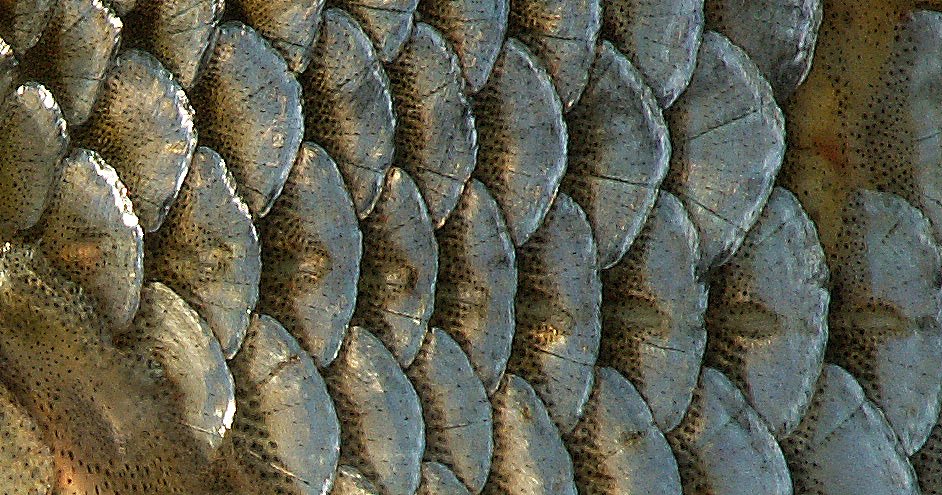
Scales provide mechanical protection, reduce water loss, aid locomotion and contribute to coloration. In fish such as fish, overlapping scales streamline the body and act as a barrier to parasites. Reptilian scales can offer armor-like defense and help retain moisture on land. On butterfly and moth wings, scales produce vivid patterns by pigment and microscopic structure, serving in camouflage, signaling and thermoregulation. Scales also appear in specialized contexts—turtle shells retain large scutes derived from similar tissues—illustrating functional variation.
Notable distinctions
- Origin: epidermal (reptiles, insects) versus dermal (many fish).
- Composition: keratinous plates in reptiles, bony or dentine-like materials in some fish, chitinous or membranous plates in insects.
- Role in color: pigmentation versus structural coloration; insect scales often produce iridescent effects through microstructure.
When studying surface coverings it helps to contrast scales with related structures such as scutes, plates and feathers to understand how similar functions arise from different tissues. For further general information see entries in broader biological references on animal integument and skin, or specific treatments of insect wing morphology and of zoological integumentary systems.
Related articles
Author
AlegsaOnline.com Animal Scales: Structure, Function and Diversity Leandro Alegsa
URL: https://en.alegsaonline.com/art/87750