
Scelidosaurus — an early armoured herbivorous dinosaur
Scelidosaurus, a basal thyreophoran from the Early Jurassic of England, is known from well-preserved skeletons. Its anatomy, armour, diet and basal position illuminate early armoured-dinosaur evolution.
Overview
Scelidosaurus is a genus of early, lightly armoured herbivorous dinosaur best known from fairly complete skeletons collected from Lower Jurassic rocks on the southern English coast. It lived during the Early Jurassic (roughly 196–183 million years ago) and grew to about four metres in length. Because several specimens preserve much of the skeleton and body armour, Scelidosaurus is frequently cited as one of the earliest largely complete dinosaur fossils, providing important anatomical information about the early evolution of ornithischian dinosaurs.
Image gallery
10 Images




Anatomy and armour
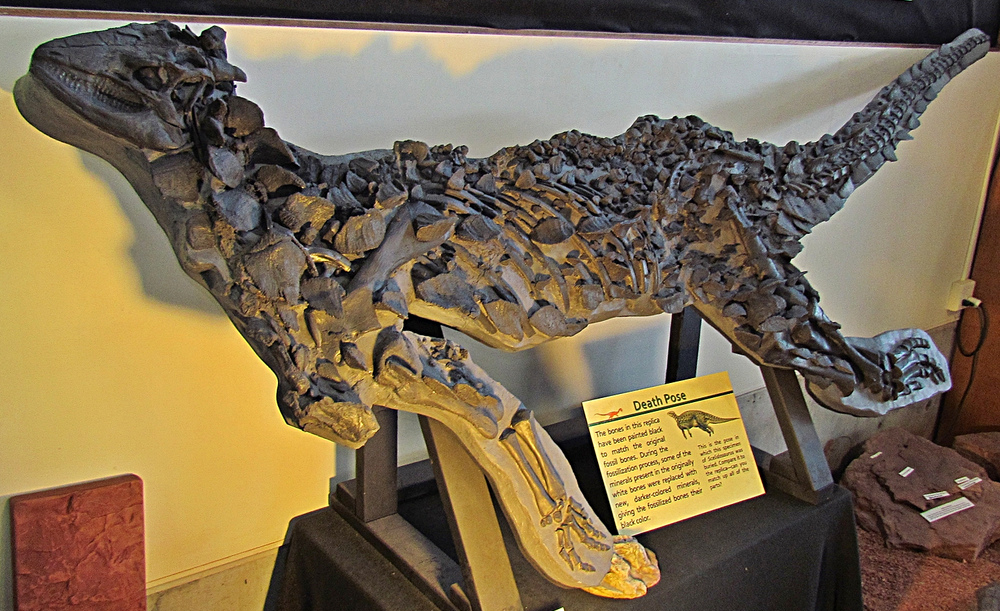
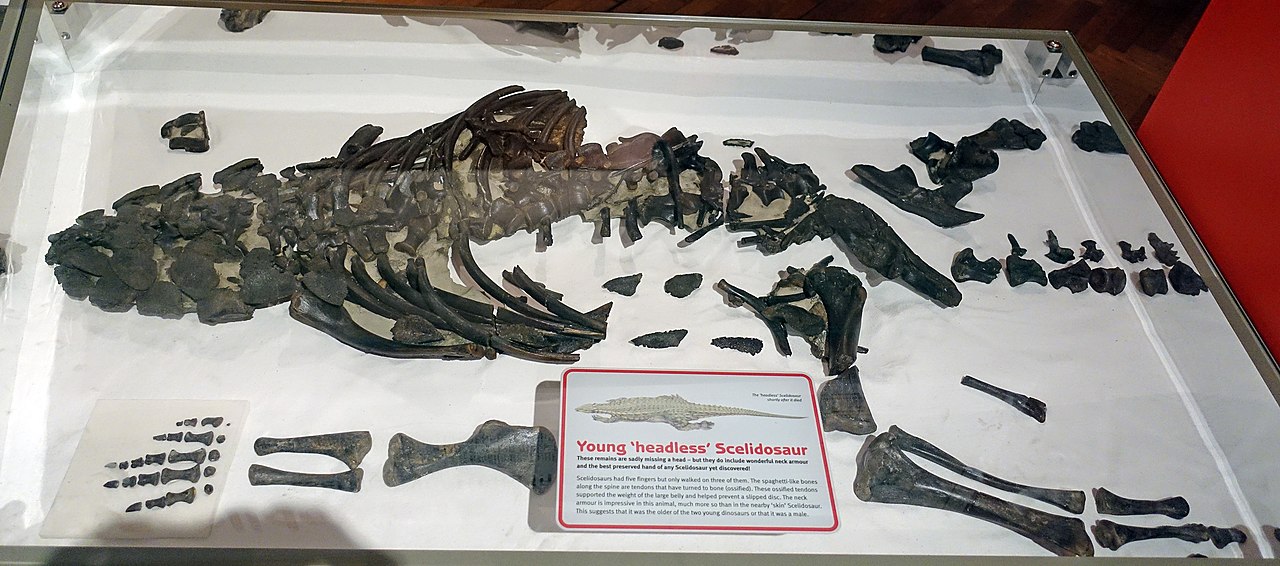
As a member of the armoured-dinosaur group, Scelidosaurus belongs to the Thyreophora (Thyreophora) and displays rows of osteoderms (bony scutes) running along the body. These osteoderms are numerous but were not arranged into the highly derived plates or tail clubs that appear later in stegosaurs and ankylosaurs. The skeleton shows a robust, relatively low-slung body with limb proportions indicating a primarily quadrupedal stance: hindlimbs were longer than the forelimbs, yet the forefeet were substantial and capable of supporting weight. The skull was relatively small with simple leaf-shaped teeth suited for cropping vegetation rather than complex chewing.
Feeding, dentition and digestion
Scelidosaurus was herbivorous but retained primitive dental features compared with later ornithischians. Teeth were less complex and the jaw motion appears to have been mainly vertical rather than the sophisticated grinding seen in some later herbivores. Because of this limited oral processing, paleontologists have suggested that Scelidosaurus and similar taxa may have used gastroliths (swallowed stones) to help break down plant material, a behaviour also found in several modern bird and reptile groups. Likely foods included low-growing plants such as ferns and cycads; coastal vegetation and even seaweed have been proposed as occasional items. It could not have eaten modern grass, which did not appear until much later, during the Cretaceous.
Locomotion and posture
The limb proportions and foot anatomy indicate Scelidosaurus was primarily quadrupedal. The relatively long hindlimbs suggest it could adopt a bipedal posture for short periods, such as rearing up to reach higher foliage, but the stout forelimbs and heavy armour imply a mostly four-legged gait. Trackway evidence from related early thyreophorans supports a generally slow-moving, stable locomotion adapted to a herbivorous lifestyle on floodplains and coastal plains.
Classification and evolutionary significance
Scelidosaurus is considered one of the most basal or primitive members of Thyreophora. Because it retains a mixture of generalized ornithischian features and early armoured specializations, it occupies an important position near the base of the group and is often used to test hypotheses about the origins of skin armour and the divergence of major thyreophoran lineages. Some phylogenetic analyses have recovered Scelidosaurus as close to the common ancestor of Stegosauria and Ankylosauria, while other studies place it in slightly different basal positions; overall it remains central to debates about early armoured-dinosaur relationships (basal positions).
Discovery, age and geographic distribution
Specimens of Scelidosaurus were first described from exposures near Charmouth along the Dorset coast of southern England. The type and many referred specimens come from early Jurassic marine-influenced sediments, preserving animals that lived on nearby coastal plains and lowlands. The Dorset locality (Charmouth) in Dorset, England remains a classic site for Early Jurassic vertebrate fossils. During the Early Jurassic the genus inhabited parts of the northern landmass known in paleogeographic reconstructions as Laurasia (Laurasia being the northern supercontinent in which Europe lay), occurring in environments with abundant ferns and other low vegetation.
Paleobiology and ecology
In life, Scelidosaurus would have been a slow-moving, low-browser that relied on its armour for defence against predators. Its teeth and jaw structure indicate a diet of relatively soft vegetation. The presence of gastroliths in comparable animals and the composition of associated plant fossils support reconstructions of a diet based on ferns, horsetails and cycads. These ecological traits place Scelidosaurus among the typical herbivores of Early Jurassic ecosystems, contributing to nutrient cycling and serving as prey for contemporaneous theropods.
Importance and continuing research
Because several Scelidosaurus specimens preserve much of the skeleton, this genus has been described as one of the earliest substantially complete dinosaurs, making it a keystone taxon for studies of early ornithischian morphology and the emergence of body armour. Ongoing work—re-examination of historical specimens, new field discoveries, and modern imaging and phylogenetic methods—continues to refine details of its anatomy and evolutionary relationships. For introductory overviews and specialized discussions, see resources on armour and plating and reviews addressing basal thyreophoran positions. Comparative context is provided in treatments of Stegosauria and Ankylosauria.
Selected points
- Length about four metres, primarily quadrupedal with longer hindlimbs.
- Light dermal armour composed of osteoderms rather than large plates or clubs.
- Simple teeth and vertical jaw action suggest limited chewing and possible use of gastroliths.
- Known from Early Jurassic deposits near Charmouth, Dorset, England, and inhabited lowland coastal habitats on Laurasia.
Questions and answers
Q: What type of dinosaur was Scelidosaurus?
A: Scelidosaurus was a lightly plated, herbivorous dinosaur.
Q: When did Scelidosaurus live?
A: Scelidosaurus lived during the early Jurassic period, from 196 to 183 million years ago.
Q: Where were fossils of Scelidosaurus found?
A: Fossils of Scelidosaurus were found in Charmouth, Dorset, England.
Q: How long was the length of a typical Scelidosaurus?
A: A typical Scelidosaurus had a length of about 4 metres (13 ft).
Q: Was the posture of a Scelidosaurs mostly quadrupedal or bipedal?
A: The posture of a Scelidosaurs was mostly quadrupedal. Its forefeet were as large as its hind feet which suggests that it reared up on its hind legs to browse on foliage from trees but mainly walked on all fours.
Q: What type of food did they eat?
A: They ate low-lying plants like ferns and cycads and may have also eaten seaweed. Grass had not yet evolved during this time period so they could not have eaten grass.
Q: How did they process their food since they lacked chewing ability?
A: It is suggested that they swallowed gastroliths to aid in processing their food, similar to how modern birds and crocodiles do today.
Related articles
Author
AlegsaOnline.com Scelidosaurus — an early armoured herbivorous dinosaur Leandro Alegsa
URL: https://en.alegsaonline.com/art/87818
Sources
- web.me.com : Stegosaurs
- wikidata.org : Q18862
- species.wikimedia.org : Scelidosaurus
- fossilworks.org : 38801
- gbif.org : 4823038
- irmng.org : 1097015