
Salvia pratensis (Meadow Clary): description, habitat and uses
Salvia pratensis is a perennial wild sage native to Europe, western Asia and North Africa, known for its blue-purple bilabiate flowers, opposite leaves, meadow habitats, and use in ornamental and wildlife plantings.
Overview
Salvia pratensis, commonly called meadow clary or meadow sage, is a herbaceous perennial in the mint family. It is closely related to other garden sages and is sometimes linked with the name Salvia virgata in older sources. The plant belongs to the group broadly known as sage and to the family Lamiaceae, often referred to as the mint family. Meadow clary is valued for its upright flower spikes and its role in naturalistic planting schemes.
Image gallery
4 Images


Description and distinguishing features
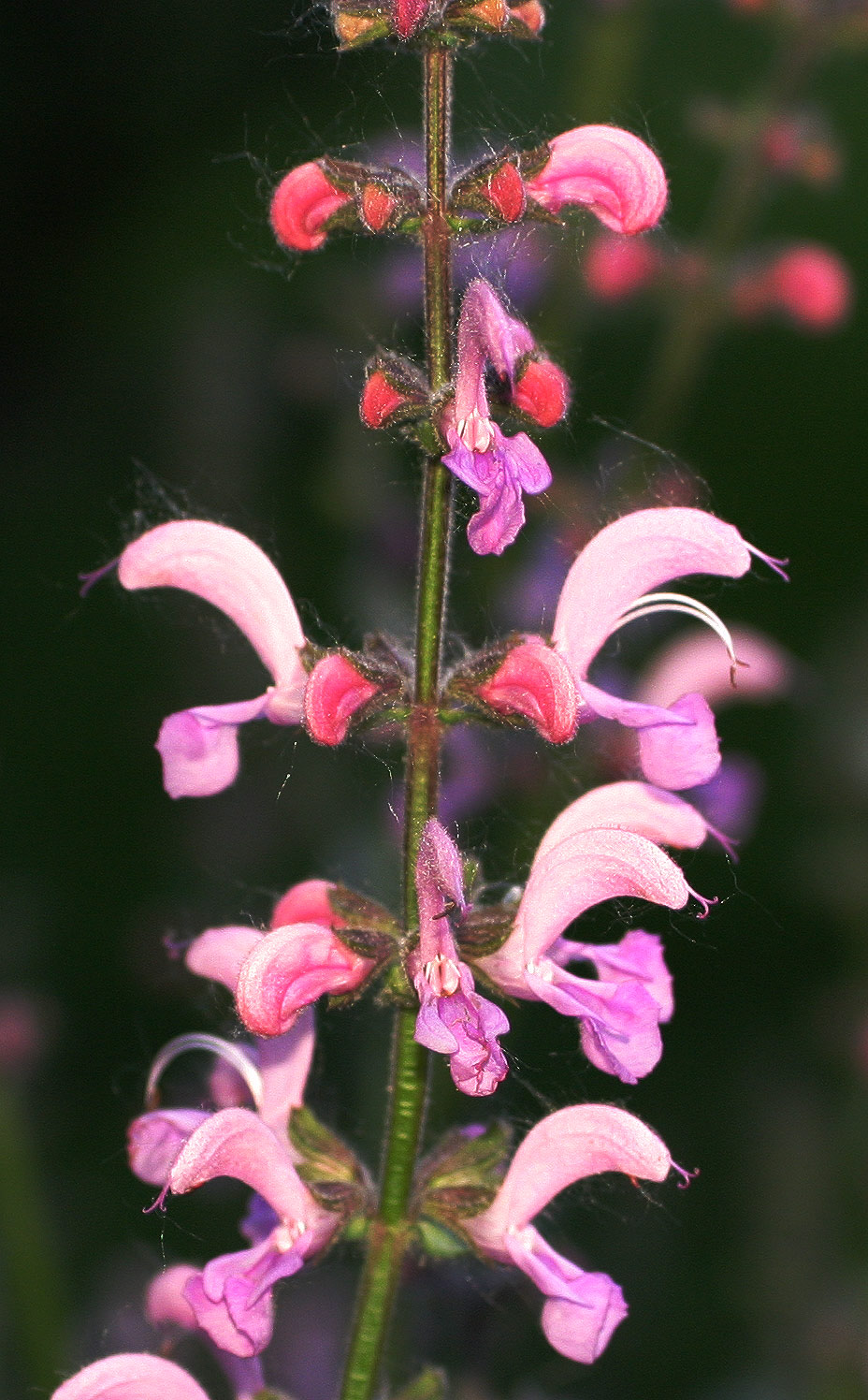
Salvia pratensis typically grows to about 1–1.5 m tall and dies back to ground level in winter while regrowing from the crown in spring. Leaves are arranged in opposite pairs along the stem; the lower foliage forms larger, stalked leaves while those higher on the stem become smaller. The plant bears whorled inflorescences of bilabiate, tubular blooms that are usually deep blue to purple, though pink or white variants occur. The structure of the corolla and the opposite leaves are characteristic of many members of the mint family.
- Leaves: opposite, often hairy, larger near the base (leaf details).
- Flowers: two-lipped, arranged on spikes, typically purple (flower form).
- Height: up to about 1.5 m in favorable conditions.
Habitat and distribution
Native across much of Europe, extending into western Asia and parts of northern Africa, meadow clary favors open, well-drained sites. It is commonly found in unimproved grassland and meadow habitats as well as at the edges of scrub and woodlands. Typical locations include calcareous or neutral soils that have not been intensively fertilized or cultivated (unimproved soils). It is a regular component of traditional grasslands, often occurring near scrub edges and on woodland borders.
Cultivation, uses and ecological role
Gardeners cultivate Salvia pratensis as an ornamental for borders, wildflower meadows and pollinator-friendly plantings. It is valued for nectar and pollen and attracts bees, butterflies and other beneficial insects. Propagation is typically by seed or by dividing established clumps. Plants prefer a sunny position with good drainage and moderate fertility.
Beyond ornamental use, meadow clary has been included in seed mixes aimed at habitat restoration and biodiversity enhancement. In gardens it is often grown alongside other meadow species to create long-flowering displays and to support wildlife.
History and notable distinctions
Historically associated with traditional hay meadows and pastoral landscapes, Salvia pratensis has cultural resonance as a meadow species rather than a culinary sage. It is distinct from the culinary Salvia officinalis, though both share the bilabiate flowers typical of the genus. Taxonomic treatments vary, and the species has been treated differently in regional floras; for details on naming and synonyms see sources that discuss Salvia virgata and related taxa. For practical gardening guidance and conservation context, many horticultural and botanical references list it among useful ornamental plants for naturalistic planting.
Further reading and regional floras provide more on identification, ecology and management; useful entry points include general pages on Lamiaceae, plant lists for Europe and guides to restoring grasslands. Additional regional notes may be found in materials covering western Asia, northern Africa and habitat-specific resources such as those addressing unimproved soils and woodland borders.
Related articles
Author
AlegsaOnline.com Salvia pratensis (Meadow Clary): description, habitat and uses Leandro Alegsa
URL: https://en.alegsaonline.com/art/86592