
Sapindaceae (soapberry family)
Sapindaceae, the soapberry family, is a diverse group of flowering plants including maples, horse chestnuts, lychee and longan; important ecologically and economically across tropical and temperate regions.
The Sapindaceae, commonly called the soapberry family, is a large and varied group of flowering plants found from tropical lowlands to temperate woodlands. Modern treatments place the family in the order Sapindales. It comprises a wide range of growth forms—trees, shrubs, lianas and some herbaceous species—and contains many species of ecological and economic importance. For an overview see Sapindaceae.
Image gallery
9 Images


Characteristics
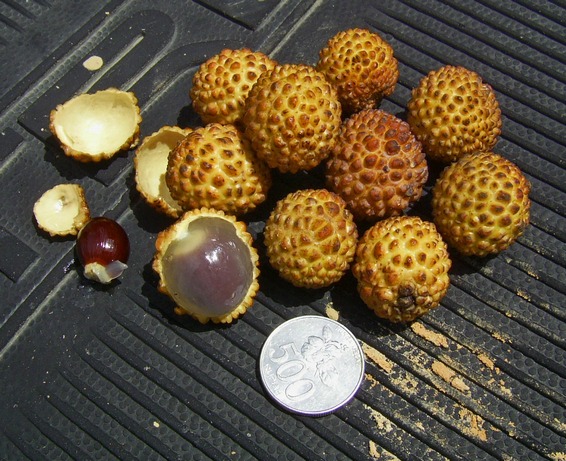
Members of the family typically have alternate leaves that are simple to pinnately or palmately compound. Flowers are generally small, often arranged in panicles, and may be bisexual or unisexual. Fruits vary greatly across the family: maples produce winged samaras, some species yield capsules or drupes, and several tropical genera form fleshy fruits with an aril that surrounds the seed. Many species contain saponins or other compounds that can create a soapy foam when fruits or seeds are rubbed in water, which is the origin of the common name.
Taxonomy and development
Historically, distinct groups such as the maples and horse chestnuts were placed in their own families (Aceraceae and Hippocastanaceae). Molecular phylogenetic studies led to a broader circumscription: since the early 21st century these groups have generally been included within Sapindaceae. This reclassification unites familiar genera such as Acer (maples) and Aesculus (horse chestnuts) under one family, reflecting evolutionary relationships rather than just morphological similarities.
Overall the family comprises around a hundred or more genera and many hundreds to over a thousand species, with highest diversity in tropical regions but notable temperate representatives.
Uses and importance
Sapindaceae includes several cultivated fruit trees valued for their edible arillate fruits, for example lychee and longan. Other members are planted as ornamentals (maples and horse chestnuts), provide timber, or are used in traditional medicines. Some species are harvested for surfactant-like compounds in berries that have been used historically as natural soaps.
Ecologically, sapindaceous plants play roles in forest canopies and understories, providing food for birds and mammals that disperse seeds. Their varied fruit and seed types reflect diverse dispersal and pollination strategies.
Distinctions and identification tips
- Look for leaf arrangement and leaf complexity—maples are distinctive with palmate leaves, while many tropical genera have pinnate leaves.
- Examine the fruit—winged samaras point to maples, fleshy arillate fruits suggest tropical Sapindaceae.
- Note any soap-like properties of crushed fruits or seeds, which can indicate the presence of saponins.
Representative genera to explore further include Acer, Aesculus, and cultivated fruit genera such as Litchi and Dimocarpus. For additional resources on classification and species accounts see family-level treatments and broader summaries of the order Sapindales.
Related articles
Author
AlegsaOnline.com Sapindaceae (soapberry family) Leandro Alegsa
URL: https://en.alegsaonline.com/art/87265