
Q*bert
Q*bert is a 1982 isometric arcade puzzle game by Gottlieb in which a hopping protagonist changes cube colors on a pyramid while avoiding enemies. It spawned many ports, sequels and cultural references.
Overview
Q*bert is an early 1980s arcade classic first released by Gottlieb in 1982. In its original form it was a coin-operated arcade video game built around a simple but distinctive premise: guide a small, orange, long-nosed creature across an isometric stack of blocks and change their colors by landing on them. The title combined fast, reflex-driven play with an immediately recognizable main character and a bright, minimalist presentation.
Image gallery
10 Images



Gameplay and mechanics
Levels in Q*bert take place on a stepped isometric pyramid of staggered cubes. The player controls Q*bert as he hops diagonally from cube to cube; each landing alters the color or state of that cube until the entire playfield matches a target color or pattern. While the basic goal is straightforward, the game adds layers of challenge through timed sequences, color reversals, and additional objectives on later stages. Falling off the sides of the pyramid costs a life, as do contact with hostile creatures and projectiles.
Characters and hazards
The game populates its pyramid with a variety of enemies and obstacles that require different avoidance or defeat strategies. The most famous is Coily, a snake that starts as a bouncing ball and becomes lethal when it transforms and chases Q*bert. Other adversaries include Wrong-Way and Ugg, which move on the sides of the cubes, and the mischievous Slick and Sam who can change cubes back to undesirable colors. Several later releases and remakes introduced many more themed variants and allies; the modern reboot and licensed titles expanded the roster with playful takes on the core cast.
- Enemies commonly seen: Coily, Ugg, Wrong-Way, Slick, Sam
- Additional variants (introduced later): many reboots added thematic and humorous characters derived from the original design
Ports, releases and notable editions
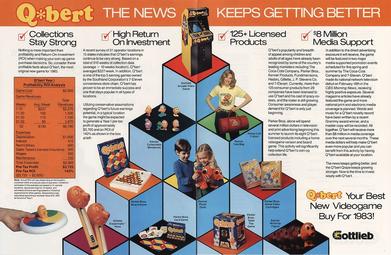
Because of its popularity in arcades, Q*bert was widely ported to home systems of the early 1980s and beyond. Home versions appeared on numerous consoles and computers including ports for the Atari 2600, ColecoVision and Commodore 64. The arcade original was reportedly successful in its era, with contemporaneous estimates of tens of thousands of cabinets produced. Over time Q*bert was bundled in retro collections, reissued on modern platforms, and adapted into several sequels and licensed tie-ins.
Development, releases and revivals
Gottlieb—better known at the time for pinball machines—designed Q*bert around a concise design ethic: one clear objective per screen, new challenges introduced incrementally, and a character with instant appeal. That design proved durable; Q*bert has been revived in various forms, including a 2014 title sometimes referenced as Q*bert Rebooted, which reshuffled and enlarged the cast with playful, themed names and modernized visuals while retaining the core jump-and-color gameplay loop.
Legacy and cultural impact
Q*bert remains one of the iconic figures of classic arcade culture. Its simple rules and memorable protagonist made it a frequent presence in compilations, museum retrospectives, and popular culture — including cameos in films about gaming and animated homages. Designers and historians point to Q*bert as an early example of how tight rules and a strong visual identity can produce a game that endures well beyond its original hardware.
For further information about variations, ports and retrospectives, see dedicated resources and collections that catalog arcade history and home conversions.
arcade | video game | cubes | pyramid | consoles | Atari 2600 | ColecoVision | Commodore 64
Related articles
Author
AlegsaOnline.com Q*bert Leandro Alegsa
URL: https://en.alegsaonline.com/art/80267
Sources
- arcade-museum.com : "Q*bert Videogame by Gottlieb (1982)"