
Orbital eccentricity
Orbital eccentricity measures how much an orbit deviates from a perfect circle, classifying conic-section trajectories and influencing apses, energy, and orbital behavior.
Overview
Orbital eccentricity is a dimensionless parameter used in astrodynamics and celestial mechanics to express how an object's orbit differs from a perfect circle. It is one of the classical orbital elements that helps categorize paths traced under gravity into circular, elliptical, parabolic or hyperbolic trajectories. The value and orientation of eccentricity affect periapsis and apoapsis distances, the shape of the orbit, and how a body moves along that path.
Image gallery
5 Images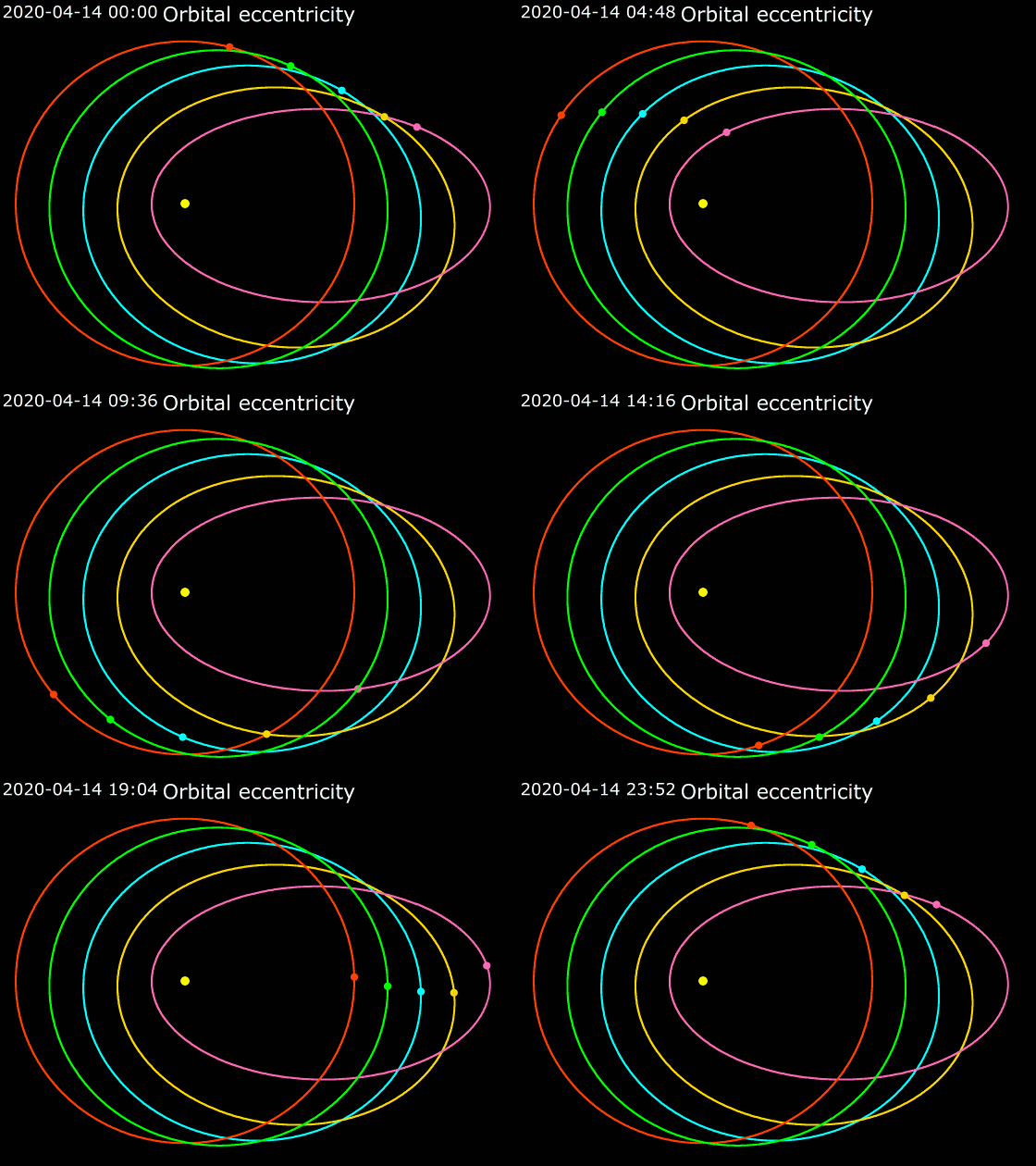



Definition and classification
Symbolized by the lowercase letter e, eccentricity is defined for all conic-section orbits. Its magnitude indicates the deviation from circularity and leads to the standard classification:
- e = 0: a perfect circle;
- 0 < e < 1: an ellipse (bound orbit);
- e = 1: a parabola (marginally unbound trajectory);
- e > 1: a hyperbola (unbound trajectory).
Key properties and relations
Geometrically, eccentricity is the ratio that arises from conic-section definitions. In orbital mechanics its value equals the length of the eccentricity vector, which points from the focus toward periapsis. For an elliptical orbit with semimajor axis a, the closest and farthest distances from the central body are r_peri = a(1-e) and r_apo = a(1+e). The sign and magnitude of the total specific orbital energy also correlate with these categories: bound orbits have negative energy (ellipses), zero corresponds to parabolic motion, and positive energy to hyperbolic escape paths.
Historical context
The concept traces back to the study of conic sections in ancient geometry and was brought into astronomy through efforts to model planetary motion. Johannes Kepler’s recognition that planets follow elliptical orbits replaced earlier circular models and made eccentricity a central descriptor. Later, Newton’s law of universal gravitation provided the dynamic explanation that conic-section trajectories arise naturally from inverse-square forces.
Uses and examples
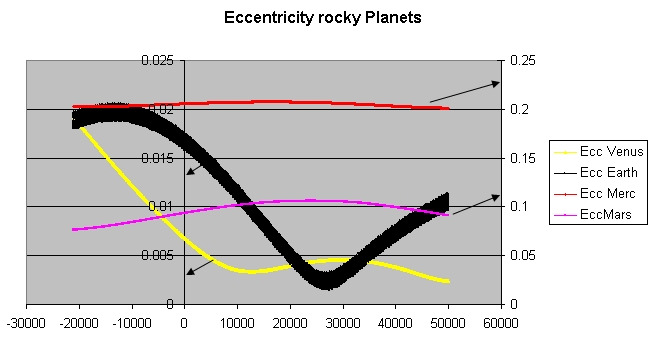
Eccentricity is used in mission design, long-term orbital stability studies, and in describing natural systems. Spacecraft trajectories are selected by eccentricity to meet mission goals such as close flybys or insertion into bound orbits. In planetary science, the small eccentricities of most major planets make their seasons and climates more regular, whereas many comets and some small bodies have high eccentricity, producing dramatic changes in solar distance during each passage. The element is also central to understanding binary stars and exoplanet orbits.
Notable facts and distinctions
Small changes in eccentricity can substantially change distances at periapsis and apoapsis, altering surface temperatures and tidal effects for natural satellites. While many solar system planets have near-circular paths, objects like long-period comets often approach e ≈ 1, appearing on near-parabolic trajectories. Accurate measurement of eccentricity, combined with other orbital elements, fully determines the shape and orientation of an orbit in space.
Further reading: astrodynamics overview, orbital elements, or introductions to circles, ellipses, parabolas, and hyperbolas.
Related articles
Author
AlegsaOnline.com Orbital eccentricity Leandro Alegsa
URL: https://en.alegsaonline.com/art/72976