
Proxima Centauri — the nearest star to the Sun
Proxima Centauri is a nearby red dwarf star in the constellation Centaurus. It is the closest known star to the Sun and hosts at least one Earth-sized planet; it is notable for strong stellar flares and scientific interest.
Overview
Proxima Centauri is a small red dwarf star that lies at the shortest interstellar distance from the Sun. It is considered part of the wider Alpha Centauri system and is commonly described as the closest star to our Solar System, at a distance of roughly 4.2 light‑years. Visually it sits in the southern sky within the constellation Centaurus. Because Proxima is intrinsically faint, it cannot be seen without a telescope from Earth.
Image gallery
10 Images






Physical characteristics
Proxima Centauri is much smaller and cooler than the Sun. Its spectral type is commonly given as a late‑type M dwarf (often noted as M5.5V), which implies a low luminosity and surface temperature compared with solar‑type stars. Estimates place its mass at only a small fraction of the Sun’s—roughly one‑tenth to one‑eighth—and its radius is similarly reduced. The star’s apparent magnitude is around 11, so it requires optical aid to observe.
Activity and variability
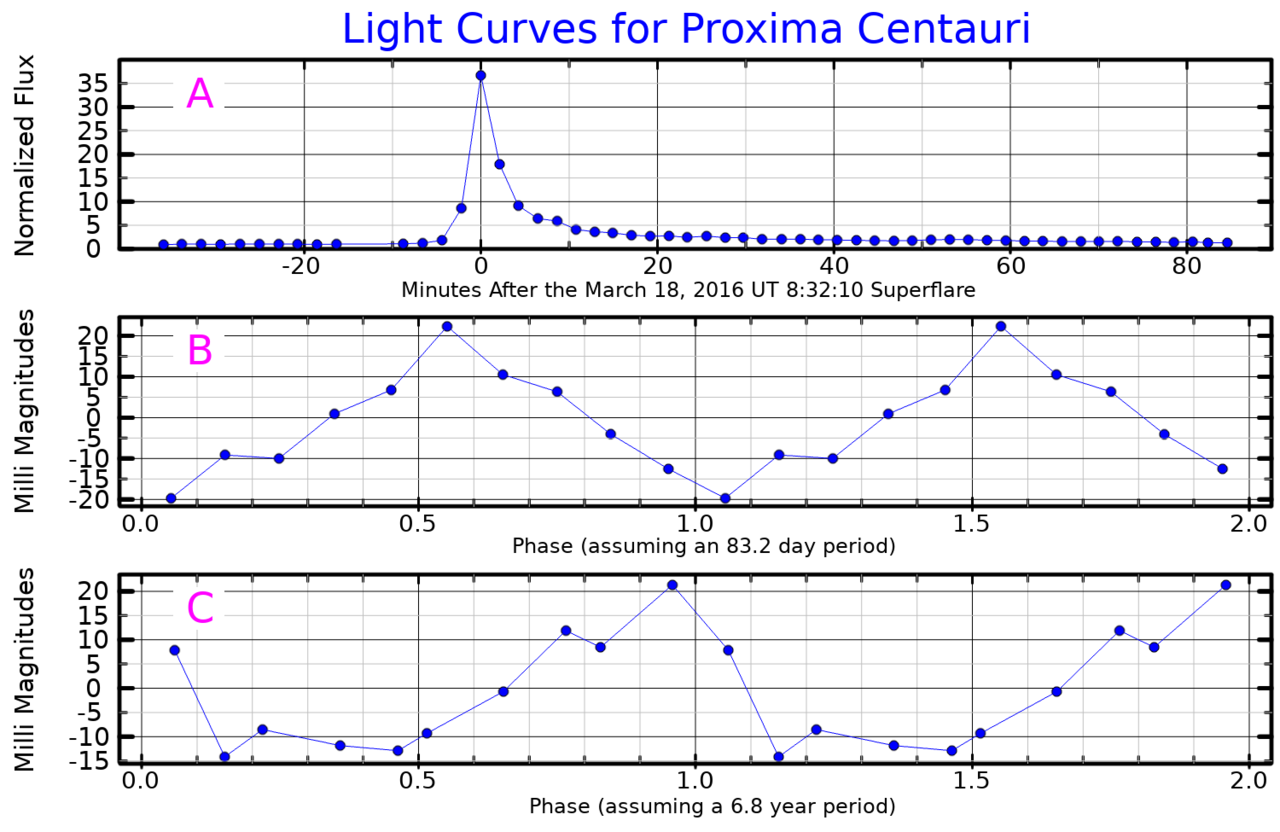
Proxima is an active, variable star that frequently produces energetic outbursts. Historically it has been classified as a flare star, meaning that its magnetic activity can cause sudden increases in brightness and high fluxes of charged particles. These flares make Proxima a subject of interest for stellar astrophysics and also a complicating factor when assessing the environment around any orbiting planets.
Discovery and association with Alpha Centauri
The star was identified as sharing motion across the sky with the Alpha Centauri pair early in the 20th century. In 1915, astronomer Robert Innes noted that Proxima’s proper motion matched that of Alpha Centauri, suggesting a physical association rather than a chance alignment. This connection was observed while Innes worked at the Union Observatory in South Africa, and the shared motion is often described in terms of proper motion studies. Today Proxima is generally treated as a distant, loosely bound companion to Alpha Centauri A and B, orbiting the pair on a very long, wide trajectory.
Planets and habitability
Around 2016 astronomers reported an Earth‑sized planet in orbit around Proxima, located near the star’s temperate zone. That planet, commonly referred to as Proxima b, has generated significant discussion because of its proximity and because it lies where liquid water could conceivably exist under the right conditions. At the same time, Proxima’s flare activity, tidal effects, and stellar wind raise questions about atmospheric retention and surface habitability. Additional candidate bodies, including a possible longer‑period companion, have been proposed but remain under study.
Scientific importance and future study
Being the nearest stellar neighbor makes Proxima Centauri a natural focus for many lines of research. It is a prime target for precise radial‑velocity monitoring, transit searches, and direct imaging efforts. The star is also an attractive target for conceptual interstellar missions and technical studies aimed at probes or communication; proposals such as small‑satellite concepts that could reach the Alpha Centauri region have highlighted Proxima as a potential destination. Continued observations aim to refine knowledge of its planets, magnetic behavior, and long‑term orbital relationship with the Alpha Centauri pair.
Key facts
- Type: red dwarf (M class).
- Association: part of the Alpha Centauri system and the constellation Centaurus.
- Nearest known star to the Sun and target of extensive study.
- Noted in early 20th century proper‑motion work at the Union Observatory in South Africa (proper motion measurements).
- Active magnetically and classified as a flare star.
- Hosts at least one confirmed planet and remains a focus of exoplanet searches.
Questions and answers
Q: What is Proxima Centauri?
A: Proxima Centauri is a red dwarf star that is likely a part of the Alpha Centauri star system and is the closest star to the Sun at a distance of 4.22 light-years (3.99×10¹³ km; 2.48×10¹³ mi).
Q: Where is Proxima Centauri located?
A: Proxima Centauri is in the constellation of Centaurus.
Q: Who discovered that Proxima Centauri shared the same proper motion as Alpha Centauri?
A: Robert Innes discovered that Proxima Centauri shared the same proper motion as Alpha Centauri in 1915 while he was Director of the Union Observatory in Johannesburg, South Africa.
Q: When did Harlow Shapley say that Proxima Centauri was a flare star?
A: Harlow Shapley said that Proxima Centauri was a flare star in 1951.
Q: How often does Proxima Centuari become measurably brighter?
A: Recorded photographs showed that Proxima Centuari becomes measurably brighter about 8% of the time, making it the most active flare star then found.
Q: How far away from Earth is Proximia Centuari?
A: The distance between Earth and Pr
Related articles
Author
AlegsaOnline.com Proxima Centauri — the nearest star to the Sun Leandro Alegsa
URL: https://en.alegsaonline.com/art/79772
Sources
- ui.adsabs.harvard.edu : 2001A&A...379..634G
- doi.org : 10.1051/0004-6361:20011330
- ui.adsabs.harvard.edu : 1994QJRAS..35....1M
- phl.upr.edu : phl.upr.edu
- space.com : space.com/39829-nearest-exoplanet-proxima-b-superflare.html
- phys.org : "Planet in star system nearest our Sun 'may have oceans'"