
Ecliptic — the plane of Earth's orbit and the Sun's apparent path
The ecliptic is the plane of Earth's orbit and the Sun's apparent annual path among the stars. It defines the zodiac, underlies the ecliptic coordinate system, and tilts relative to other reference planes.
Overview
The ecliptic is the geometric plane defined by Earth's orbit around the Sun. From the surface of Earth the Sun appears to travel along a single great circle on the celestial sphere over the course of a year; that apparent path is called the ecliptic. This plane is commonly described as the Earth's orbital plane.
Image gallery
10 Images






Geometry and key properties
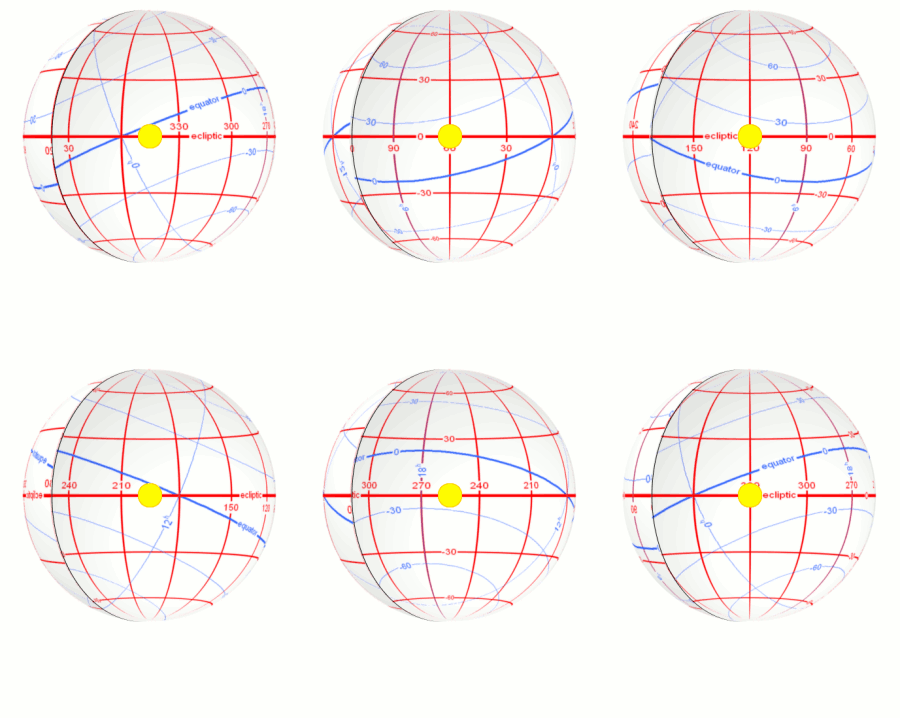
The ecliptic is inclined to the celestial equator by the obliquity of the ecliptic, approximately 23.44°, which is the tilt responsible for the seasons. The two intersections of the ecliptic and the celestial equator mark the vernal and autumnal equinoxes, when day and night are of almost equal length. Perpendicular to the ecliptic are the ecliptic poles, used in some astronomical coordinate systems.
Coordinates, nodes and eclipses
A commonly used coordinate system in astronomy uses the ecliptic as its fundamental plane: ecliptic longitude and latitude locate objects relative to this plane. The Moon's orbit is inclined a few degrees to the ecliptic, so the points where it crosses the ecliptic are called nodes. Solar and lunar eclipses occur only when a new or full Moon happens near one of these nodes.
Relation to the rest of the Solar System
The ecliptic is not the same as the Solar System's invariable plane, which represents the average plane of all planetary orbits determined by the system's total angular momentum. The invariable plane passes through the system barycenter (center of mass) and can be referenced as the invariable plane defined through the solar system barycenter. At present the ecliptic is inclined by about 1.5° to the invariable plane.
History and importance
Ancient astronomers recognized the ecliptic as the path of the Sun and used it to define the zodiac—twelve traditional sectors of the sky associated with constellations. In modern astronomy the ecliptic remains important for planetary ephemerides, celestial navigation, calendar definitions and understanding seasonal cycles. Slow changes in Earth's axis (precession, with a period of roughly 26,000 years) cause the orientation of the ecliptic relative to the fixed stars to change over long timescales.
Notable facts and uses
- The zodiacal constellations lie along or near the ecliptic and have been culturally significant across civilizations.
- Eclipses require alignment of the Sun, Moon and ecliptic nodes.
- Astronomers and navigators use ecliptic coordinates for predicting planetary positions and mapping the sky.
Related articles
Author
AlegsaOnline.com Ecliptic — the plane of Earth's orbit and the Sun's apparent path Leandro Alegsa
URL: https://en.alegsaonline.com/art/29910