
C-type asteroid
Dark, carbon-rich asteroids that dominate the outer main belt; primitive bodies containing hydrated minerals, organics, and clues to early Solar System history.
Overview
C-type (carbonaceous) asteroids are a widespread class of small bodies in the Solar System distinguished by low reflectivity and a composition rich in carbon-bearing minerals. They are the most common detectable asteroid type in the main asteroid belt and are especially abundant in its outer regions. Because their surfaces are very dark, observational surveys can undercount them relative to brighter asteroid classes.
Image gallery
1 Image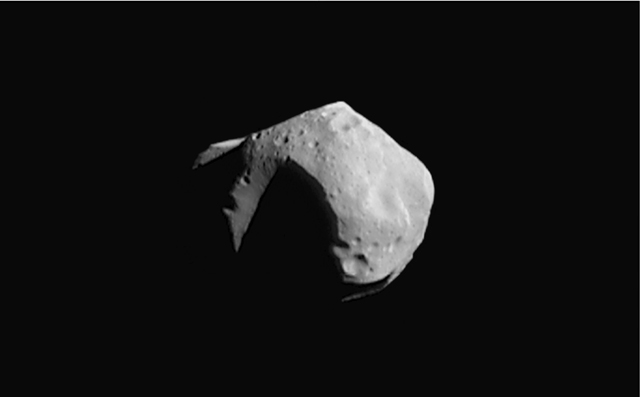
Physical characteristics
C-type asteroids typically have low albedos (they reflect only a small fraction of incident sunlight) and show relatively featureless, often slightly reddish spectra at visible wavelengths. Many display absorption features in the near-infrared associated with water-bearing minerals. Sizes range from small kilometer-scale rocks to the largest primitive belt members. Their weak thermal emission and dark surfaces influence how they are imaged and detected.
Composition and spectral properties
These bodies are thought to contain a mixture of clay minerals, silicates, carbon compounds and complex organics, together with volatile-bearing phases that indicate past or present hydrated minerals. Spectral taxonomies (for example, the Tholen and Bus–DeMeo systems) subdivide carbonaceous objects into related subtypes based on subtle spectral differences. Researchers often look for a characteristic near-3-micron absorption that signals hydrated materials.
Distribution and origin
C-type asteroids predominate in the middle to outer main belt and become increasingly common beyond about 2.7 astronomical units from the Sun. Their distribution and primitive composition suggest they formed in the cooler regions of the protoplanetary disk and have undergone relatively little thermal alteration since formation, preserving early Solar System materials.
Scientific importance and exploration
Because they preserve volatile-rich and carbon-bearing compounds, C-type asteroids are key targets for understanding the origin of water and organic matter on Earth. Sample-return and flyby missions have studied or targeted carbonaceous asteroids to test links between asteroids and carbonaceous chondrite meteorites and to sample primitive matter directly. They are also of interest for in situ resource utilization due to possible water content.
Classification, distinctions and resources
- Classification: carbonaceous types include several subgroups that capture spectral diversity within the broad C class.
- Distinctions: C-types differ from brighter S-type (silicaceous) and metallic M-type asteroids by their darker, more featureless spectra and greater abundance of volatiles and organics.
- Observational bias: their darkness makes surveys less sensitive to them, so estimates of their true population may be revised as instruments improve.
For more technical overviews and classification details see taxonomic summaries, for composition and laboratory analogs consult spectral and meteoritic studies, and for recent mission results see mission pages at spacecraft science sites.
Questions and answers
Q: What are C-type asteroids made of?
A: C-type asteroids are made of carbonates.
Q: How common are C-type asteroids?
A: C-type asteroids are the most common variety, taking up around 75% of known asteroids.
Q: Where in the asteroid belt are C-type asteroids most dominant?
A: C-type asteroids are most dominant in the farther part of the belt beyond 2.7 AU.
Q: What percentage of asteroids beyond 2.7 AU are C-type asteroids?
A: An even higher percentage of asteroids beyond 2.7 AU are C-type asteroids.
Q: Why might the actual amount of C-type asteroids be higher than currently known?
A: The actual amount of C-type asteroids may be higher than currently known because they are much darker than most other asteroid types except D-types and others common only at the extreme farther edge of the Main Belt.
Q: What types of asteroids are commonly found only at the extreme farther edge of the Main Belt?
A: D-types and others are commonly found only at the extreme farther edge of the Main Belt.
Q: What is the theory behind the darker appearance of C-type asteroids?
A: The theory behind the darker appearance of C-type asteroids is that they may contain more carbon and other dark materials.
Related articles
Author
AlegsaOnline.com C-type asteroid Leandro Alegsa
URL: https://en.alegsaonline.com/art/15775