
Equator
The equator is the 0° latitude circle midway between the poles that divides Earth into northern and southern hemispheres and strongly influences climate, daylight and navigation.
Overview
The equator is an imaginary line encircling a rotating body at the midpoint between its poles. On a roughly spherical object such as an sphere or a planet, the equator marks the location where the surface is perpendicular to the axis of spin. On Earth the equator is the principal reference for geographic latitude and is commonly described as a circle of latitude at 0°.
Image gallery
10 Images


Physical characteristics
Geometrically, the equator lies halfway between the North Pole and the South Pole. Around the equator the planet's surface is roughly parallel to its axis of rotation, which influences rotational speed and centrifugal force there. Because of Earth's slight equatorial bulge the equatorial circumference is slightly larger than meridional measurements.
Climate, daylight and ecology
Regions along the equator experience distinctive climatic and daylight patterns. Solar elevation remains high year-round, producing generally warm temperatures and, in many places, abundant rainfall that supports tropical rainforests. Day and night lengths are close to equal throughout the year, a feature noted in the word equator itself, derived from Latin. The equator divides the globe into the southern hemisphere and the northern hemisphere, affecting seasonal contrasts on either side.
History and human use
Historically the equator has been important for navigation, mapping and astronomy. Mariners and mapmakers used the concept to define latitude and to plan routes; modern navigation replaces manual observations with satellites, but the equator remains the basis for many coordinate systems and timekeeping conventions.
Notable facts and distinctions
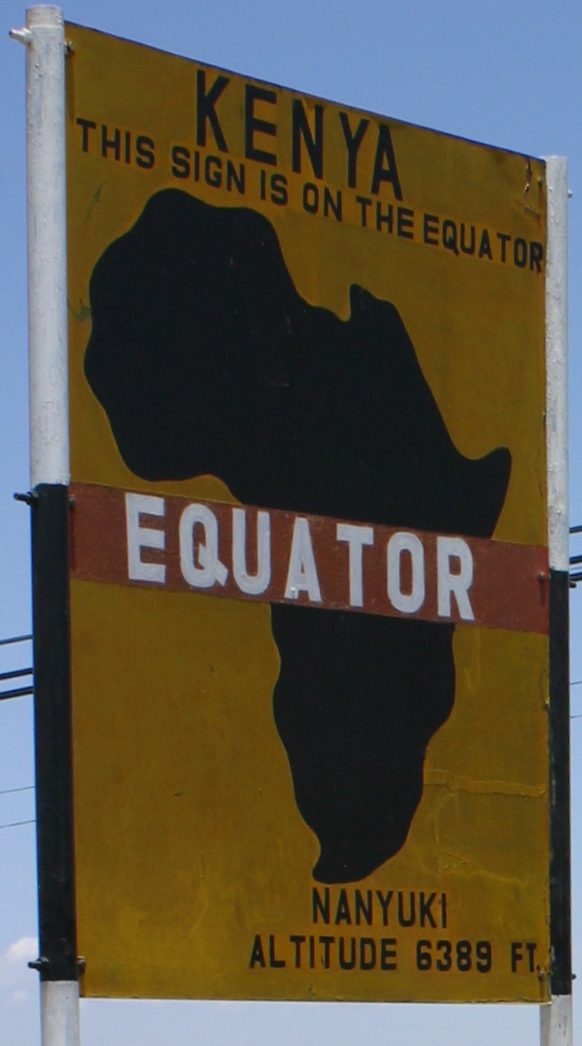
- The equator is a conceptual line, not visible on the Earth's surface except where marked by human-made monuments.
- Several countries lie on or near the equator, creating cross-border ecological zones and unique cultural ties to equatorial environments.
- Because rotational speed is greatest at the equator, objects there experience a small outward centrifugal effect compared with the poles.
The equator therefore serves as a fundamental geographic reference with wide implications for climate, ecosystems, navigation and the way humans describe the planet, especially the Earth.
Related articles
Author
AlegsaOnline.com Equator Leandro Alegsa
URL: https://en.alegsaonline.com/art/31816