
Particle accelerator
Machines that accelerate charged particles to high speeds for research and practical applications; include linear and circular designs like cyclotrons and large colliders.
A particle accelerator is a device that increases the kinetic energy of charged particles—such as electrons, protons or atomic nuclei—so they travel at very high speeds. These machines are often called "atom smashers" in popular language, but their use extends well beyond collisions. Accelerators push and guide particles using electric fields and magnetic fields and operate inside evacuated beam pipes to avoid unwanted interactions. Simple forms of particle acceleration include the cathode ray tube used in older televisions and monitors, while the most powerful systems are large facilities built for basic research and advanced industrial or medical purposes. atom smasher and machine are common informal terms linked to this technology, and the phrase atomic nuclei appears in descriptions of the types of particles accelerated.
Image gallery
10 Images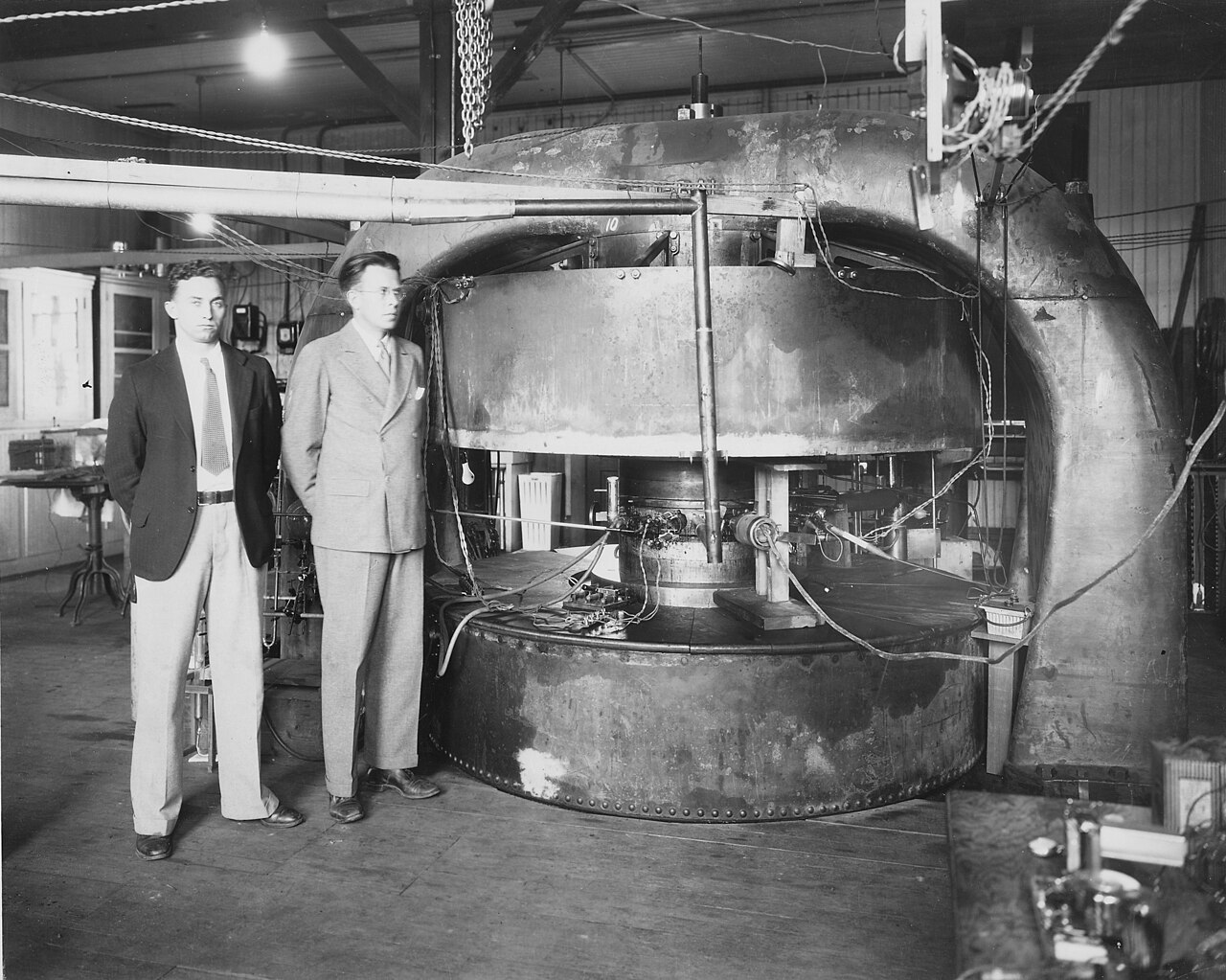


Basic principles and main components
Acceleration relies on electric fields to transfer energy to charged particles and on magnetic fields to steer and focus their trajectories. Key components found in most accelerators include injectors that produce the initial particle beam, radiofrequency (RF) cavities that provide accelerating electric fields, dipole and quadrupole magnets for bending and focusing, vacuum systems to maintain a collision-free path, and detectors that record particle interactions. Large superconducting magnets and cryogenic systems are used in high-energy machines to achieve stronger fields with lower power loss. electric fields and particle physics are central concepts; some designs use alternating RF phases to synchronise acceleration while others rely on continuous-wave fields.
Types and notable examples
Accelerators are broadly divided into linear and circular machines. Linear accelerators (linacs) send particles in a straight line through successive accelerating structures and are widely used as injectors and for linear-collider proposals. Circular accelerators, such as cyclotrons, synchrotrons and storage rings, bend particles around closed paths to allow repeated acceleration and efficient use of RF power. Examples range from small medical cyclotrons to research giants: the Large Hadron Collider and earlier facilities like the Tevatron. Historic and illustrative devices include the linear and example categories; the LHC at CERN is often cited as the preeminent modern collider. See also the Large Hadron Collider and the laboratory CERN where it is located. The US facility Tevatron contributed decades of results, and the familiar United States history includes many accelerator milestones. Simple electron accelerators like the cathode ray tube were once common in televisions and computer monitors.
Scientific and practical uses
In fundamental research, colliders probe matter at the smallest scales and have discovered particles predicted by the Standard Model, including efforts to confirm the Higgs boson. Accelerators convert kinetic energy into new particles in high-energy collisions; under the right conditions, this process can create short-lived antimatter and other exotic states. Beyond particle physics, accelerators are essential tools in medicine for cancer radiotherapy, in industry for materials testing and ion implantation, and in chemistry and biology via synchrotron light sources. They also produce isotopes for medical imaging and research. The translation between energy and matter and the production of antimatter are topics often explained with reference to conservation laws and relativistic energy, examples of which include movement energy and the creation of matter in collisions; contrasts are sometimes drawn with processes that release energy from matter, such as those in nuclear weapons, although the technologies and contexts are very different.
History, costs and technological impact
Accelerator development began in the early 20th century with devices like Cockcroft–Walton generators and Lawrence's cyclotron, and it progressed through radiofrequency accelerators and large synchrotrons to today's superconducting colliders. Because modern accelerators often require cutting-edge magnets, RF systems and precision detectors, they are expensive to build and operate; funding commonly comes from governments or international consortia. The technological advances driven by accelerator research—superconducting magnets, particle detectors, vacuum engineering and computer control systems—have had broad spillover effects in industry and medicine. Facilities and projects are often described in accessible resources about accelerator technology and basic research funding policy, including discussions of antimatter production and advanced technology spurred by the field.
Distinctions and future directions
Notable distinctions among accelerators include energy reach (how fast particles are made to travel), luminosity (collision rate in colliders), and beam type (electrons, protons, heavy ions). Current research explores compact accelerators using plasma wakefield acceleration, improved superconducting materials, and more efficient light sources for laboratories and hospitals. While the largest machines will remain central to probing fundamental questions, smaller, lower-cost accelerators expand access to practical applications worldwide. For more specific introductions and facility descriptions, consult technical summaries and public outreach pages offered by major laboratories and research networks. Atom smasher remains a popular shorthand, but the field encompasses a broad set of scientific and technological enterprises.
Related articles
Author
AlegsaOnline.com Particle accelerator Leandro Alegsa
URL: https://en.alegsaonline.com/art/74831
Sources
- science.howstuffworks.com : "How Atom Smashers Work"