
Pauli exclusion principle
The quantum rule that no two identical fermions in the same quantum system can occupy the same quantum state; key to atomic structure, chemistry and stellar degeneracy.
Overview
The Pauli exclusion principle is a fundamental rule of quantum mechanics stating that no two identical fermions can share the same complete set of quantum numbers within the same quantum system. In plain terms, it prevents certain particles from occupying exactly the same quantum state and so governs how matter is arranged at the microscopic level. For a concise statement and background see definition and context.
Image gallery
1 Image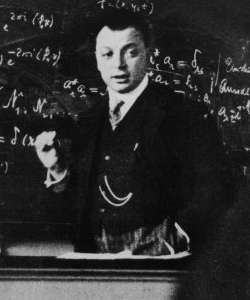
Particles and quantum statistics
Particles fall into two broad categories by their quantum statistics. Fermions are subject to the exclusion principle; familiar examples include protons, neutrons and electrons. In contrast, bosons can occupy the same state in large numbers—photons are an example—see photons and bosons. The deeper reason behind this division is the spin–statistics relation: particles with half-integer spin obey Fermi–Dirac statistics and are antisymmetric under particle exchange; particles with integer spin follow Bose–Einstein statistics and have symmetric wavefunctions.
Precise statement and mathematical form
Mathematically, the exclusion principle is expressed by the antisymmetry of the multi-particle wavefunction for identical fermions. Swapping two identical fermions reverses the sign of the wavefunction; if the two particles were in the same state the wavefunction would equal its negative and thus vanish, which forbids that configuration. In atomic physics this is often paraphrased as "no two electrons in an atom can have the same set of quantum numbers." Typical quantum numbers used for electrons include the principal, azimuthal, magnetic and spin quantum numbers.
History and development
The principle was introduced by the Austrian physicist Wolfgang Pauli in 1925 to account for observed patterns in atomic spectra and the structure of the periodic table. Pauli's insight predated the full development of quantum mechanics and the concept of electron spin; subsequent work placed his rule on firmer theoretical ground within the emerging formalism of quantum theory. For Pauli's original formulation and related historical material see Pauli's work.
Consequences, examples and importance
The exclusion principle shapes much of the visible universe. It explains the arrangement of electrons in shells and subshells that produces the periodic table and chemical behavior, determines the properties of solids and metals through band structure and the Fermi energy, and gives rise to degeneracy pressure that supports white dwarfs and neutron stars against gravitational collapse. Examples include the way electrons fill atomic orbitals, how conduction electrons populate energy bands in solids, and why matter has volume and resists compression.
Notable distinctions and limitations
The rule applies only to identical fermions within the same quantum system; distinguishable particles or particles sufficiently separated so they do not share a single quantum description are not constrained in the same way. The Pauli exclusion principle is a statement about quantum states and symmetry rather than a classical force: it emerges from quantum mechanics and the properties of fermionic wavefunctions rather than from a new interaction. Its operational consequences, however, are observable across chemistry, condensed matter physics and astrophysics.
Related articles
Author
AlegsaOnline.com Pauli exclusion principle Leandro Alegsa
URL: https://en.alegsaonline.com/art/75210