
Antimatter
Antimatter: particles composed of antiparticles that mirror ordinary matter in mass but have opposite charges and quantum numbers, notable for annihilation on contact and roles in physics, medicine, and cosmology.
Overview
Antimatter denotes a class of particles that correspond to ordinary particles but carry opposite internal quantum properties such as electric charge and certain conserved quantum numbers. The concept arises naturally in modern particle physics and relativity; antiparticles have the same inertial mass as their particle counterparts but opposite charges and related quantum labels. For accessible introductions see particle physics and standard discussions of antiparticles.
Image gallery
2 Images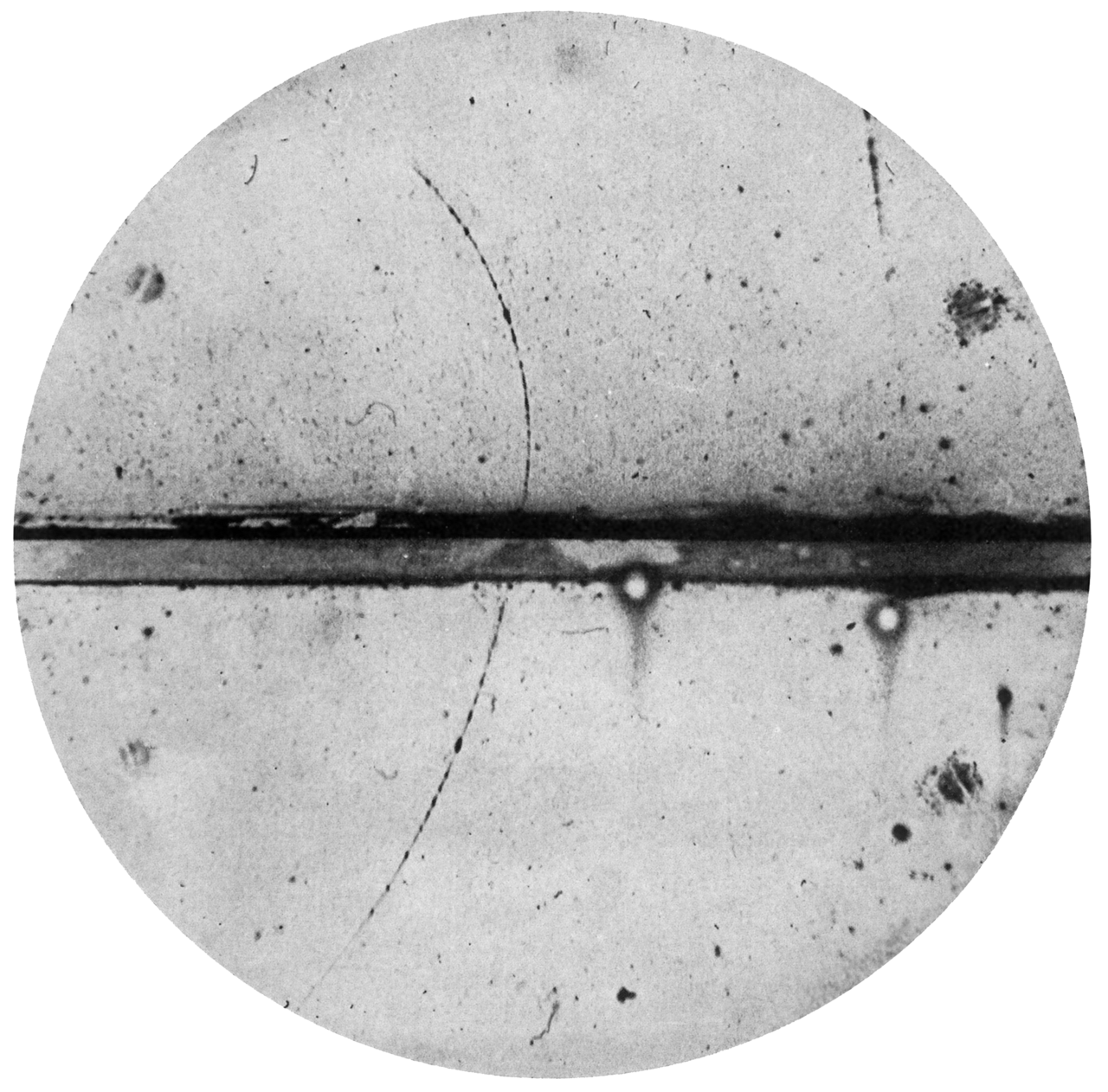

Characteristics and examples
Common examples include the positron (the electron's antiparticle), the antiproton, and the antineutron. Collections of antiparticles can form antiatoms — for example, antihydrogen — which mirror ordinary atoms except for reversed charge arrangement. The equality of mass between particle and antiparticle is a central feature noted in experimental tests and theoretical arguments (same mass). Antiparticles are often denoted with a bar or a plus/minus sign to indicate reversed charge and quantum numbers.
Annihilation and conservation laws
When a particle meets its antiparticle, they can annihilate, converting their mass and kinetic energy into other particles such as high-energy photons (gamma rays), neutrinos, or lighter particle–antiparticle pairs. Annihilation respects fundamental conservation laws (energy, momentum, charge, and appropriate quantum numbers), and processes often produce gamma radiation and neutrinos; discussions of resulting neutrino emission appear in particle detection literature (neutrinos).
History and theoretical basis
Antimatter was anticipated by theoretical work that combined quantum mechanics and special relativity; the first antiparticle observed was the positron, discovered in cosmic-ray experiments. Theoretical symmetries such as charge-parity-time (CPT) invariance relate particles and antiparticles and underpin many precision tests of fundamental physics. Experimental searches test whether antiparticles match particles in all properties, with any differences being of profound significance for physics and cosmology.
Production, containment, and uses
Antiparticles are produced in natural processes (cosmic rays and some radioactive decays) and in accelerators and reactors for research. Creating macroscopic quantities is expensive and difficult because antimatter annihilates on contact with container walls; trapping relies on electromagnetic and magnetic techniques to hold charged antiparticles or neutral antiatoms in vacuum. Practical uses include medical imaging (positron emission tomography) and fundamental studies of matter–antimatter asymmetry and atomic structure. Proposed applications in propulsion and energy are speculative and face major technical and economic barriers (applied research).
Cosmological and notable facts
A key open question is why the observable universe appears dominated by ordinary matter rather than equal parts matter and antimatter; this baryon asymmetry is an active area of research that connects particle physics, cosmology, and early-universe conditions. Antimatter also appears in discussions of cosmic-ray composition, laboratory tests of fundamental symmetries, and high-energy astrophysical processes. For further reading and technical resources see introductory and specialist material (overview, technical review, neutrino-related topics).
Questions and answers
Q: What is antimatter?
A: Antimatter is a material made up of antiparticles with the same mass as particles of ordinary matter but opposite charges and properties.
Q: What is the relationship between particles and antiparticles?
A: Particles and antiparticles have opposite charges and properties, and encounters between them lead to both being destroyed.
Q: What types of particles and energy are produced when a particle and an antiparticle are destroyed?
A: The destruction of a particle and an antiparticle produces high-energy photons (gamma rays), neutrinos, and lower-mass particle-antiparticle pairs.
Q: What is meant by the term lepton number?
A: Lepton number refers to the number of leptons in a particle or antiparticle.
Q: What is meant by the term baryon number?
A: Baryon number refers to the number of baryons in a particle or antiparticle.
Q: How does antimatter differ from ordinary matter?
A: Antimatter is composed of antiparticles, which have the same mass as particles of ordinary matter but opposite charges and properties.
Q: What is the significance of encounters between particles and antiparticles?
A: Encounters between particles and antiparticles result in their mutual destruction and the production of high-energy photons, neutrinos, and lower-mass particle-antiparticle pairs.
Related articles
Author
AlegsaOnline.com Antimatter Leandro Alegsa
URL: https://en.alegsaonline.com/art/4656
Sources
- rspa.royalsocietypublishing.org : "The Quantum Theory of the Electron"
- doi.org : 10.1098/rspa.1928.0023
- worldcat.org : 1364-5021
- worldcat.org : Studyguide for Introduction to elementary particles by Griffiths, David, 2nd edition