
Electric field: concept, laws, history and practical applications
An electric field describes how electric charges exert force in space. This article explains its definition, mathematical laws, historical development, key properties and common applications.
Overview
An electric field is a physical quantity that describes how electric charges influence the space around them. It is a vector quantity: at each point it has a magnitude and a direction indicating the force that a small positive test charge would experience. In the simplest form, the force on a charge q placed in an electric field E is given by F = qE. The concept helps separate the action of charged objects from the instantaneous notion of contact forces and allows predictions of forces, energy changes and motion.
Image gallery
2 Images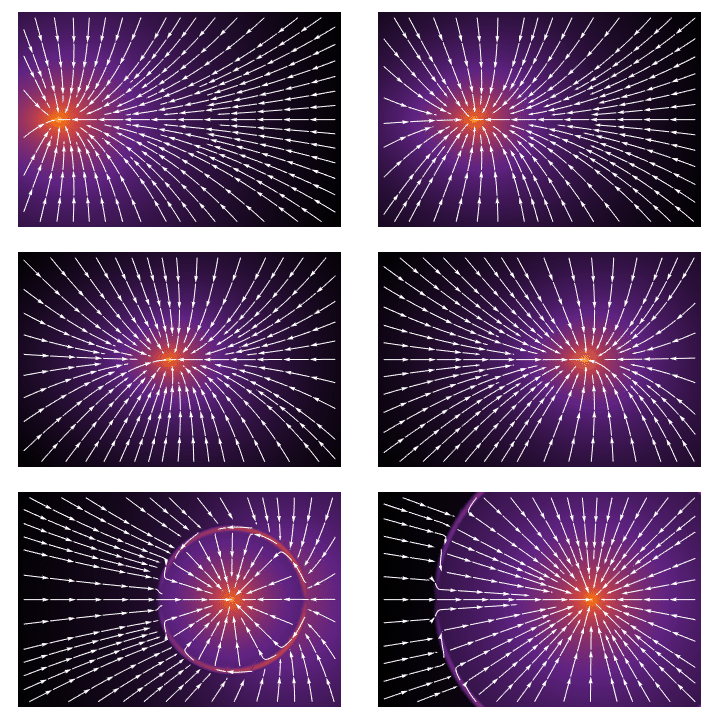

Basic properties and representation
Electric fields originate from distributions of electric charge and, when they vary in time, from changing magnetic fields. They are commonly depicted by field lines: the lines point in the direction a positive test charge would move, are denser where the field is stronger, and never cross. Important qualitative properties include:
- Direction and magnitude: the field at a point is a vector specifying the force per unit positive charge.
- Superposition: fields created by different sources add vectorially, so the net field is the sum of individual contributions.
- Field sources: static electric charges produce radial fields; time-varying magnetic fields can induce nonconservative electric fields.
Mathematical laws and relationships
Electric fields are governed by fundamental relations that connect them to charge and to changing magnetic fields. Gauss's law links the electric flux through a closed surface to the enclosed charge and is a convenient tool for finding fields with high symmetry. Faraday's law of induction describes how a time-dependent magnetic field produces an electric field. Together with other relations these form part of the set known as Maxwell's equations. For further technical details, see Gauss's law, Faraday's law and Maxwell's equations. The expression F = qE is central to connecting the field to mechanical effects on charges; more generally the fields and sources are coupled to currents and changing fields (charges and currents).
Historical context
The modern idea of the electric field emerged in the 19th century. Michael Faraday introduced the notion of field lines to visualize interactions at a distance and emphasized fields as physical intermediaries rather than instantaneous action across empty space. The mathematical formulation that unified electric and magnetic phenomena into a consistent theory was completed by James Clerk Maxwell. For background on the concept and its development see resources on Michael Faraday and historical expositions of electromagnetism (magnetic field relations).
Applications and examples
Electric fields are fundamental in many technologies and natural phenomena. Examples include:
- Electrostatics: forces between charged particles, charge separation in insulators and conductors, and the design of capacitors.
- Electronics: fields inside components determine how charges move in semiconductors, vacuum tubes, and microelectronic devices.
- Electromagnetic induction: varying magnetic fields create electric fields used in generators and transformers.
- Atmospheric and biological effects: fields in lightning, thunderclouds, and nervous tissues influence large-scale and microscopic processes.
For concise definitions and related concepts consult entries about vector fields and electric charge. Practical calculations often combine symmetry arguments, Gauss's law and superposition to compute E for idealized charge distributions.
Notable distinctions and further reading
Distinguish between electrostatic fields (derived from stationary charges and having a scalar potential) and induced electric fields (nonconservative fields produced by time-varying magnetic flux). Both fit within the unified framework described above, but they have different mathematical properties and physical consequences. Readers seeking a deeper mathematical treatment can follow introductory texts and guided resources on vector field methods, Gauss's law techniques and the full set of Maxwell's equations.
Related articles
Author
AlegsaOnline.com Electric field: concept, laws, history and practical applications Leandro Alegsa
URL: https://en.alegsaonline.com/art/30671
Sources
- feynmanlectures.caltech.edu : The Feynman Lectures on Physics Vol II
- public.wsu.edu : "Michael Faraday"