
Pascal's law
Pascal's law: in a confined, nearly incompressible fluid, an applied pressure change is transmitted undiminished. It underpins hydraulic machines, jacks, brakes and many engineering devices.
Pascal's law is a fundamental principle of continuum mechanics describing how pressure changes propagate in static fluids. In plain terms, when an external pressure is applied to a confined, nearly incompressible fluid, that pressure change is transmitted throughout the fluid so that every small region experiences the same increase. The statement is central to the study of physics of fluids and to the design of devices that rely on transmitting force through a liquid.
Image gallery
2 Images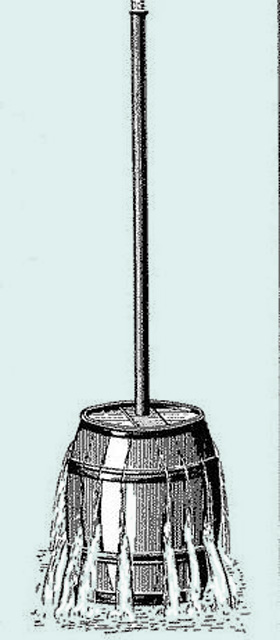
Formal statement and simple formulas
Conceptually, Pascal's law says that a pressure increment Δp applied at one point in an enclosed static fluid appears everywhere in the fluid and on the walls of its container. Pressure p is force per unit area (p = F/A). In hydraulic machines the law combines with the area ratio of pistons to produce mechanical advantage: F2 = F1·(A2/A1). In hydrostatics the vertical variation of pressure due to gravity follows p(h) = p0 + ρgh, which is a separate, compatible result for fluids at rest.
Historical note
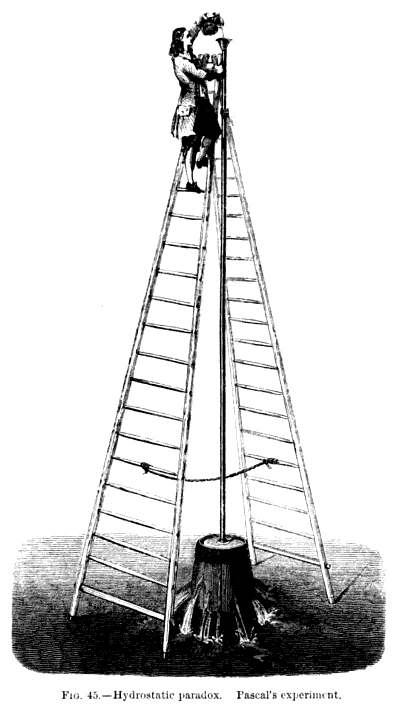
The principle is named after Blaise Pascal, who investigated pressure in fluids in the mid-17th century. A well-known demonstration attributed to him involved a sealed barrel and a long tube; when the tube was filled and blocked, the vessel reportedly burst, illustrating that a pressure increase at one location can act throughout a container. Accounts vary in detail, but the experiment has become a common historical example.
Applications and examples
- Hydraulic presses and jacks use small input forces on a small-area piston to produce larger output forces on a larger-area piston.
- Automotive brake systems transmit pedal force through brake fluid to apply pads or shoes at the wheels.
- Syringes and hydraulic lifts, elevators, and many industrial actuators rely on pressure transmission in liquids.
Limitations and distinctions
Pascal's law applies to fluids at rest (hydrostatics) and to nearly incompressible liquids. Gases, being compressible, and flows involving rapid motion, significant viscosity, or turbulence do not follow the simple transmitted-pressure picture without additional analysis. The law describes scalar pressure — it does not imply directional forces other than the normal stresses exerted on container walls.
Because of its simplicity and robustness, Pascal's law remains a foundational idea taught in physics and engineering curricula and continues to inform practical design of machines and safety systems that move or multiply forces using fluids. For introductory treatments and experiments see general fluid mechanics texts or online resources such as further reading on Blaise Pascal and his work.
Related articles
Author
AlegsaOnline.com Pascal's law Leandro Alegsa
URL: https://en.alegsaonline.com/art/74894