
Octocorallia (Octocorals): soft corals, sea fans and sea pens
Octocorallia are eight‑armed colonial anthozoans (soft corals, sea fans, sea pens) distinguished by eight-fold symmetry, sclerites or gorgonin support, diverse habitats, and ecological roles from shallow reefs to deep sea.
Octocorallia, commonly called octocorals, form a distinct subclass of the Anthozoa within the phylum Cnidaria. They include familiar animals such as soft corals, sea fans and sea pens. More than three thousand species have been described worldwide, occupying habitats from shallow tropical reefs to temperate and deep‑sea communities. Octocorals are important benthic organisms that contribute to habitat complexity, filter feeding and, in some cases, symbiotic primary production.
Image gallery
2 Images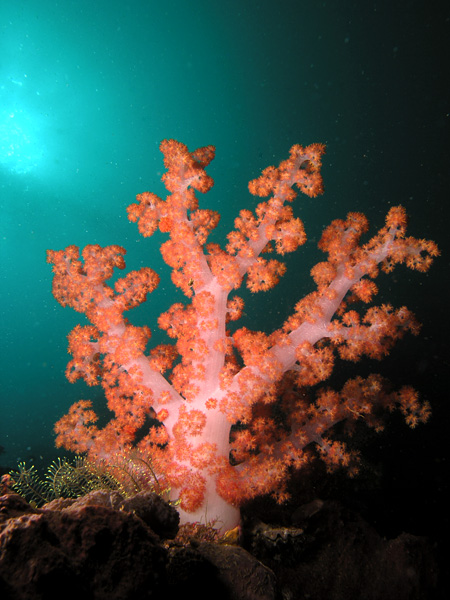

Key characteristics
Octocorals are defined by an eightfold radial symmetry expressed in two main ways: each polyp bears eight pinnate tentacles and there are eight internal mesenteries (partitions) in the body cavity. Most species form colonies of many polyps that share a common tissue and, in many taxa, an internal connective skeleton. Distinguishing features include:
- Pinnate tentacles: each tentacle is featherlike, bearing side branches (pinnules).
- Sclerites and gorgonin: many octocorals contain microscopic calcareous spicules (sclerites) embedded in the tissues or a proteinaceous support called gorgonin in gorgonians.
- Skeletal diversity: unlike many stony corals, most octocorals lack a massive calcium‑carbonate skeleton and therefore do not form true reef frameworks, though exceptions exist.
- Colonial organization: colonies can vary from encrusting mats and lobed soft corals to upright fans and pennatulacean (sea pen) shapes.
Classification and history
Historically grouped under the name Alcyonaria, Octocorallia today encompass several major assemblages such as soft corals, gorgonians (sea fans and sea whips) and sea pens. Their fossil record and molecular studies show a long evolutionary history within Anthozoa, distinct from the Hexacorallia (stony corals and sea anemones), which exhibit sixfold symmetry. Taxonomic revisions continue as genetic data refine relationships among families and orders.
Ecology, distribution and interactions
Octocorals occur worldwide from sunlit coral reefs to dark continental slopes. Many shallow species host symbiotic microalgae (zooxanthellae) that provide photosynthetic nutrients, while deep‑sea forms rely entirely on suspended particulate organic matter captured by their tentacles. Octocorals provide three‑dimensional habitat for fish and invertebrates and can form dense assemblages known as coral gardens in temperate and deep environments.
Reproduction and defenses
Reproductive strategies include sexual reproduction (broadcast spawning or brooding larvae) and asexual propagation (fragmentation, budding). Colonies are often functionally unisexual—most polyps within a colony produce gametes of the same sex—though hermaphroditism occurs in some species. Predators and competitors have driven a range of chemical and structural defenses: many octocorals produce distasteful or toxic metabolites, and sclerites or tough gorgonin provide mechanical deterrence.
Human relevance and notable facts
Octocorals are valued in aquaria, for their ecological role in fisheries, and as subjects of biomedical research because their secondary metabolites can have pharmaceutical potential. They differ markedly from reef‑building stony corals (Hexacorallia) in symmetry and skeletal form; despite this, octocorals are essential contributors to marine biodiversity and benthic ecosystem function. The group remains a focus of conservation concern due to habitat loss, climate change and fishing impacts.
- General overview and taxonomy
- Phylum Cnidaria context
- Species diversity estimates
- Eightfold symmetry explanation
- Colonial lifestyles
- Sessile polyp form
- Comparison with Hexacorallia
- Skeletal structures and exceptions
- Reef building differences
- Symbiotic relationships
- Algal symbionts (zooxanthellae)
- Sexual reproduction modes
- Asexual reproduction and colony growth
Questions and answers
Q: What is Octocorallia?
A: Octocorallia is a subclass of the Anthozoa in the phylum Cnidaria.
Q: How many different species of Octocorallia are there?
A: There are over 3,000 different species of Octocorallia.
Q: What is the symmetry of Octocorallia?
A: Octocorallia have an eight-fold symmetry.
Q: How are Octocorallia different from stony corals?
A: Octocorallia lack a lasting skeleton, unlike stony corals. This means they do not build coral reefs. Most Octocorallia also have a different, eight-fold symmetry compared to the six-fold symmetry of stony corals.
Q: What is the older name for Octocorallia?
A: The older name for Octocorallia is Alcyonaria.
Q: Do Octocorallia form symbioses with unicellular algae?
A: Yes, many species of Octocorallia form symbioses with unicellular algae.
Q: How do Octocorallia reproduce?
A: Many species of Octocorallia can reproduce both sexually and asexually. It is common to find a colony of Octocorallia where most polyps have the same sex.
Related articles
Author
AlegsaOnline.com Octocorallia (Octocorals): soft corals, sea fans and sea pens Leandro Alegsa
URL: https://en.alegsaonline.com/art/71930