
Oestrous cycle
The oestrous cycle is the recurring reproductive cycle in most female mammals, controlled by hormones and expressed as periods of sexual receptivity (heat). It differs from the menstrual cycle of primates.
The oestrous cycle (U.S. spelling: estrous cycle) is the series of physiological and behavioural changes that prepare most female mammals for mating and pregnancy. Driven by interactions among the brain, pituitary gland and ovaries, the cycle begins after puberty and continues throughout reproductive life except when interrupted by pregnancy, lactation or prolonged non-breeding seasons. Many domestic and wild species show clear signs of receptivity known as "heat" during a specific phase of the cycle.
Image gallery
1 Image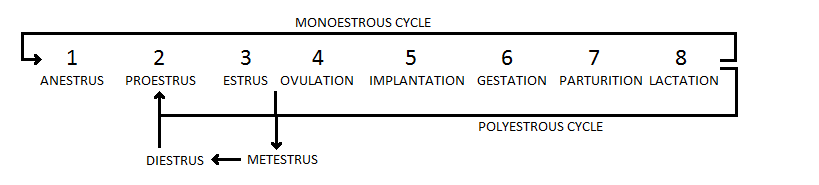
Phases and physiology
The cycle is commonly divided into recurring stages that reflect ovarian activity and hormone profiles. Broadly these stages include proestrus (follicle development and rising estrogens), estrus (sexual receptivity and ovulation in many species), metestrus (corpus luteum formation) and diestrus (progesterone dominance). Some authors group stages differently or use the term anestrus for periods without cyclic activity. Key hormones are gonadotropin-releasing hormone from the hypothalamus, luteinising hormone and follicle-stimulating hormone from the pituitary, and ovarian estrogens and progesterone, which together coordinate ovulation and uterine preparation.
Variation among species
Patterns of oestrous cycling vary. Some mammals are polyoestrous and cycle repeatedly through the year, while seasonal breeders restrict cycles to particular seasons under environmental cues such as day length. Species can be spontaneous ovulators (ovulation occurs in a cycle without mating) or induced ovulators (mating triggers ovulation), a distinction important for understanding reproductive strategies. Domestic examples include cattle and horses as spontaneous ovulators and cats and rabbits as commonly induced ovulators. For general context about mammals see mammals, and for the typical timing of onset consult sources on puberty and sexual maturity such as puberty references.
Detection and applications
Heat detection relies on behavioural observation (standing to be mounted, restlessness), physical signs (vaginal discharge, swelling), and diagnostic tests (vaginal cytology, hormone assays, ultrasound). Understanding the oestrous cycle is essential in animal husbandry, timed breeding programs, veterinary care and reproductive research. Accurate cycle staging improves success in artificial insemination, embryo transfer and population management of wild species.
Comparative and historical notes
Unlike the menstrual cycle of many primates, which involves uterine shedding visible as menstruation, the oestrous cycle typically reabsorbs the endometrial lining without external bleeding. The term is spelled "oestrous" in British English and "estrous" in American English. Scientific knowledge of these cycles expanded considerably with twentieth-century advances in endocrinology and reproductive physiology, enabling modern practices in both clinical and agricultural settings.
- Key distinctions: oestrus (period of receptivity) vs. oestrous cycle (entire series of stages).
- Practical tip: combine behavioural observation with hormonal testing for reliable cycle staging.
Questions and answers
Q: What is the oestrous cycle?
A: The oestrous cycle is the reproductive system found in most mammals.
Q: What causes the oestrous cycle to start?
A: The cycle starts due to reproductive hormones that are released after puberty in sexually mature females.
Q: Are there interruptions in the oestrous cycle?
A: Yes, non-breeding phases or pregnancies can interrupt the cycle.
Q: How long does the oestrous cycle typically last?
A: The cycle usually continues until death.
Q: Do all mammals have an oestrous cycle?
A: No, not all mammals have an oestrous cycle.
Q: What is the U.S. term for the oestrous cycle?
A: The U.S. term for the oestrous cycle is the estrous cycle.
Q: How do reproductive hormones affect the oestrous cycle?
A: Reproductive hormones cause the cycles to start and play a crucial role in regulating the cycle.
Related articles
Author
AlegsaOnline.com Oestrous cycle Leandro Alegsa
URL: https://en.alegsaonline.com/art/72008
Sources
- unm.edu : "Ovulatory cycle effects on Tip earnings by lap dancers: economic evidence for human estrus?"
- findarticles.com : "Women's sexual experience during the menstrual cycle: identification of the sexual phase by noninvasive measurement of luteinizing hormone"
- doi.org : 10.1080/00224490409552216
- pubmed.ncbi.nlm.nih.gov : 15216427