
Ocean current
Flowing masses of seawater driven by wind, Earth's rotation, density differences and tides; they shape climate, marine ecosystems, and sea navigation worldwide.
Overview
An ocean current is a persistent, directed movement of water across the oceans. Currents operate at the surface and at depth, forming coherent pathways that can extend for thousands of kilometers. They are distinct from short-lived waves and local tides, although tides can interact with and modify current patterns.
Image gallery
10 Images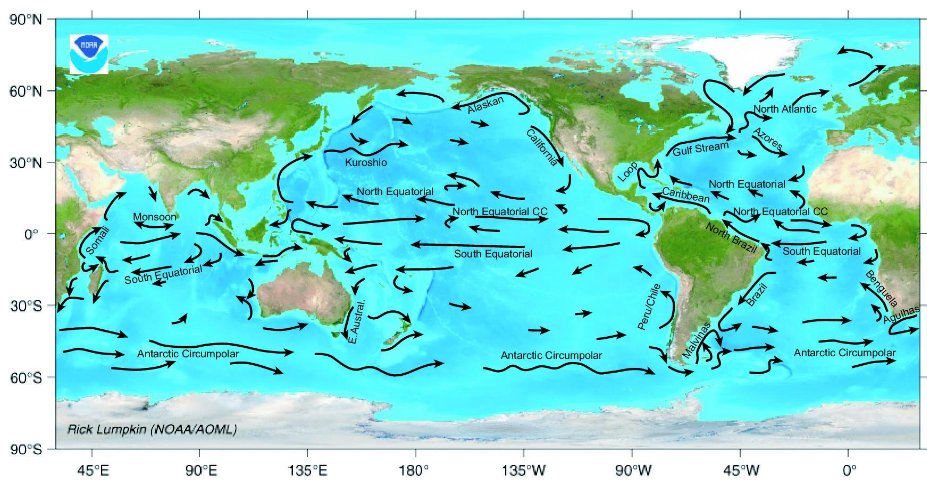






Causes and mechanisms
Several physical processes drive ocean currents. Wind blowing over the sea surface transfers momentum into the water and establishes large-scale surface flows; trade winds and westerlies are major examples (wind). Differences in temperature and salt concentration create density contrasts that cause vertical and horizontal movement known as thermohaline circulation (temperature, salinity). The Earth's rotation produces the Coriolis effect, which deflects moving water and helps form circular gyres. Gravitational forcing from the Moon and Sun produces tides that influence currents along coasts and in shallow seas (tides).
Types and structure
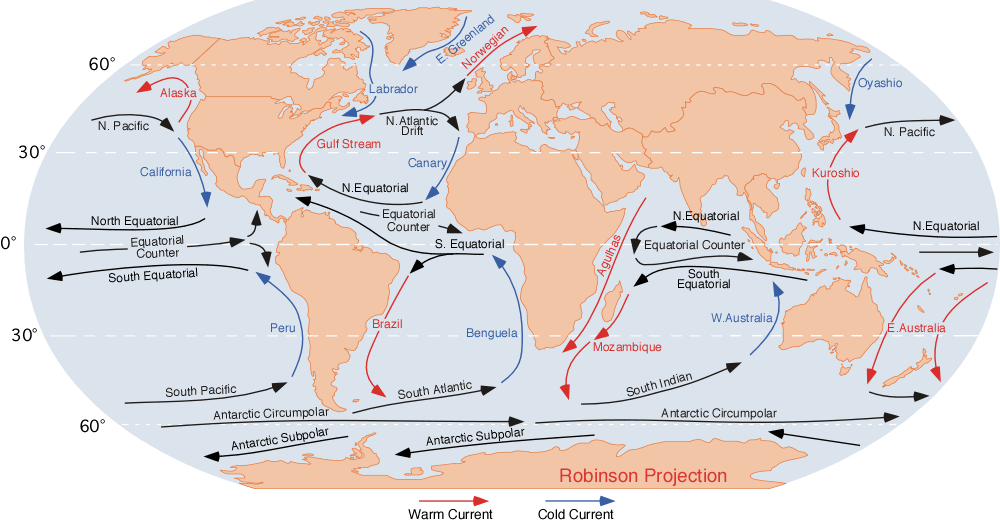
Ocean currents are broadly categorized as surface currents (driven mainly by wind and modified by Coriolis and coastline shapes) and deep currents (driven mainly by density differences). Other relevant features include western boundary currents (fast, warm poleward flows), eastern boundary currents (cooler, slower equatorward flows), equatorial currents, gyres, and the global conveyor-like network of deep-water movement. Upwelling zones bring nutrient-rich deep water to the surface and support productive fisheries.
Importance for climate and ecosystems
Currents redistribute heat from the tropics toward higher latitudes, influencing regional climates and weather systems. They also transport dissolved gases and nutrients, shaping primary productivity and the distribution of marine life. For example, the Gulf Stream carries warm water across the North Atlantic and affects climate along adjacent continents. The Antarctic Circumpolar Current and other major flows play crucial roles in global heat and carbon cycles.
Human interactions and notable facts
- Navigation and exploration: sailors have long used currents for faster passages; 18th-century mariners and mapmakers studied major currents to improve routes.
- Fisheries and coastal economies depend on nutrient patterns created by currents.
- Pollution and floating debris are transported by currents, accumulating in convergence zones.
Understanding ocean currents remains a central subject in oceanography because of their wide-ranging effects on climate, ecosystems, and human activities. Further reading and data are available from oceanographic institutions and research programs (water science, wind studies, thermal data, salinity observations, tidal records, regional analyses).
Related articles
Author
AlegsaOnline.com Ocean current Leandro Alegsa
URL: https://en.alegsaonline.com/art/71840
Sources
- oceancurrents.rsmas.miami.edu : "Surface Currents in the Atlantic Ocean"