
Oceanic crust: composition, formation, and lifecycle
Oceanic crust is the dense, mafic portion of Earth's outer shell beneath the seas. This article explains its structure, formation at mid‑ocean ridges, recycling by subduction, age limits, and geological importance.
Overview
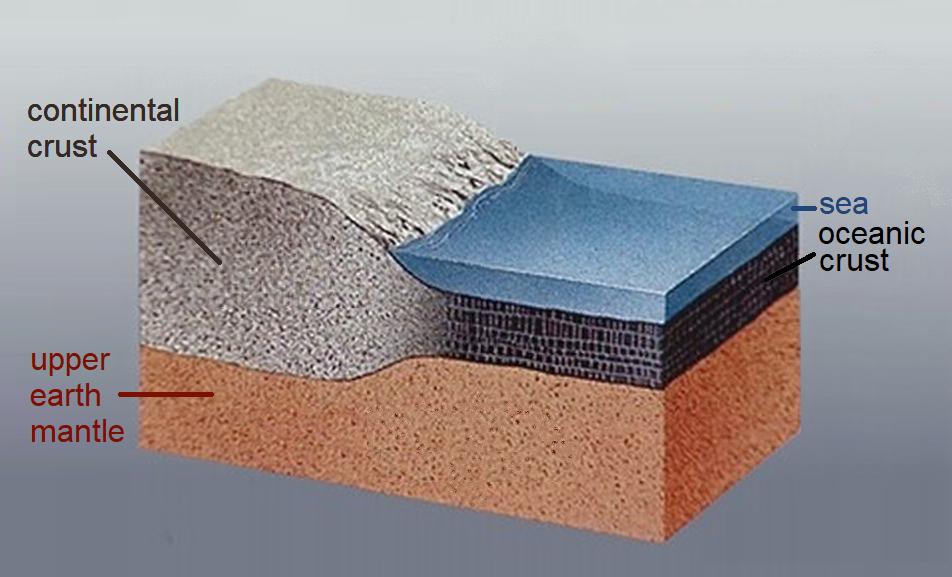
The oceanic crust is the portion of Earth's outer shell that lies under the global ocean basins and forms the uppermost part of tectonic plates. It is a comparatively thin, dense layer that contrasts with the thicker, less dense continental crust. As part of the lithosphere, oceanic crust plays a central role in plate tectonics and in the transfer of heat, mass and chemical species between Earth's interior and its surface, including the oceans (ocean basins).
Image gallery
4 Images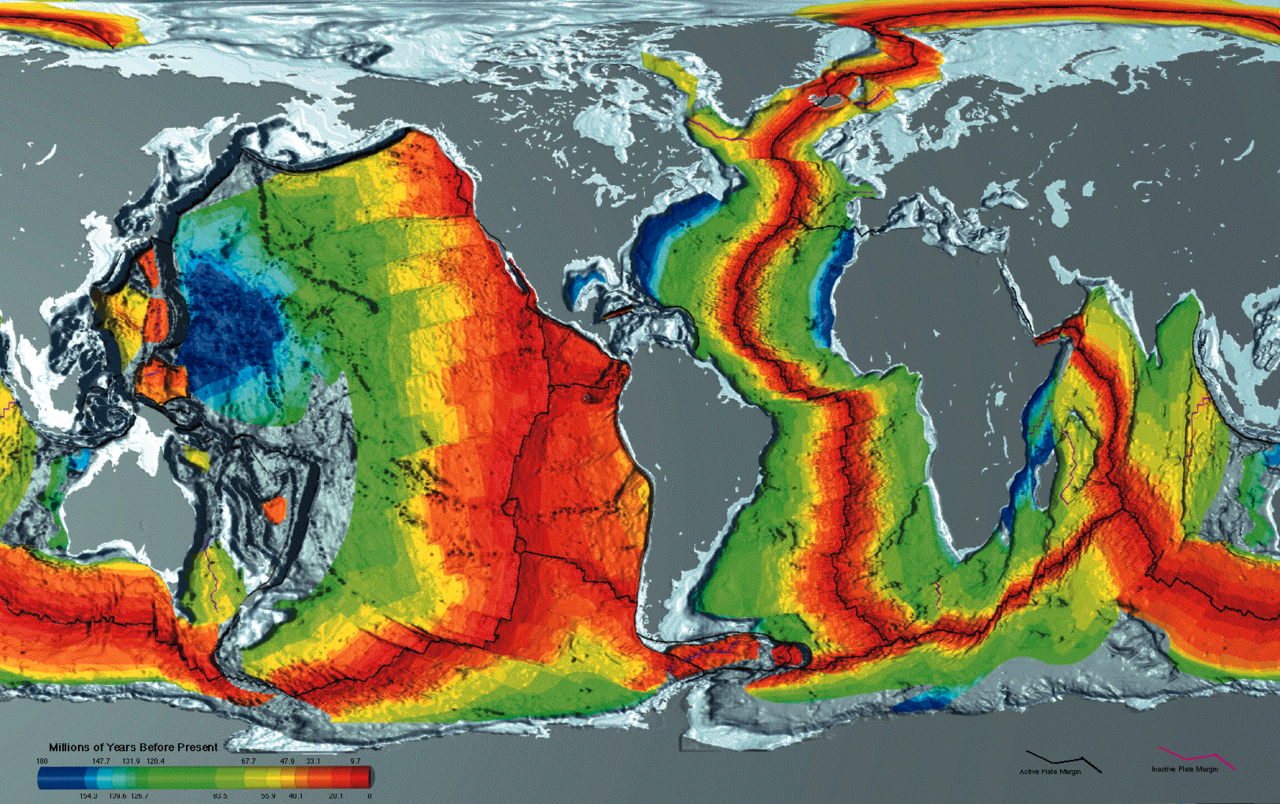

Composition and internal structure
Oceanic crust is composed predominantly of mafic volcanic and intrusive rocks—rocks rich in iron and magnesium common to basalt and gabbro types (mafic). The term "sima" historically referred to the silica‑magnesium composition of these rocks, reflecting their higher magnesium content. Their mineralogy includes a suite of silicate minerals such as pyroxene and plagioclase.
- Upper layer: commonly pillow basalts and volcanic flows formed at the seafloor.
- Middle layer: sheeted dike complexes that fed the surface eruptions.
- Lower layer: layered gabbros and ultramafic rocks that crystallized at depth.
Formation at spreading centers
New oceanic crust is continuously created where tectonic plates pull apart at mid‑ocean ridges. Hot mantle material partially melts to generate magma, which ascends and crystallizes to form basaltic crust. As magma supplies and cooling continue, fresh crust is added and older crust is carried laterally away from the ridge axis. Cooling and interaction with seawater alter physical and chemical properties of the crust as it ages and moves outward.
Lifecycle, age and recycling
Unlike continental crust, oceanic crust is relatively short‑lived on geological timescales. Most oceanic plates are less than about 200 million years old because they are recycled back into the mantle at convergent margins by subduction. As crust migrates away from the ridge it becomes cooler and denser; increasing weight and density help drive its return into the mantle where it contributes to the dynamism of the rock cycle.
Physical properties and variability
Typical thickness is on the order of 7–10 kilometres, thinner than most continental sections, while its average bulk density is higher—commonly cited near 3.3 g/cm3—reflecting its mafic composition. Local variations occur: oceanic plateaus and island arcs produce thicker or compositionally different crust, and hydrothermal circulation near ridges alters chemistry and supports unique ecosystems.
Importance and distinguishing facts
Oceanic crust governs seafloor topography, hosts mineral deposits and hydrothermal vents, and records magnetic field reversals in the sequence of basaltic flows—evidence that was crucial for establishing the theory of seafloor spreading. Fragments of ancient oceanic crust can be preserved on continents as ophiolites, where slices of seafloor and upper mantle are uplifted and exposed for study. Modern research combines seafloor mapping, drilling, geochemistry and geophysics to refine our understanding of crustal formation and evolution.
For detailed introductions to related concepts see tectonics and seafloor spreading resources: lithosphere overview, ocean basins, mafic rock description, magnesium in rocks, silicate mineral groups, density measurements, units and conversions, rock cycle, and magma generation.
Related articles
Author
AlegsaOnline.com Oceanic crust: composition, formation, and lifecycle Leandro Alegsa
URL: https://en.alegsaonline.com/art/71852