
Ocean gyre: large-scale circular ocean current systems
An ocean gyre is a vast, circular system of surface currents driven by wind, Earth's rotation and ocean physics. Gyres shape climate, marine ecosystems and concentrate floating debris in convergent zones.
An ocean gyre is a broad, roughly circular pattern of ocean surface currents that spans hundreds to thousands of kilometres. These persistent circulations are the dominant structure of the world’s surface ocean and are usually described as major subtropical and subpolar gyres. They arise from the interaction of prevailing winds, the planet’s rotation and the physical response of seawater, and they play a central role in heat transport, nutrient distribution and the movement of floating material.
Image gallery
10 Images




How gyres form and behave
Gyres are driven primarily by wind patterns: steady trade winds and westerlies impart momentum to the sea surface (wind stress) which, under the influence of the Coriolis effect, is deflected to the right in the northern hemisphere and to the left in the southern hemisphere. That planetary deflection is a consequence of the Earth's rotation. The resulting circulation produces clockwise rotation in the north and counter-clockwise rotation in the south; this distinction explains basic features of southern hemisphere circulation. The wind forcing creates a net transport of surface water (Ekman transport) toward the gyre center, and internal balances between the imposed torque (torque and wind forcing), Coriolis deflection, frictional dissipation (frictional surface currents) and vorticity (vorticity) set the gyre’s structure.
Components and notable examples
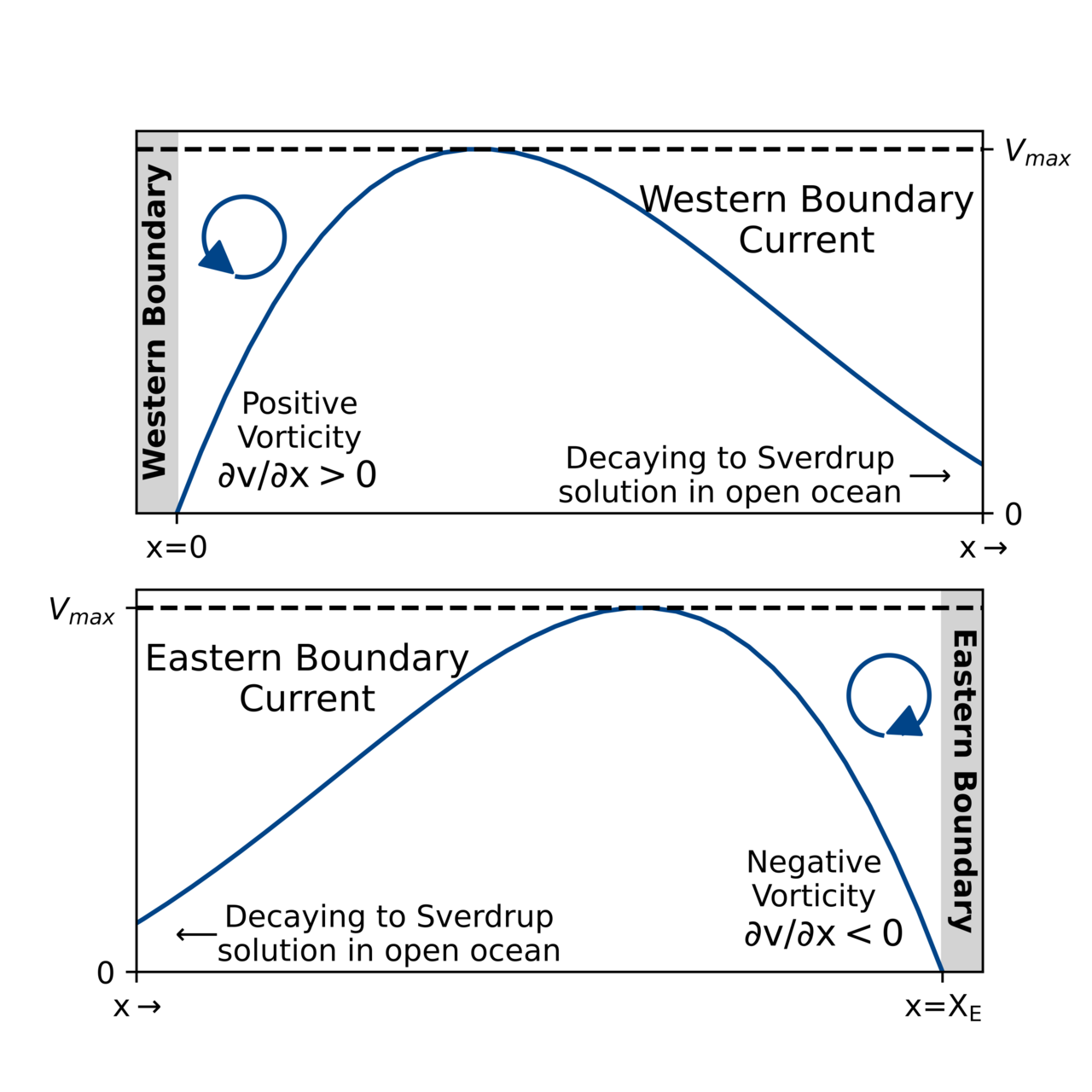
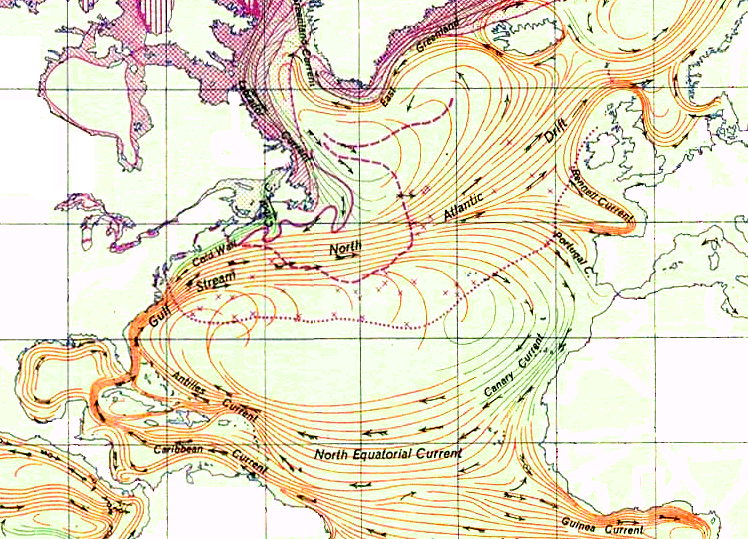
Subtropical gyres tend to have a convergent center with relatively calm seas and downwelling, and stronger boundary currents on their western edges due to western intensification. These western boundary currents (for example, the Gulf Stream and Kuroshio) transport large amounts of heat poleward. There are also subpolar gyres at higher latitudes dominated by cyclonic circulation. The term gyre is sometimes used more generally for any large-scale vortex, including similar patterns in the atmosphere (atmospheric gyres), but its primary use in modern science is within oceanography.
Environmental and human significance
Gyres are important to climate because they redistribute heat between equatorial and polar regions, influence regional weather, and affect sea surface temperature. Biologically, gyres shape productivity patterns: convergent centers can concentrate plankton and debris, while boundary currents support productive fisheries. A well-known consequence of gyre convergence is the accumulation of floating debris and microplastics in quasi-stable zones often referred to in public discourse as "garbage patches"; these are symptoms of the ocean’s tendency to concentrate buoyant material in gyre interiors.
Scientific study and historical context
Understanding gyres developed through a combination of ship observations, theoretical fluid dynamics and later, satellite remote sensing. Pioneering work on wind-driven ocean circulation and concepts such as Ekman transport and western intensification provided the theoretical framework; later observational technologies allowed mapping of surface currents, sea-surface height and drifting objects. Modern models combine these approaches to study how gyres respond to changing wind patterns, melting polar ice and long-term climate variability.
Distinctions and important facts
- Gyre versus local eddy: a gyre is a basin-scale, persistent circulation, while eddies are smaller, transient vortices.
- Gyres concentrate floating material, but they are dynamic — the precise location and intensity of accumulation zones change with winds and seasons.
- Research continues into how climate change will alter gyre strength and position; shifts could affect heat transport, fisheries and debris distribution.
For more technical or introductory materials about the processes described above see: major ocean current systems, Coriolis effect overview, Earth rotation and ocean dynamics, hemispheric circulation patterns, wind forcing on the ocean, wind torque and ocean spin, latitude dependence of the Coriolis effect, vorticity in fluid dynamics, surface friction effects, definition of a vortex, atmospheric gyres compared, and oceanographic perspectives.
Questions and answers
Q: What is a gyre?
A: A gyre is a large system of ocean currents moving in a circle.
Q: What causes gyres?
A: Gyres are caused by the Coriolis effect.
Q: How do ocean currents move in the northern hemisphere?
A: Ocean currents in the northern hemisphere tend to move in a clockwise direction.
Q: How do ocean currents move in the southern hemisphere?
A: Ocean currents in the southern hemisphere move in an anti-clockwise direction.
Q: What is the Coriolis force?
A: The Coriolis force is a force that acts most strongly on the wind and creates a torque that tends to spin the ocean currents.
Q: Why are gyres pushed against the eastern coast of continents?
A: Gyres form strong currents on the western side of oceans and are pushed against the eastern coast of continents.
Q: What balances out the vorticity of gyres?
A: Frictional surface currents normally act against the spin of the water and balance out the vorticity of gyres, but in the middle of the ocean, the effects of friction are very weak.
Related articles
Author
AlegsaOnline.com Ocean gyre: large-scale circular ocean current systems Leandro Alegsa
URL: https://en.alegsaonline.com/art/71841
Sources
- bbc.co.uk : "Gyres and the Coriolis effect"
- books.google.com.au : Climate and the Oceans
- www-pord.ucsd.edu : "The five most notable gyres"