
Oceanic trench
Deep, narrow depressions on the seafloor formed where one tectonic plate descends beneath another; sites of intense geology, unique ecosystems, seismic hazards, and deep‑sea exploration.
Overview
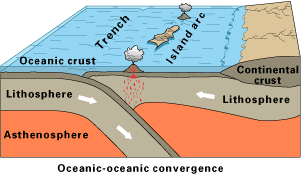
Oceanic trenches are long, narrow depressions in the seafloor that mark the boundary where one tectonic plate bends and sinks beneath another. These features are among the deepest parts of the oceans and are key surface expressions of plate tectonics. Trenches are typically linear, have steep sides, and can extend for thousands of kilometres. They are most often associated with subduction zones, where an older, denser oceanic plate descends beneath either another oceanic plate or a continental plate.
Image gallery
6 Images


Formation and structure
Trenches form as a plate flexes downward into the mantle during subduction. The descending plate creates a narrow trough at the contact between plates, and sediments that accumulate near the margin may be scraped off to form an accretionary wedge. The geometry of a trench depends on the age and temperature of the subducting lithosphere, the convergence angle, and sediment supply. Typical widths range from a few tens to over a hundred kilometres, and depths can reach several miles. Around some trenches, volcanic island arcs or continental volcanic belts develop on the overriding plate as fluids released from the sinking slab promote melting in the mantle above it.
Dimensions, seismicity and notable examples
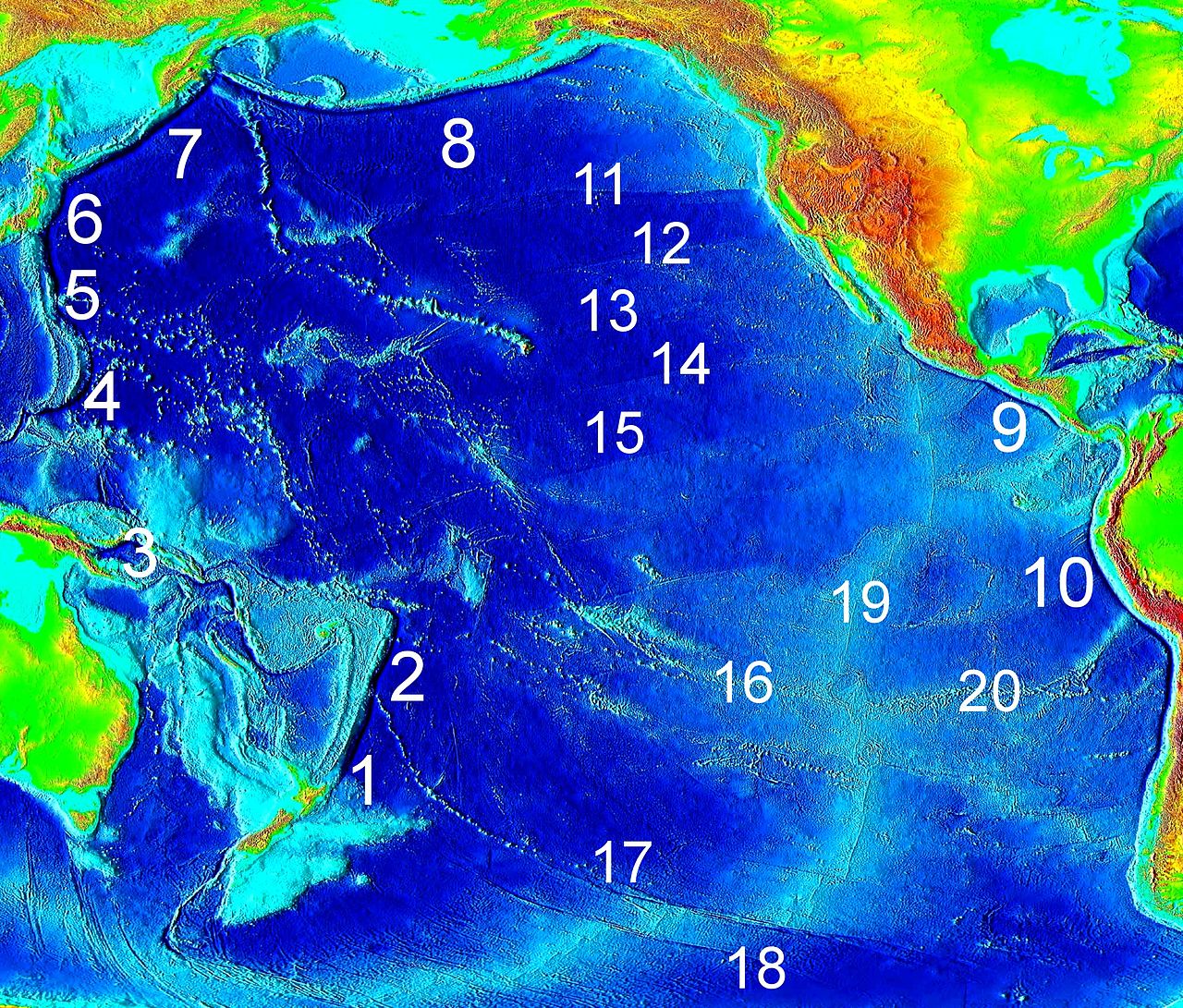
Individual trenches vary widely in size. Some are thousands of kilometres long; widths may be tens to more than a hundred kilometres; and maximum depths reach roughly 11,000 metres in the deepest known places. Trenches are active earthquake zones because the process of one plate descending past another produces frequent and sometimes very large earthquakes, which can generate tsunamis. Well‑known trenches include the Mariana Trench with the Challenger Deep—commonly cited near 11,000 m as the greatest measured depth—the Peru–Chile (Atacama) Trench, the Aleutian Trench, and the South Sandwich Trench. Human exploration of trenches has been intermittent: the bathyscaphe Trieste reached the deepest point in 1960 and later solo and remotely operated dives have explored these extreme depths.
Ecology and geological importance
The deepest trench floors define the hadal zone, an environment of near‑freezing temperatures, crushing pressure, and limited food. Despite these extremes, specialized microbial communities and scavenging animals inhabit trenches, often adapted to low energy conditions. Geologically, trenches control the recycling of oceanic crust into the mantle, influence volcanic activity, and play a role in long‑term carbon and sediment redistribution by trapping and burying organic material delivered from continental margins.
Hazards and human relevance
Because trenches concentrate strain where plates converge, they are the sites of great earthquakes and the tsunamis that sometimes follow. Coastal regions near subduction zones are among the most vulnerable to these hazards. Trenches are also targets for scientific study because they preserve records of past earthquakes and climate through thick sediment accumulations and because they test limits of life and technology in oceanography and engineering.
Further resources
- Plate density and buoyancy concepts
- Tectonic plate interactions explained
- Subduction zone processes
- Mariana Trench and Challenger Deep details
- Seismicity near trenches
- Tsunami generation at subduction zones
- Island arc formation and examples
- Seafloor topography and bathymetry
- Trench geometry and concave margins
- Aleutian region and volcanic arcs
- Guam and western Pacific settings
- Eurasian plate boundaries
- South Sandwich Trench overview
- Peru–Chile (Atacama) Trench
- Antarctic margin and nearby trenches
Questions and answers
Q: What is an ocean trench?
A: An ocean trench is a long, narrow feature on the ocean floor caused when an oceanic crustal plate slides under a lighter continental plate or another oceanic plate.
Q: How are trenches formed?
A: Trenches are typically caused by subduction, which is when one plate slides under another. This process works by density.
Q: How deep can an ocean trench be?
A: Ocean trenches can be 1,500 miles (2,400 km) long, several miles deep and as much as 70 miles (112 km) wide. The deepest known spot in any ocean is the Challenger Deep of the Mariana Trench at 11,034 m (36,201 ft) below sea level.
Q: What type of activity occurs in trenches?
A: Trenches are active with earthquakes and resulting tsunamis. Most volcanism associated with trenches occurs on the continent rather than on the sea floor.
Q: Are there any notable examples of trenches around the world?
A: Yes, some notable examples include the South Sandwich Trench between South America and Antarctica; the Peru-Chile Trench; and the Aleutian Trench near Guam where Pacific Plate descends under Eurasian Plate - this trench has been measured at 36,201 feet - over 6.8 miles (11 km) deep!
Q: Who reached bottom of Mariana Trench in 1960? A: Two men in a bathyscaph Trieste reached bottom of Mariana Trench in 1960.
Related articles
Author
AlegsaOnline.com Oceanic trench Leandro Alegsa
URL: https://en.alegsaonline.com/art/71854
Sources
- ui.adsabs.harvard.edu : 2002GSAB..114..927R
- doi.org : 10.1130/0016-7606(2002)114<0927:ROPCAD>2.0.CO;2
- bbc.co.uk : bbc.co.uk/news/science-environment-21520404