
Neutrino: properties, origins, detection, and scientific importance
Neutrinos are neutral, nearly massless elementary particles produced in nuclear processes. This article describes their properties, types, production, detection methods, history, and roles in astrophysics and particle physics.
Overview
Neutrinos are elementary particles that carry no electric charge and interact primarily through the weak nuclear force and gravity. Because their interactions with matter are so feeble, neutrinos travel long distances with very low probability of collision, giving them the reputation of "ghostly" or elusive particles. They are produced in enormous numbers in stars, in radioactive decays, in natural and human-made nuclear reactions, and in energetic astrophysical events, and many travel at speeds very close to the speed of light.
Image gallery
8 Images





Basic properties and types
There are three known neutrino flavors, each paired with a charged lepton: the electron neutrino, the muon neutrino, and the tau neutrino. Each flavor has a corresponding antiparticle, called an antineutrino. For a long time neutrinos were treated as massless in the simplest models, but experiments have demonstrated that they have a very small, nonzero mass. The precise absolute masses remain unknown, and open questions include the ordering of the mass states (normal or inverted) and whether neutrinos are Dirac particles (distinct from their antiparticles) or Majorana particles (their own antiparticles).
Interactions and role in the Standard Model
Neutrinos interact via the weak interaction, through processes mediated by the W and Z bosons. In charged-current interactions a neutrino converts to its associated charged lepton and transfers charge via a W boson; in neutral-current interactions a neutrino scatters without changing its flavor via a Z boson. Because neutrinos lack electric charge they do not participate in electromagnetic interactions and are unaffected by Coulomb forces, which contributes to their low interaction probability with ordinary matter.
Production and natural sources
Common neutrino sources include the Sun and other stars (thermonuclear fusion processes in stellar cores), radioactive decay in the Earth and in laboratories (beta decay produces electron antineutrinos), nuclear reactors, particle accelerators that produce focused beams of neutrinos, interactions of cosmic rays with the atmosphere that yield atmospheric neutrinos, and violent astrophysical events such as core-collapse supernovae and compact-object mergers that generate intense short bursts of neutrinos. There is also a cosmic neutrino background of very low-energy relic neutrinos left over from the early universe.
Neutrino oscillation and implications for mass
A key discovery about neutrinos is flavor oscillation: a neutrino born as one flavor can change into another as it propagates. Oscillation is a quantum-mechanical effect that arises because flavor states are quantum superpositions of mass eigenstates with different masses and phases. Observation of oscillation therefore implies that at least two neutrino mass eigenstates have nonzero mass. Oscillations resolved the historical deficit of observed solar electron neutrinos compared with early theoretical expectations: many electron neutrinos produced in the Sun arrive at Earth transformed into muon or tau flavors.
Detection techniques and major experiments
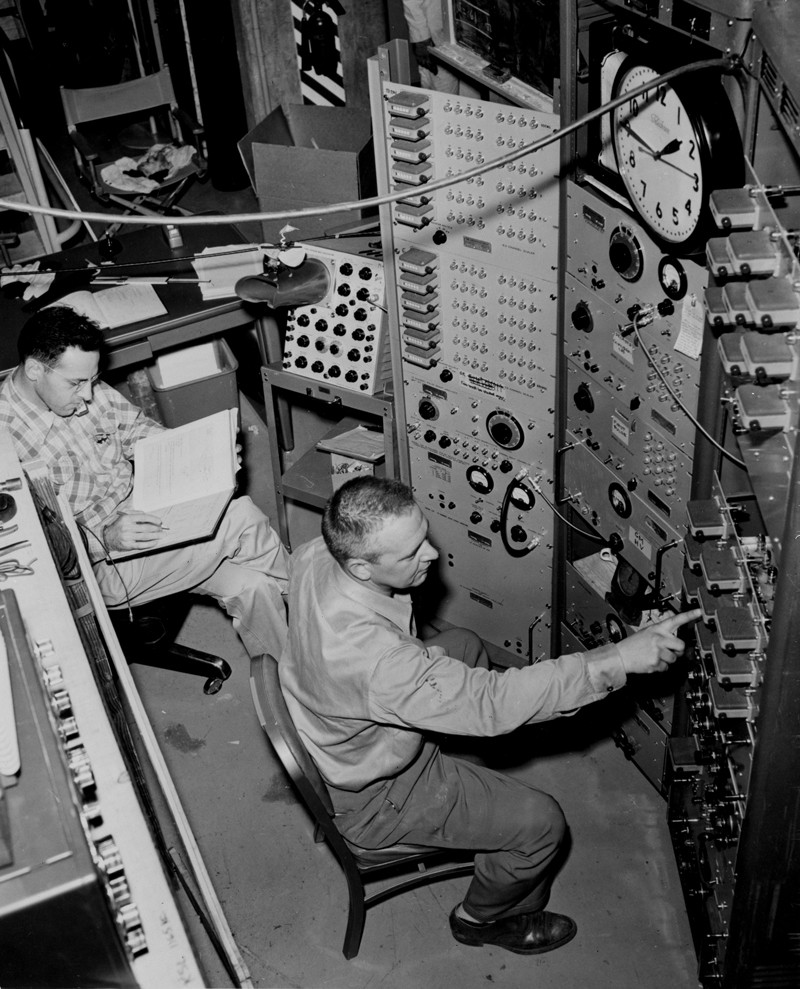
Detecting neutrinos requires very large detectors and careful background suppression because individual interaction probabilities are tiny. Techniques include radiochemical methods that accumulate and later count reaction products, large water or heavy-water Cherenkov detectors that capture light from charged particles produced by neutrino interactions, liquid scintillator detectors that register light from energy deposited, tracking calorimeters, and very large natural detectors using Antarctic ice or deep-sea water instrumented with optical sensors to study high-energy cosmic neutrinos. Representative experiments include radiochemical solar detectors, Super-Kamiokande and other water Cherenkov observatories, heavy-water detectors that established flavor conversion, long-baseline accelerator experiments that probe oscillation parameters, and large arrays such as IceCube that map the high-energy neutrino sky.
Solar, atmospheric and geoneutrinos
Solar neutrinos arise from chains of fusion reactions in the Sun's core and provide a direct probe of those nuclear processes. Atmospheric neutrinos are produced when cosmic rays strike the upper atmosphere and create showers of secondary particles that decay to produce neutrinos of different flavors and energies. Geoneutrinos are electron antineutrinos produced by radioactive decays of elements such as uranium and thorium inside Earth; their detection helps constrain models of Earth's heat production and composition.
Astrophysical neutrinos and their uses
Neutrinos convey information from regions that are opaque to electromagnetic radiation. For example, neutrinos from a core-collapse supernova escape the dense interior before photons and were detected from Supernova 1987A, providing crucial tests of collapse models. High-energy neutrinos detected from extragalactic sources serve as unique messengers of particle acceleration and hadronic processes in active galaxies, gamma-ray bursts, and other extreme environments, enabling a complementary view to electromagnetic and gravitational-wave observations.
Open questions and experimental goals
Active research areas include precise determination of the neutrino mass scale and ordering, measurements of the neutrino mixing angles and possible CP-violating phases in the lepton sector, searches for neutrinoless double beta decay which would reveal whether neutrinos are Majorana particles, improved measurements of solar and atmospheric fluxes, and identification of astrophysical neutrino sources. These questions have implications for fundamental particle physics, the origin of matter–antimatter asymmetry, and cosmology.
History and notable milestones
The neutrino was first postulated in 1930 to account for missing energy and angular momentum in beta decay. The first direct experimental detection of neutrinos came decades later and established their reality. Subsequent experiments discovered neutrino oscillations and thus nonzero mass, which marked a major extension of the original Standard Model framework for elementary particles. Nobel Prizes have been awarded for several experimental breakthroughs that clarified neutrino behavior and opened new observational windows on the universe.
Further reading and resources
- Basic introduction to neutrinos
- How neutrinos interact with matter
- Neutrinos passing through the Earth
- Particle interactions and scattering
- Neutrino velocities and relativistic behaviour
- Charged leptons and electromagnetic charge
- Neutrino beams from particle accelerators
- Solar neutrino production
- Nuclear reactions that emit neutrinos
- Reactor neutrino experiments
- Beta decay and neutrino emission
- Historical views on neutrino mass
- Cosmological implications of neutrinos
- Leptons and the Standard Model
- Electron neutrino specifics
- Muon neutrino specifics
- Tau neutrino specifics
- Notation for neutrino flavors
- Antineutrinos and antiparticles
The study of neutrinos remains a dynamic field at the intersection of particle physics, astrophysics and cosmology. Continuing experiments aim to refine our quantitative understanding of neutrino properties and to exploit neutrinos as probes of otherwise hidden processes in the universe.
Related articles
Author
AlegsaOnline.com Neutrino: properties, origins, detection, and scientific importance Leandro Alegsa
URL: https://en.alegsaonline.com/art/69385
Sources
- news.sciencemag.org : news.sciencemag.org/scienceinsider/2012/06/once-again-physicists-debunk.html
- arxiv.org : astro-ph/0412440
- ui.adsabs.harvard.edu : 2005ApJ...621L..85B
- doi.org : 10.1086/428929