
Newton's law of universal gravitation
Statement and explanation of Newton's universal law of gravitation, its formula, history, applications, units, limitations, and key properties in classical physics.

Newton's law of universal gravitation is a fundamental principle of classical physics that describes the attractive force between any two masses. In its simplest modern form the law states that every pair of point masses attracts one another with a force directed along the line that joins them and whose magnitude depends on the product of their masses and the inverse square of their separation. This concise description is one way to understand the general phenomenon of gravitational attraction that governs motion from falling apples to planetary orbits.
Image gallery
4 Images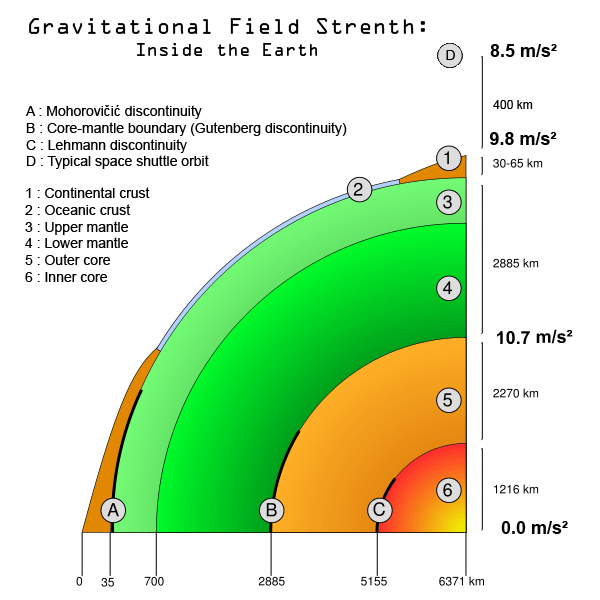


Formula and symbols
The quantitative statement of the law is commonly written as F = G m1 m2 / r^2. Here F is the magnitude of the gravitational force between two point objects, m1 and m2 are their masses, r is the distance between their centers, and G is the universal gravitational constant. A diagram or derivation is often shown alongside the formula to indicate center-to-center separation and vector direction.
When applied to extended bodies, the law is used by integrating contributions from all mass elements; for many symmetric bodies (spherical masses, thin shells) the result is equivalent to treating each body as if its mass were concentrated at its center. The law fits within the framework of classical mechanics and can explain Kepler's laws of planetary motion when combined with Newton's second law of motion.
Units and numerical constant
In the International System of Units (SI units) the force F is measured in newtons (N), masses in kilograms (kg), and distances in metres (m). The constant G has an experimentally determined value of approximately 6.674×10⁻¹¹ in SI units (N·m2·kg−2). Because G is very small, gravitational forces between everyday objects are negligible compared with other forces such as electromagnetic contact forces.
History and development
The law appears in Isaac Newton's work and synthesis of earlier ideas about motion and planetary behavior; readers can consult sources on Isaac Newton and his Principia for historical context. Newton showed that an inverse-square gravitational force produces the elliptical orbits described empirically by Kepler. Experimental measurement of G and of Earth's mass and density came later, notably in late 18th-century experiments that estimated the constant and refined numerical values used in engineering and astronomy.
Applications, limitations, and notable properties
- Applications: predicting satellite trajectories, calculating orbital periods, planning space missions, estimating tides, and solving many engineering and geophysical problems.
- Key properties: the force obeys an inverse-square law and superposes linearly—forces from multiple masses add vectorially.
- Limitations: Newton's law is an excellent approximation for most everyday and celestial situations but is superseded by general relativity in regimes involving very strong gravity, very high precision, or the need to account for spacetime curvature.
- Examples: the Sun–Earth attraction governs Earth's orbit; near a planet's surface the law reduces to the familiar near-constant gravitational acceleration used for free-fall calculations.
Taken together, Newton's law of universal gravitation provided a unifying, quantitative description of gravity that transformed natural philosophy into predictive mathematical science. It remains one of the cornerstone laws taught in physics and engineering, both as a practical tool and as a historical milestone linking observation, experiment, and theory.
Related articles
Author
AlegsaOnline.com Newton's law of universal gravitation Leandro Alegsa
URL: https://en.alegsaonline.com/art/69824
Sources
- csep10.phys.utk.edu : "Sir Isaac Newton: The Universal Law of Gravitation"
- doi.org : 10.1103/RevModPhys.88.035009