
Newton metre (N·m) — SI unit of torque and moment
The newton metre (N·m) is the SI derived unit for torque and moment of force. Dimensionally equal to a joule but conceptually distinct; used in mechanics, engines, and engineering measurements.
The newton metre, written N·m (also spaced as N m or hyphenated as newton-metre), is the International System (SI) derived unit for a moment of force or torque. In plain terms it quantifies the turning effect produced when a force acts at some distance from a pivot. The quantity is often called a moment or, more specifically in rotational contexts, torque.
Image gallery
1 Image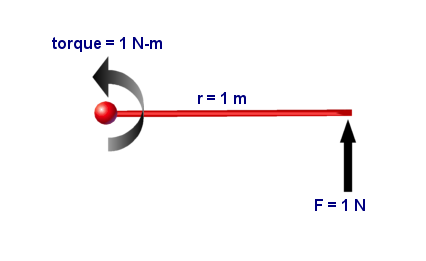
Definition and dimensional form
One newton metre is defined as the moment generated by a force of one newton applied perpendicularly at a lever arm of one metre. Using vector notation, torque τ = r × F, so the SI unit is metre·newton, commonly written N·m. Dimensionally the unit is equivalent to kg·m²·s⁻², which is the same base-unit combination as the joule.
Although a newton metre and a joule share the same dimensions, they represent different physical concepts: a joule denotes energy or work done, while a newton metre expresses rotational tendency. For clarity, energy is usually reported as joules and torque as newton metres.
Usage and examples
The newton metre is used across engineering and physics wherever rotational forces are important. Typical examples include:
- Automotive engine torque ratings, which describe the twisting power produced by the crankshaft.
- Wrenches and fasteners, where specified torque ensures proper tightening without damage.
- Electric motors and gearboxes, where torque determines load capacity and acceleration.
Practical calculations are straightforward: applying a 5 N force at 0.2 m from a pivot produces a torque of 1 N·m (5 × 0.2). Instrumentation such as torque wrenches and dynamometers directly report readings in N·m or in other units converted to N·m.
Notable distinctions and conventions: SI prefers the multiplication dot or a space in the symbol N·m rather than concatenation. In some industries and older literature, imperial units like pound-foot (lb·ft) are encountered; conversion to newton metres is routine in international contexts. Because of the dimensional equality with energy, authors and engineers should avoid using N·m to express energy to prevent conceptual confusion.
Related articles
Author
AlegsaOnline.com Newton metre (N·m) — SI unit of torque and moment Leandro Alegsa
URL: https://en.alegsaonline.com/art/69814