
Mount Silverthrone: Silverthrone Caldera in the Ha-Iltzuk Icefield (British Columbia)
Mount Silverthrone is a 20 km-wide, deeply dissected caldera complex in southwestern British Columbia. Formed by Pleistocene volcanism, it is heavily glaciated and is the highest point of the Ha‑Iltzuk Icefield.
Overview
Mount Silverthrone is a large volcanic caldera complex in the remote southwestern portion of British Columbia, Canada. The caldera measures roughly 20 kilometres across and occupies a central position within the Ha‑Iltzuk Icefield, the largest icefield in the Coast Mountains south of the Alaska Panhandle. The mountain and its surrounding glacial landscape are most commonly referred to as the Silverthrone Caldera.
Image gallery
2 Images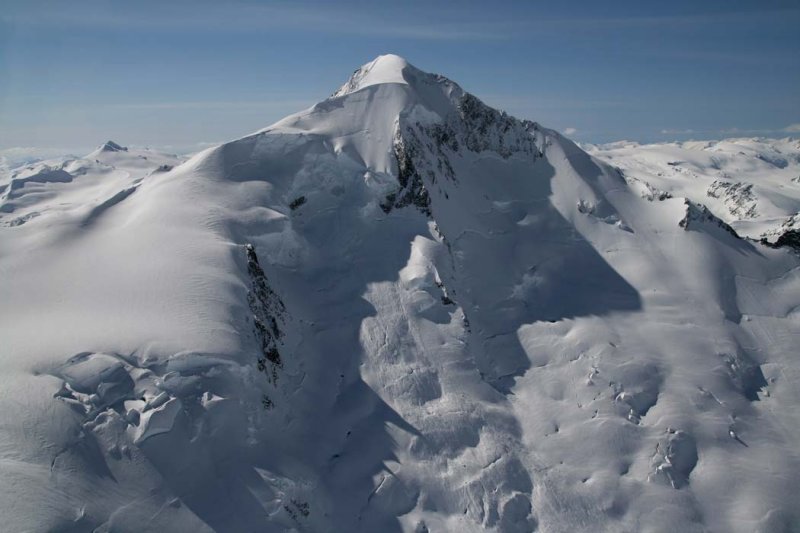

Geology and physical characteristics
The complex is a product of Pleistocene volcanism. Many of its eruptions took place during the last ice age, producing volcanic deposits that were subsequently altered and sculpted by thick glacial ice. Because volcanic activity and glaciation overlapped in time, some eruptions show features typical of subglacial volcanism. Over succeeding millennia, glaciers and weathering have deeply dissected the original volcanic edifice so that its primary structures are now heavily eroded.
Parts and notable features
- Caldera basin: A broadly circular depression formed by large effusive or explosive events, now partly filled and shaped by ice.
- Glacial cover: Extensive icefields and outlet glaciers dominate the scenery and obscure many volcanic outcrops.
- Volcanic remnants: Eroded domes, lava flows and pyroclastic deposits remain as fragmented ridges and isolated peaks.
History and development
Most documented volcanic activity at Mount Silverthrone occurred during the Pleistocene epoch. Because the eruptions coincided with glacial advances, researchers interpret much of the volcanic record as being modified by or produced beneath glaciers. Following the end of the last ice age, continued glacial erosion and post‑glacial weathering reduced much of the original volcanic relief, leaving the deeply dissected terrain visible today.
Importance, uses and access
Mount Silverthrone is primarily of interest to volcanologists and glaciologists studying interactions between ice and magma, and to mountaineers seeking remote, glaciated terrain. Access is difficult: travel requires long approaches by helicopter, ski‑plane, or extended overland routes through rugged Coast Mountains terrain. Visitors must be prepared for crevasses, unstable weather and limited rescue options.
Notable distinctions and further resources
The Silverthrone Caldera is one of Canada’s larger caldera systems and forms the highest point within the Ha‑Iltzuk Icefield. Its combination of volcanic structures and heavy glaciation makes it a clear example of how Pleistocene volcanism can be reshaped by ice. For regional context and geological summaries, see resources on caldera complexes and glaciovolcanic interaction: caldera overview, Ha-Iltzuk Icefield notes, Coast Mountains geology, Pleistocene volcanism, and specific studies or trip reports at further readings.
Related articles
Author
AlegsaOnline.com Mount Silverthrone: Silverthrone Caldera in the Ha-Iltzuk Icefield (British Columbia) Leandro Alegsa
URL: https://en.alegsaonline.com/art/67090
Sources
- peakbagger.com : "Silverthrone Mountain, British Columbia"