
Mudrock: fine-grained siliciclastic sedimentary rocks and their importance
Mudrocks are the most abundant fine-grained sedimentary rocks. This article explains their composition, types, classification challenges, history, uses, and significance for fossils, resources and engineering.
Overview
Mudrocks are a broad class of fine-grained siliciclastic rocks that together form a major component of the Earth's sedimentary cover. They are commonly grouped with other sedimentary rocks but are distinct because most of their constituent particles are smaller than about 0.0625 mm. Because of their abundance and widespread distribution, mudrocks exert a large influence on landscapes, sedimentary basins and the preservation of fossils.
Image gallery
10 Images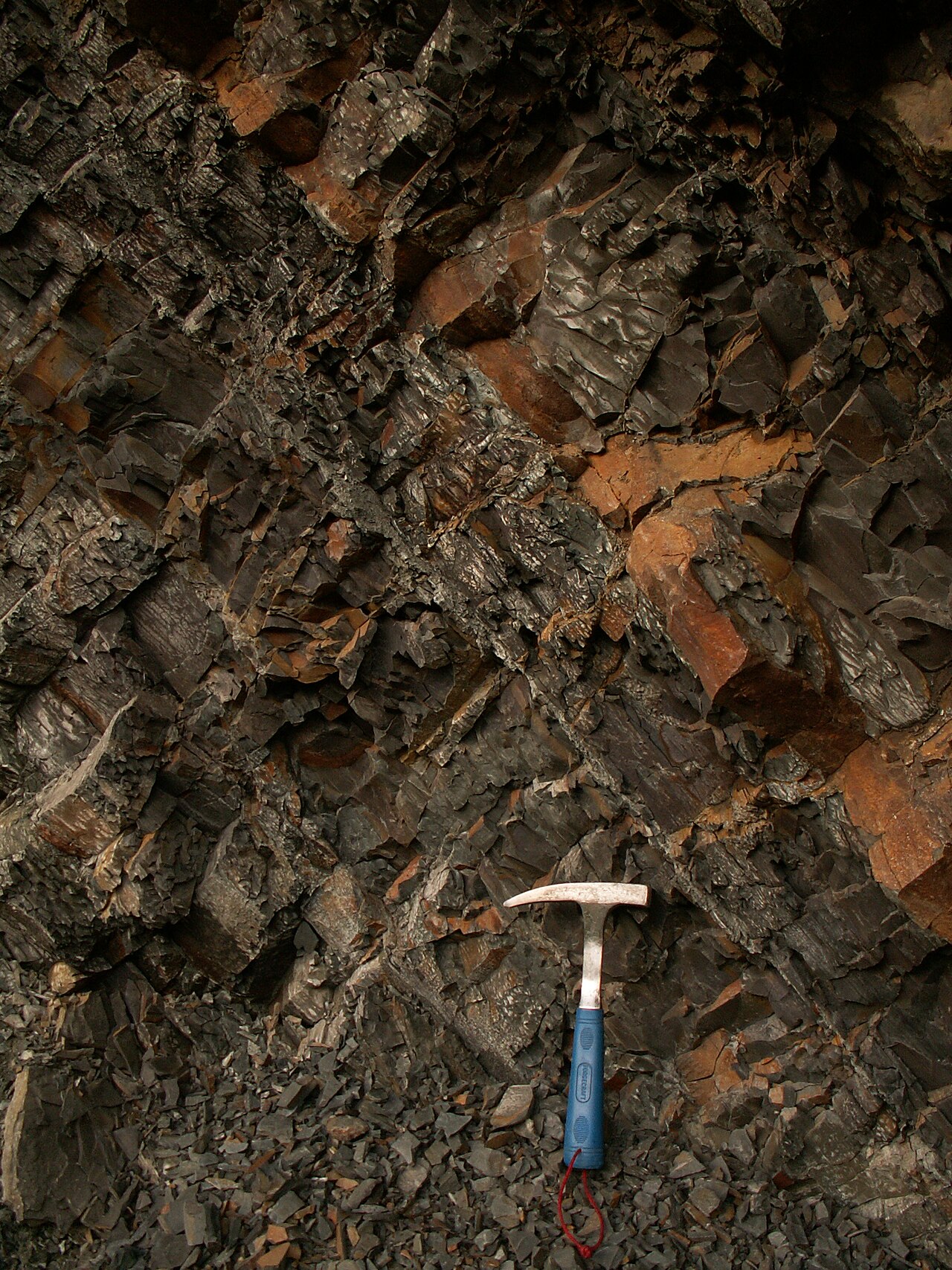




Characteristics and composition
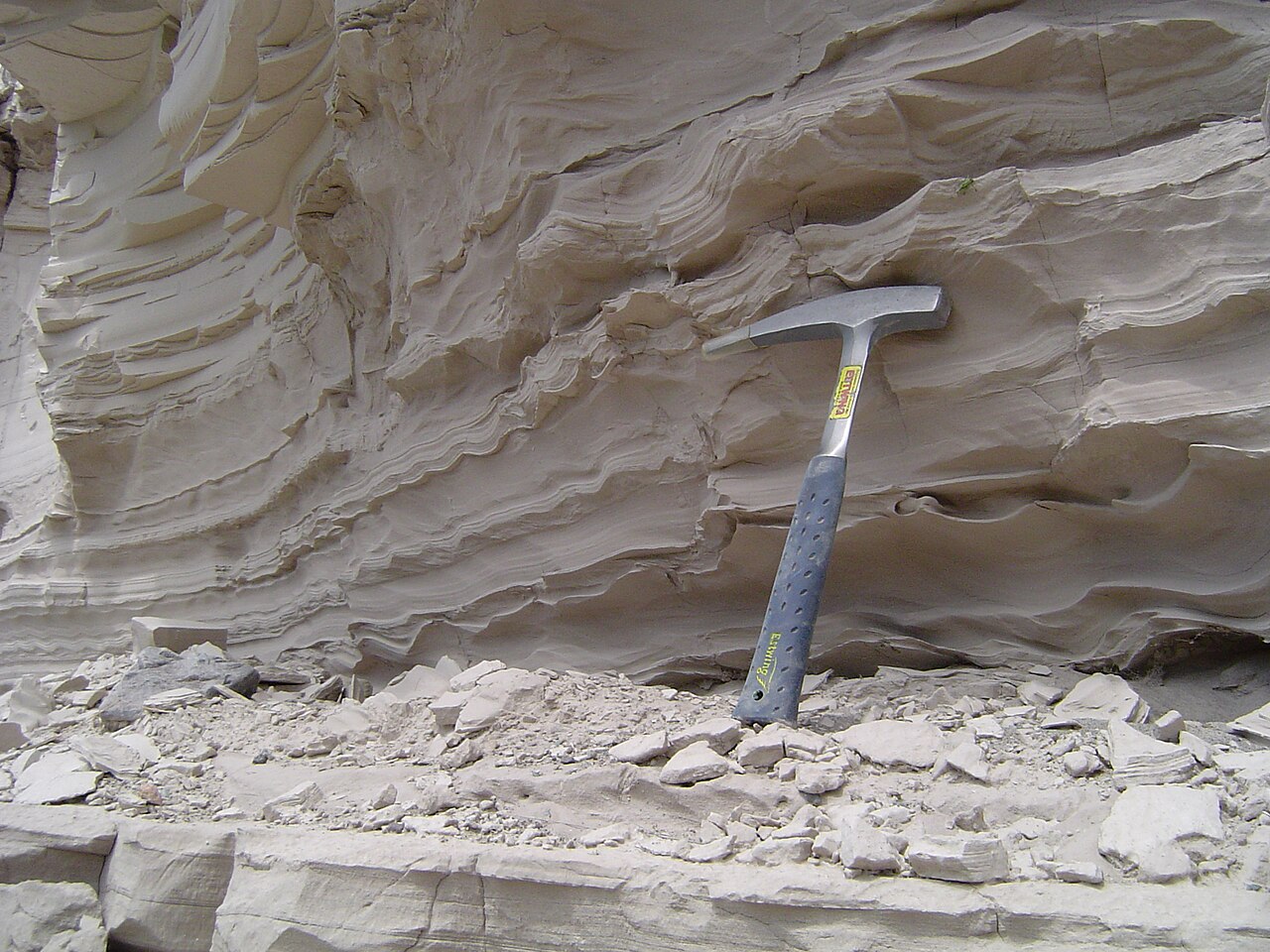
Mudrocks are dominated by very small particles of clay and silt. The clay-sized fraction is typically composed of plate-like phyllosilicate minerals (often loosely referred to as clay minerals) while the silt fraction contains finer quartz and feldspar fragments. At burial depths and under increasing pressure these platy clay minerals tend to orient parallel to bedding, producing thin, laterally continuous laminae and sometimes a splitable fabric called fissility. When fissility is pronounced the rock is commonly called shale, whereas non-fissile, blocky varieties are often labeled mudstone.
Common types
- Siltstone — coarser member of the mudrock family with a larger silt fraction.
- Claystone — dominated by clay-sized particles and often very soft when fresh.
- Mudstone — massive, non-fissile mudrock.
- Slate — a low-grade metamorphic rock derived from mudrocks with a well-developed slaty cleavage.
- Shale — fissile, finely laminated mudrock that splits easily along bedding planes.
Classification challenges
Geologists have debated mudrock classification for decades. Three practical difficulties make classification complicated: (1) the primary particles are tiny and hard to observe or measure in the field, (2) mudrocks can contain variable proportions of clay, silt and organic matter that change their behaviour, and (3) several competing schemes exist for naming rocks by grain size, composition or texture. Because of these factors, researchers often combine petrographic microscopy, grain-size analysis and chemical tests to assign a formal name.
History, fossils and human use
Mud-rich sediments have been used by humans since the earliest settled societies to make pottery and sun-dried mudbricks. Scientifically, notable deposits such as the Burgess Shale demonstrated the exceptional fossil preservation potential of anoxic muds, changing our understanding of early animal life. In modern times mudrocks are central to hydrocarbon systems: fine-grained organic-rich mudstones and shales can act both as source rocks for oil and gas and as low-permeability seals that trap hydrocarbons. Engineers and geoscientists routinely evaluate mudrocks for foundations, tunnels and slope stability because their mechanical properties control many civil engineering problems (engineers study them for this reason).
Environmental role and importance
Mudrocks record much of Earth’s sedimentary history because fine sediment is the most common product of weathering and erosion. Their widespread deposition in lakes, floodplains, deltas and deep marine basins preserves details of paleoenvironments, climate change and biological communities. Although they are among the least conspicuous rocks in the landscape, mudrocks are crucial archives for sedimentologists, paleontologists and basin analysts seeking to reconstruct past environments and to locate natural resources.
Notable distinctions and practical notes
- Fissility versus massive fabric is a key field distinction: shale splits, mudstone does not.
- Terminology may vary by region and by whether the focus is grain size, mineralogy or engineering behaviour.
- Mudrocks may alter into slates and phyllites under low-grade metamorphism, changing their mechanical and cleavage properties.
Because their tiny particles make them challenging to study, modern investigations of mudrocks often combine traditional fieldwork with laboratory grain-size distributions, X-ray mineralogy and geochemical fingerprinting to build a comprehensive picture of their origin and role in Earth systems.
For further reading on sedimentary rock types and classification see general references on sedimentary rocks and specialized discussions of siltstone, mudstone, slate, shale, the processes of erosion and the influence of clay minerals. The human and industrial connections are highlighted in sources addressing early civilization, traditional pottery, engineering applications (engineers) and landmark fossil sites such as the Burgess Shale, as well as economic studies of oil-bearing shales.
Questions and answers
Q: What are mudrocks?
A: Mudrocks are a class of fine-grained siliciclastic sedimentary rocks. They make up most of the sedimentary rocks on Earth and include siltstone, claystone, mudstone, slate, and shale.
Q: How small are the particles in mudrocks?
A: The particles in mudrocks are less than 0.0625 mm (1/16th mm or 0.0025 inches) which is too small to study readily in the field.
Q: Why is there disagreement about the classification of mudrocks?
A: There is disagreement about the classification of mudrocks due to their tiny size making them difficult to study, multiple accepted classification schemes by scientists, and because they are one of the least understood and understudied sedimentary rocks to date.
Q: How common are mudrocks?
A: Mudrocks make up half of all sedimentary rocks in the geologic record and are easily one of the most widespread deposits on Earth due to fine sediment being an abundant product of erosion.
Q: What happens when pressure increases over time with regards to mudrock composition?
A: When pressure increases over time with regards to mudrock composition, platey clay minerals may become aligned with parallel layering (fissility). This material which splits into thin layers is called shale as distinct from mudstone.
Q: How have humans used mudrock since ancient times?
A: Humans have been using mudrock since ancient times for pottery and making bricks by hand - it has always been an important resource for civilization.
Q: When was the first book onmudrock published?
A:The first book onmudrock was not published until 1964
Related articles
Author
AlegsaOnline.com Mudrock: fine-grained siliciclastic sedimentary rocks and their importance Leandro Alegsa
URL: https://en.alegsaonline.com/art/67345