
Mudstone: a fine-grained siliciclastic sedimentary rock
Mudstone is a fine-grained siliciclastic rock made of mixed silt- and clay-sized particles. It forms in low-energy settings, preserves delicate fossils and is distinct from shale by its non-fissile fabric.
Overview
Mudstone is a type of siliciclastic sedimentary rock composed predominantly of very small particles derived from the mechanical and chemical breakdown of preexisting rocks. By common definition it contains a mixture of silt-sized particles and clay-sized particles, typically with a substantial proportion of each. Some references use the term as essentially synonymous with the broader category of mudrock, while others distinguish mudstone from related varieties by grain-size distribution and fabric.
Image gallery
6 Images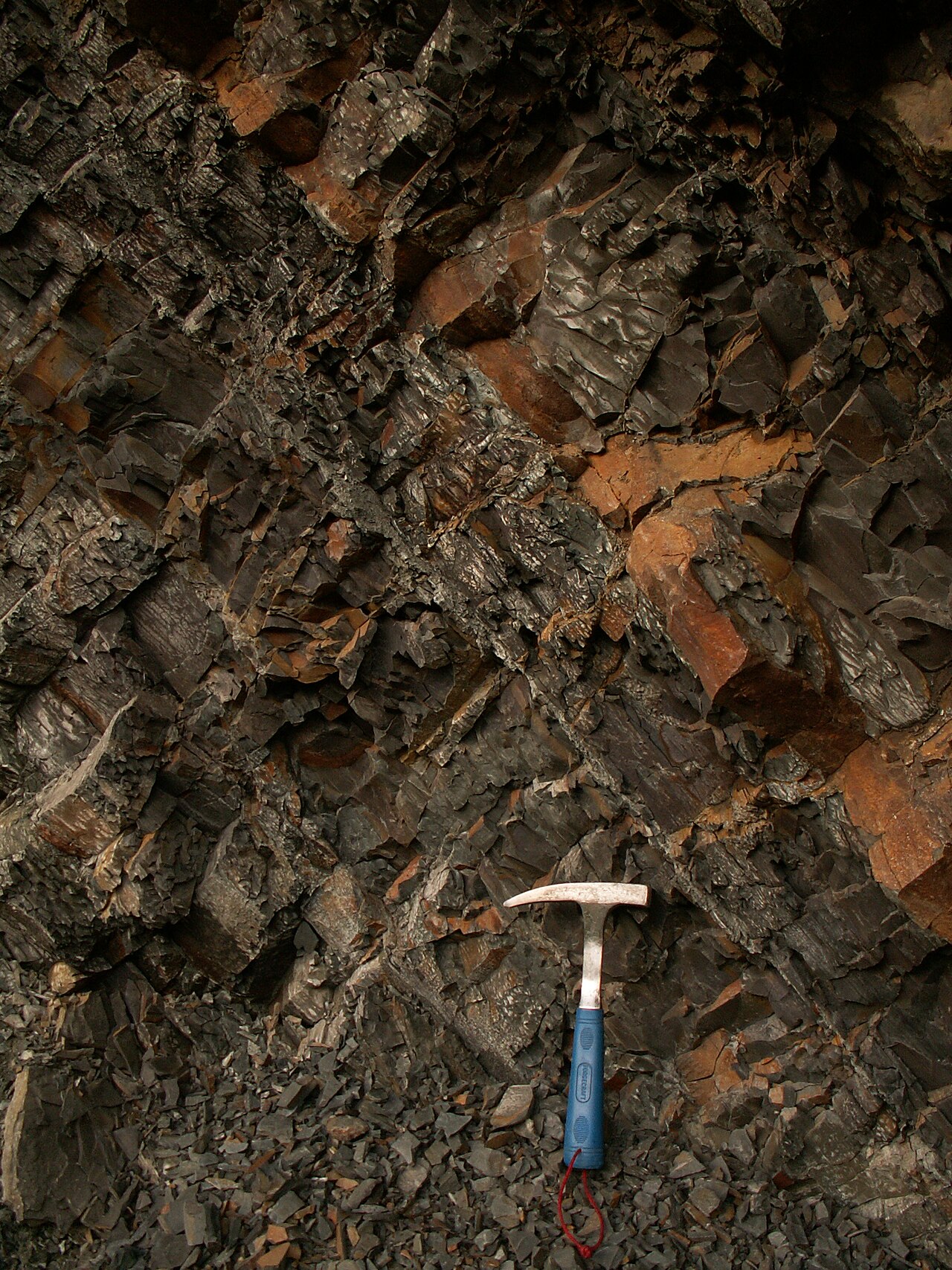




Characteristics and composition
Mudstone is fine grained, usually dull in appearance and commonly exhibits little or no natural fissility (layering that causes easy splitting). Mineralogically it contains clay minerals (such as illite, kaolinite or smectite), fine quartz and feldspar fragments, and variable amounts of organic material. Color ranges widely from gray and brown to green, red or black depending on oxidation state and organic content. Diagenetic processes like compaction and cementation reduce porosity and can alter original textures.
Formation and depositional environments
Mudstones form where water or wind energy is low enough to allow very fine particles to settle out of suspension. Typical settings include lake bottoms, floodplains, river overbank deposits, continental shelves, and deep marine basins. Because settling of fine particles is slow, mudstone beds often record quiet intervals in an otherwise more active sedimentary sequence. Fine lamination in some mudstones can preserve detailed evidence of seasonal change and small organisms.
Uses, importance and engineering aspects
Mudstones are important in geology as indicators of depositional environment, paleoclimate and basin evolution. Their fine grain size and organic-rich varieties can make them source rocks or seals in petroleum systems. In engineering, mudrocks may present challenges: some contain swelling clays that change volume when wet, and many have low permeability but poor strength, affecting foundations and slopes. They are sometimes used as construction fill or, when indurated, as building stone.
Distinctions and notable facts
- The term mudstone is often contrasted with shale, which is a fissile, laminated mudrock that splits readily into thin sheets.
- Siltstone and claystone are end-members defined largely by the dominant grain sizes; mudstone contains a significant mix of both.
- Classification schemes vary; some authorities treat mudstone as a subset of mudrock while others use it more narrowly. See further discussion at siltstone reference and terminology notes.
For more introductory material on sedimentary rocks and grain-size classification consult textbooks or online primers; a short glossary entry can clarify how these terms are applied in field descriptions and laboratory analysis. Additional resources: silt, clay, and broader discussions of siliciclastic sedimentation provide useful context.
Related articles
Author
AlegsaOnline.com Mudstone: a fine-grained siliciclastic sedimentary rock Leandro Alegsa
URL: https://en.alegsaonline.com/art/67347