
Middle Eastern theatre of World War I
The broad series of campaigns fought in and around the Ottoman Empire (1914–1918), shaping postwar borders, mandates and regional politics.
The Middle Eastern theatre of World War I was a vast and diverse zone of operations where the Entente (notably Britain and Russia) and the Central Powers contested control of territory, sea lanes and imperial frontiers. It is often described as a separate theatre because fighting extended across deserts, mountains and coasts from the eastern Mediterranean to Persia and the southern Arabian Peninsula. The Ottoman Empire, aligned with the Central Powers, was the primary regional combatant in many campaigns, most notably the Ottoman Empire forces that opposed Allied advances.
Image gallery
10 Images


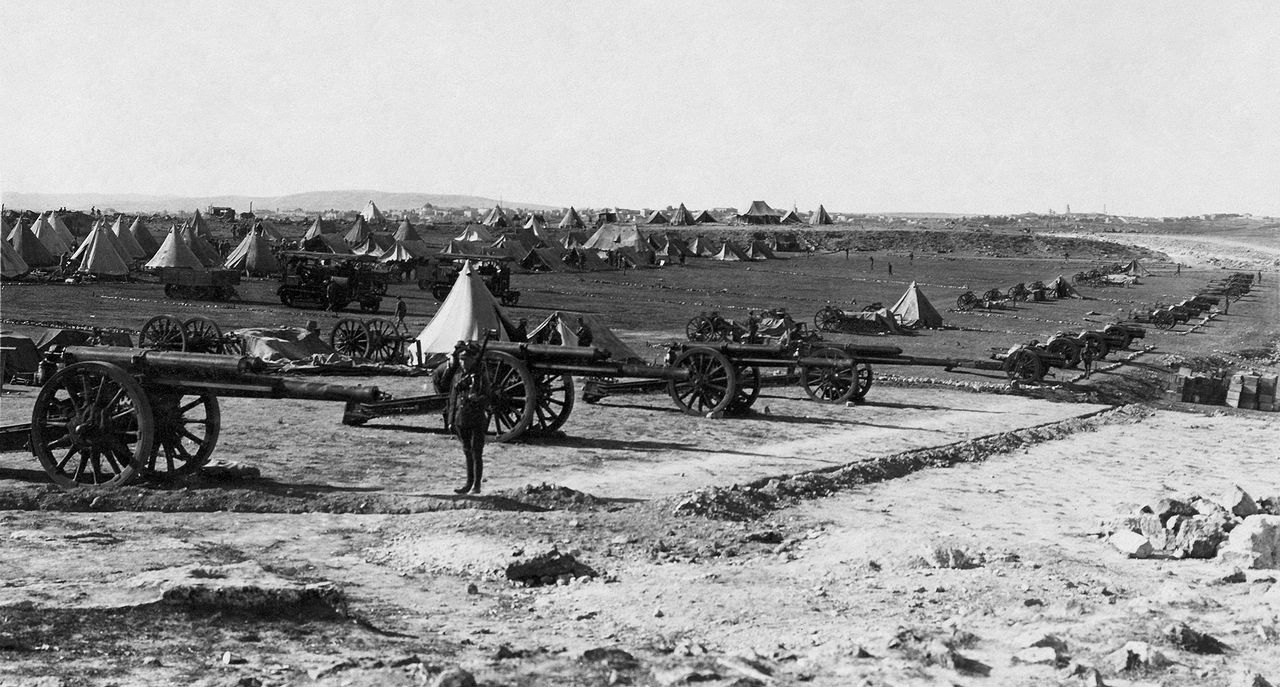


Major campaigns and theatres
The fighting is commonly divided into four main campaigns and several smaller operations. These principal theatres influenced the outcome of the war in the region and the shape of the postwar Middle East:
- Sinai and Palestine — Allied forces advanced from the Suez Canal toward Ottoman Palestine, ultimately defeating Ottoman armies and occupying Jerusalem and later Damascus.
- Mesopotamian Campaign — British and Indian Army units fought along the Tigris and Euphrates, capturing Baghdad after a prolonged struggle.
- Caucasus Campaign — Battles between Ottoman and Russian Empire forces in Anatolia and the South Caucasus involved mountainous warfare and shifting front lines.
- Dardanelles (Gallipoli) — A major amphibious operation aimed at knocking the Ottomans out of the war; the campaign ended in Ottoman defensive success and Allied evacuation.
There were also smaller but strategically significant operations in Arabia, the Hejaz (including the Arab Revolt), southern Arabia and coastal regions such as Aden, as well as military activity in Persia (modern Iran).
Characteristics and participants
Fighting in this theatre combined conventional set-piece battles, long-range desert logistics, mountain campaigns and naval operations controlling the Mediterranean and the Red Sea. British forces relied heavily on troops from the United Kingdom, the Indian Army, ANZAC contingents and local allies; Ottoman forces drew recruits and units from across the empire. The campaign also intersected with political movements — Arab nationalism, Zionist settlement in Palestine and great-power agreements — which had lasting consequences for the region.
Timeline and outcome
Hostilities in the region began shortly after war broke out in 1914 and continued through the armistice period; conventional fighting is often dated from 29 October 1914 to 30 October 1918. The military defeat of the Ottoman Empire led to its partition and to new mandates administered by Britain and France. A formal peace document, the Treaty of Sèvres, was signed in August 1920 but was later superseded by the Treaty of Lausanne (1923) after political changes in Turkey.
Significance and notable facts
- The theatre reshaped borders and directly influenced the creation of new states and mandates that lasted into the interwar period.
- Logistics—railways, water supply and control of sea routes—proved decisive in many campaigns.
- The operations involved a wide array of forces and regions, from coastal landings to highland fighting, linking local revolts with global imperial strategy.
- Histories of this theatre often highlight personalities and episodes such as the Arab Revolt and the experiences of colonial troops, which are subjects of continuing study.
For further reading and primary-source material, see specialized works and archives that document the campaigns, orders of battle and diplomatic negotiations that followed the conflict, which together explain how this theatre helped shape the modern Middle East. Additional contextual resources are available through general overviews and campaign studies listed at research repositories and libraries (campaign summaries and other collections).
Researchers may consult operational records, contemporary dispatches and later historical syntheses to trace how tactical actions combined with diplomatic decisions to produce the postwar settlement in the region.
Middle Eastern theatre overview · Theatre definitions · Central Powers · Ottoman history · Campaign summaries · Mesopotamian details · Caucasus operations · Russian involvement · Aden and Arabia · Treaty of Sèvres
Related articles
Author
AlegsaOnline.com Middle Eastern theatre of World War I Leandro Alegsa
URL: https://en.alegsaonline.com/art/64675