
Mikoyan-Gurevich MiG-19 (Farmer)
Twin‑engine Soviet fighter of the 1950s, the MiG‑19 was the USSR's first purpose‑built supersonic production fighter, serving as a short‑range interceptor and ground‑attack aircraft in several air forces.
The Mikoyan‑Gurevich MiG‑19, given the NATO reporting name "Farmer", was a twin‑engined Soviet jet fighter developed in the early 1950s. It first flew in 1953 and entered service in the mid‑1950s as a replacement for earlier subsonic fighters. The type is widely regarded as the Soviet Union's first purpose‑built production fighter capable of sustained supersonic flight in level conditions; contemporary summaries of its place among early supersonic types are available at supersonic fighter overview and in broader aircraft surveys at fighter histories.
Image gallery
9 Images
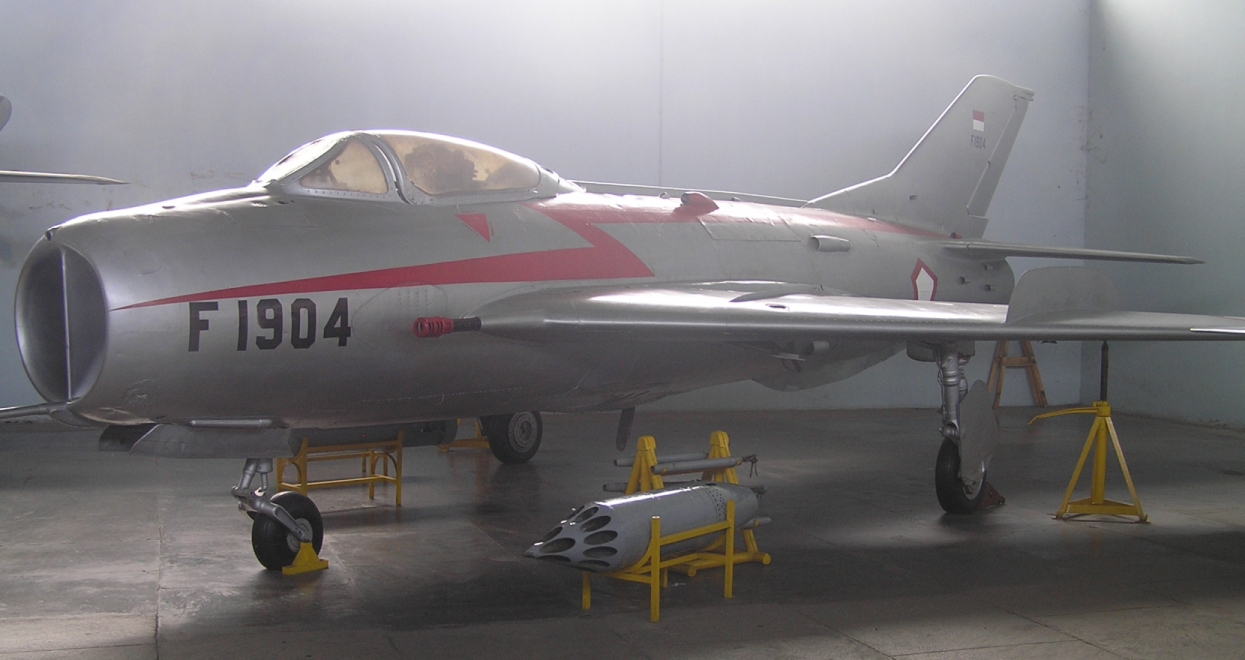


Development and design
Designed by the Mikoyan design bureau, the MiG‑19 evolved from lessons learned with the earlier MiG‑15 and MiG‑17. The airframe incorporated thin swept wings, a relatively compact fuselage housing two turbojet engines, and a simple, robust structure intended for mass production. Development notes and program context can be consulted at development summaries and details on the manufacturer are collected at Mikoyan. The twin‑engine layout used side‑by‑side nacelles that simplified maintenance and provided improved safety and thrust redundancy compared with single‑engine types.
Armament and equipment
The MiG‑19 was gun‑centred in its armament philosophy: most production versions carried three 30 mm cannons for close combat and short‑range engagements; technical notes on its guns are referenced at 30 mm armament. For ground attack it could be equipped with light bombs and unguided rockets on underwing hardpoints; further information on these stores appears at bomb loads and rocket packs. Avionics were modest by later standards and varied across export and improved variants.
Powerplant, dimensions and performance
Power was provided by a pair of Tumansky RD‑9 afterburning turbojets, a common Soviet engine of the era; engine details are available at RD‑9. Typical published dimensions place the MiG‑19 at roughly 13.1 m long with a wingspan near 9.0 m and a height around 3.7 m; for compact technical tables see wing and dimensions data. Performance figures gave it the ability to exceed the speed of sound in level flight and to accelerate rapidly in climb and dash missions, characteristics summarized at supersonic performance notes.
Operational history
Introduced in the 1950s, the MiG‑19 served with Soviet air defence units and was widely exported to allied countries. It saw varying degrees of combat use in several regional conflicts. During the Vietnam War it was employed in limited numbers by North Vietnamese units, though it was less numerous than the MiG‑17 and MiG‑21 in that theater; accounts of its service in Indochina and related operations are discussed at Vietnam War histories and specific material on North Vietnamese use is available at North Vietnamese operations. Pilots generally appreciated its firepower and acceleration, while ground crews noted its relative simplicity compared with later jet fighters.
Variants and legacy
Several variants of the MiG‑19 were produced to serve as day fighters, interceptors and reconnaissance platforms, with incremental improvements to engines, armament and equipment. By the late 1950s and early 1960s the MiG‑21, offering higher speed, altitude capability and missile armament, largely superseded the MiG‑19 in frontline Soviet service. Nevertheless, the MiG‑19 remains important as a transitional design that influenced later Soviet fighter development and demonstrates the shift from gun‑armed early jets toward higher‑performance supersonic interceptors.
- Role: Short‑range interceptor, day fighter and light ground‑attack aircraft.
- Typical armament: 3 × 30 mm cannons; underwing rockets and light bombs (guns, rockets, bombs).
- Engines: 2 × Tumansky RD‑9 turbojets (RD‑9 data).
- Notable: early Soviet production supersonic fighter; replaced in many units by the MiG‑21 (supersonic).
- Further reading: design and technical overviews at reference 1 and development histories at reference 2.
The MiG‑19 remains of interest to aviation historians and enthusiasts. Several museum examples and restored aircraft preserve its cockpit layout and systems for study, while archival material and technical summaries enhance understanding of its operational use; research guides and conflict studies may be found at conflict histories, technical data and in manufacturer archives at Mikoyan.
Questions and answers
Q: Who designed the MiG-19 Farmer?
A: The MiG-19 Farmer was designed by Mikoyan.
Q: When did the MiG-19 Farmer first fly?
A: The MiG-19 Farmer first flew in 1953.
Q: What was the purpose of the MiG-19 Farmer?
A: The MiG-19 Farmer was meant to replace the older MiG-17 Fresco.
Q: How much did the MiG-19 Farmer weigh when it was empty?
A: The MiG-19 Farmer weighed 11,397 pounds (5,170 kilograms) when it was empty.
Q: What was the maximum weight of the MiG-19 Farmer?
A: The MiG-19 Farmer could weigh up to 19,621 pounds (8,900 kilograms) at the heaviest.
Q: What kind of engines powered the MiG-19 Farmer?
A: The MiG-19 Farmer was powered by 2 Tumansky RD-9 jet engines.
Q: What was the maximum speed of the MiG-19 Farmer?
A: The MiG-19 Farmer could go 903 miles per hour (1,450 kilometers per hour), and was the first supersonic Soviet fighter.
Related articles
Author
AlegsaOnline.com Mikoyan-Gurevich MiG-19 (Farmer) Leandro Alegsa
URL: https://en.alegsaonline.com/art/64894
Sources
- home.comcast.net : home.comcast.net/~anneled/usvictor.html
- globalaircraft.org : "Global Aircraft -- MiG-19 Farmer"