
Caucasus: geography, peoples, history and significance
Overview of the Caucasus region in Eurasia: its geography, mountain ranges, populations, historical development, political divisions, and notable facts including Mount Elbrus.
The Caucasus is a diverse region of Eurasia situated between the Black Sea and the Caspian Sea. Geographically it lies at the crossroads of Asia and Europe, and is often described as a frontier between those continents. The term Caucasus or Caucasia ordinarily refers to the mountain system and adjacent lowlands in the area of modern-day Russia, the South Caucasus states and parts of northeastern Iran and eastern Turkey. For broader context the region is placed within Eurasia. Its Persian name, historically used in literature, is Qafqâz (Qafqâz).
Image gallery
10 Images


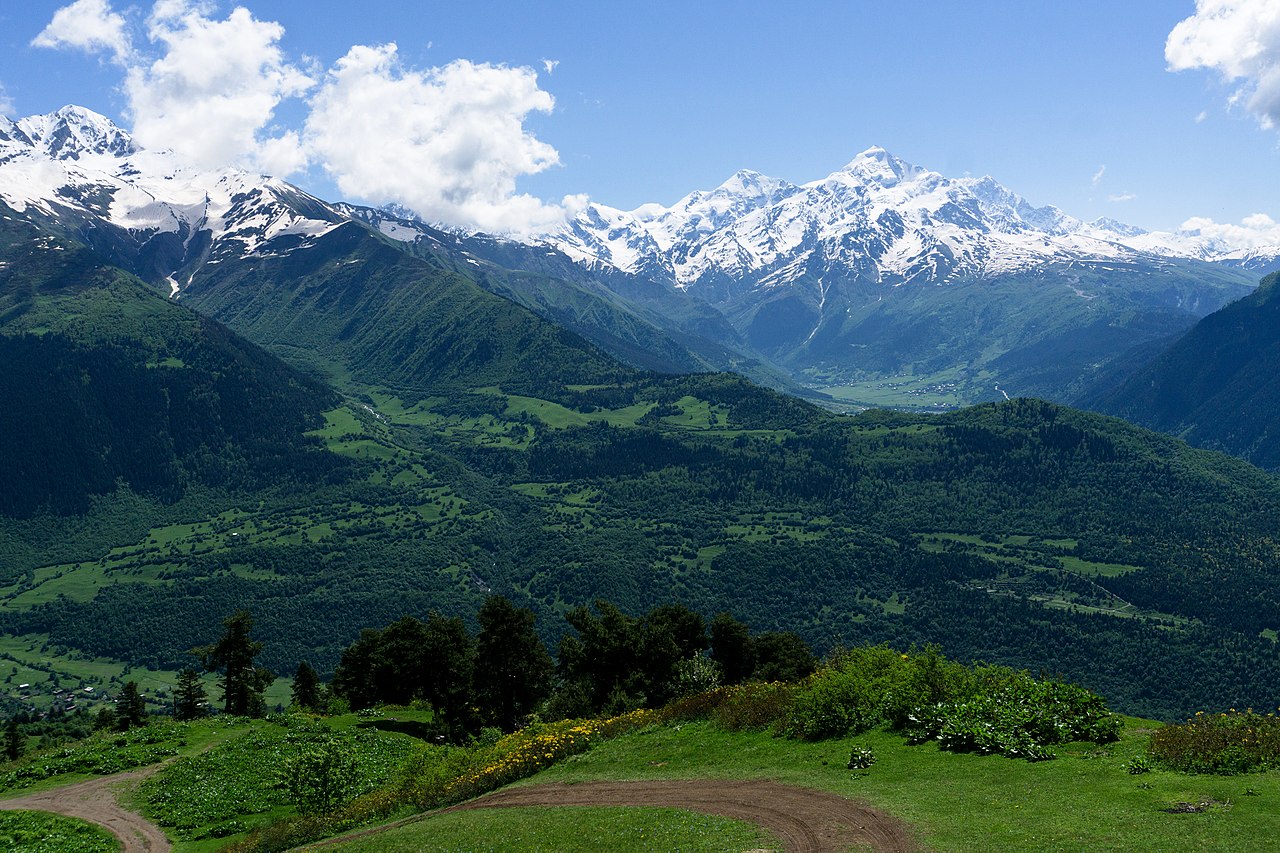
Geography and physical features
The defining physical feature is the Caucasus Mountains, a complex range that runs roughly west–east and contains both high peaks and deep valleys. The mountains are commonly divided into the northern or Ciscaucasus and the southern or Transcaucasus. The region includes coastal plains on the shores of the Black Sea to the west and the Caspian Sea to the east. The highest summit is Mount Elbrus, a dormant volcanic peak in the western Caucasus.
Peoples, languages and cultures
The Caucasus is one of the world's most linguistically and ethnically diverse areas. It hosts multiple indigenous language families as well as Indo-European and Turkic languages. Populations practice a range of religions, including Christianity, Islam and smaller indigenous faiths; cultural traditions and cuisines vary sharply with elevation and historic trade routes. Urban centers and rural highland communities often show strikingly different ways of life.
History and political development
Historically the Caucasus has been a zone of contact and contention among empires and kingdoms, including Persian, Ottoman and Russian influences, as well as smaller local polities. Modern political boundaries arose in the 19th and 20th centuries through imperial expansion, Soviet administration and later state formation. Today the area is frequently described in subregions—Northern Caucasus (within Russia) and the South Caucasus (independent states and autonomous territories).
Importance and notable facts
- The region is a biodiversity hotspot with distinct mountain ecosystems and endemic species.
- Its position at an intercontinental crossroads has made it important for trade and migration corridors.
- Mount Elbrus is often cited in debates about the boundary between Europe and Asia because of its height and location.
- Political borders, minority rights and energy transit routes remain prominent contemporary issues.
The Caucasus remains a subject of study in geography, anthropology, history and political science because of its complex mixture of landscape, peoples and strategic significance. For introductory maps and overviews see regional resources and reference works that cover continental definitions, the mountain chain and the contemporary states and territories of the area.
Questions and answers
Q: Where is the Caucasus region located?
A: The Caucasus region is located in Eurasia, bordered on the south by Iran, on the southwest by Turkey, on the west by the Black Sea, on the east by the Caspian Sea, and on the north by Russia.
Q: What is the Persian name for the Caucasus region?
A: The Persian name for the Caucasus region is Qafqâz.
Q: What does Caucasia include?
A: Caucasia includes the Caucasus Mountains and surrounding lowlands.
Q: What are the Caucasus Mountains commonly known as?
A: The Caucasus Mountains are commonly known as a line between Asia and Europe.
Q: How are the lands in Caucasia considered in relation to the continents?
A: The lands in Caucasia are considered to be in one or both continents.
Q: What are the northern and southern portions of the Caucasus known as?
A: The northern portion of the Caucasus is known as the Ciscaucasus and the southern portion as the Transcaucasus.
Q: What is the highest peak in the Caucasus?
A: The highest peak in the Caucasus is Mount Elbrus (5,642 m) which, in the western Ciscaucasus in Russia, is generally considered the highest point in Europe.
Related articles
Author
AlegsaOnline.com Caucasus: geography, peoples, history and significance Leandro Alegsa
URL: https://en.alegsaonline.com/art/17676