
Earth's mantle: structure, composition, and role in Earth's dynamics
A concise overview of Earth's mantle: its thickness, internal layering, composition, physical properties, role in plate tectonics and volcanism, and how we study it.
Overview
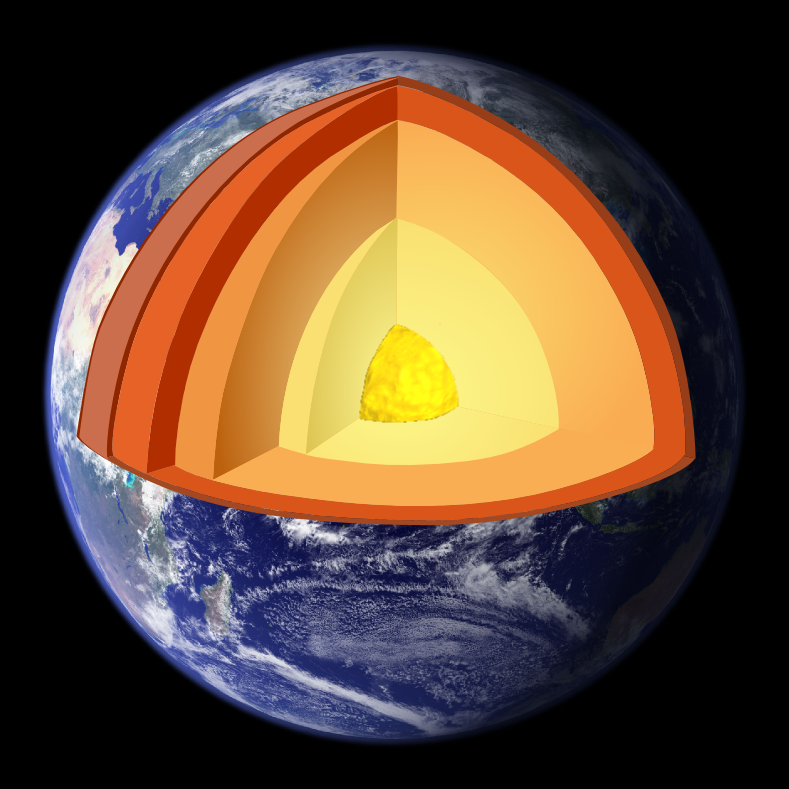
The mantle is the thick, rocky layer between Earth's crust and its central core. It extends roughly 2,900 km from the base of the crust to the top of the core and constitutes the largest fraction of Earth's volume. The mantle is primarily composed of silicate minerals rich in magnesium and iron and lies above the iron-rich core, while accounting for most of the planet's solid mass and enabling much of its internal heat transfer. See general context on Earth's proportions at Earth's volume.
Image gallery
5 Images


Structure and subdivisions
The mantle is commonly divided into several regions based on changes in seismic velocity and mechanical behavior. Near the surface, the rigid lithospheric mantle forms part of the tectonic plates. Beneath it, the asthenosphere is mechanically weaker and can flow slowly. Deeper subdivisions include the upper mantle, a transition zone with depth-related mineral changes, and the lower mantle that extends to the core–mantle boundary.
Composition and physical properties
Typical mantle rocks are peridotitic in composition—silicates of magnesium and iron such as olivine and pyroxene. Temperature and pressure increase with depth, causing solid rock to deform plastically over geological time. Although largely solid, parts of the mantle can partially melt under low pressure or when volatile-rich material is introduced, producing magmas that feed volcanoes.
Role in plate tectonics and volcanism
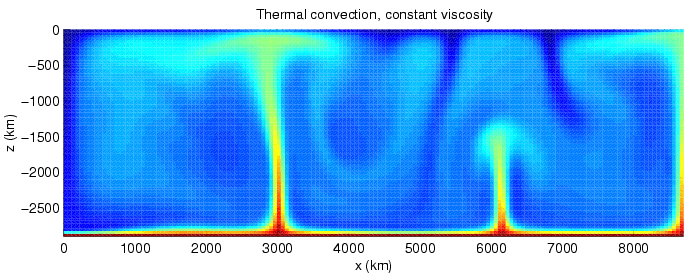
Heat-driven convection within the mantle is the principal engine of plate tectonics. Rising mantle material can generate mid-ocean ridges and volcanic activity, while sinking slabs at subduction zones recycle crustal material into the mantle. Mantle plumes are thought to produce hotspots and large volcanic provinces when hot, buoyant material ascends from deep regions.
How we know about the mantle
The mantle cannot be sampled directly except by rare xenoliths brought up in volcanic eruptions and a few deep drilling attempts. Most knowledge comes from seismology, laboratory experiments, and high-pressure mineral physics that interpret how seismic waves change with depth, revealing density, phase transitions, and flow properties. Early 20th-century seismology established the existence of distinct layers beneath the crust.
Notable facts
- The mantle makes up the majority of Earth's volume and mass compared with the crust and core.
- It stores much of Earth's internal heat, which drives geological activity.
- Variations in composition and temperature in the mantle influence surface geology, earthquakes, and long-term climate through volcanic emissions.
Related articles
Author
AlegsaOnline.com Earth's mantle: structure, composition, and role in Earth's dynamics Leandro Alegsa
URL: https://en.alegsaonline.com/art/29590
Sources
- pubs.usgs.gov : "The interior of the earth"
- glossary.oilfield.slb.com : Crust: Schlumberger Oilfield Glossary
- glossary.oilfield.slb.com : Lithosphere: Schlumberger Oilfield Glossary
- glossary.oilfield.slb.com : Asthenosphere: Schlumberger Oilfield Glossary
- msnbc.msn.com : "Distance and location"
- sciencedaily.com : "About the Mantle"
- planetearth.nerc.ac.uk : Roger Searle 2009. Planet Earth online